Academia, Love Me Back

Academia, Love Me Back

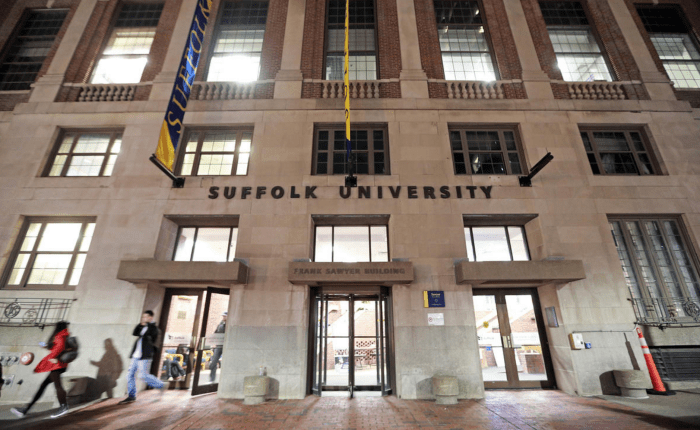
My name is Tiffany Martínez. As a McNair Fellow and student scholar, I’ve presented at national conferences in San Francisco, San Diego, and Miami. I have crafted a critical reflection piece that was published in a peer-reviewed journal managed by the Pell Institute for the Study of Higher Education and Council for Opportunity in Education. I have consistently juggled at least two jobs and maintained the status of a full-time student and Dean’s list recipient since my first year at Suffolk University. I have used this past summer to supervise a teen girls empower program and craft a thirty page intensive research project funded by the federal government. As a first generation college student, first generation U.S. citizen, and aspiring professor I have confronted a number of obstacles in order to earn every accomplishment and award I have accumulated. In the face of struggle, I have persevered and continuously produced content that is of high caliber. 

I name these accomplishments because I understand the vitality of credentials in a society where people like me are not set up to succeed. My last name and appearance immediately instills a set of biases before I have the chance to open my mouth. These stereotypes and generalizations forced on marginalized communities are at times debilitating and painful. As a minority in my classrooms, I continuously hear my peers and professors use language that both covertly and overtly oppresses the communities I belong to. Therefore, I do not always feel safe when I attempt to advocate for my people in these spaces. In the journey to become a successful student, I swallow the “momentary” pain from these interactions and set my emotions aside so I can function productively as a student. 

Today is different. At eight o’clock this morning, I felt both disrespected and invalidated. For years I have spent ample time dissecting the internalized racism that causes me to doubt myself, my abilities, and my aspirations. As a student in an institution extremely populated with high-income white counterparts, I have felt the bitter taste of not belonging. It took until I used my cloud of doubt and my sociological training to realize that my insecurities are rooted in the systems I navigate every day. I am just as capable if not more so than those around me and my accomplishments are earned. 

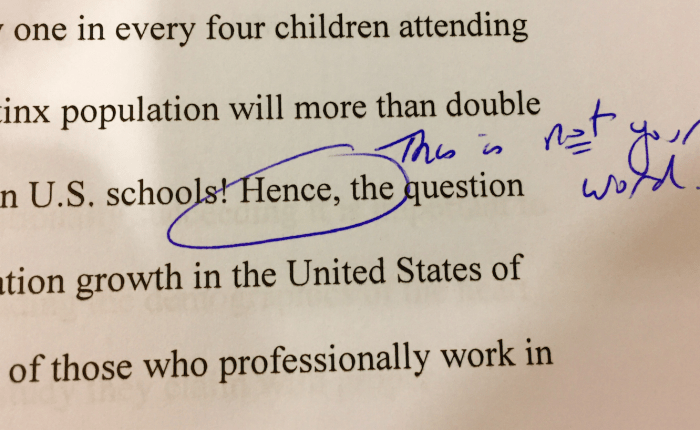
This morning, my professor handed me back a paper (a literature review) in front of my entire class and exclaimed “this is not your language.” On the top of the page they wrote in blue ink: “Please go back and indicate where you cut and paste.” The period was included. They assumed that the work I turned in was not my own. My professor did not ask me if it was my language, instead they immediately blamed me in front of peers. On the second page the professor circled the word “hence” and wrote in between the typed lines “This is not your word.” The word “not” was underlined. Twice. My professor assumed someone like me would never use language like that. As I stood in the front of the class while a professor challenged my intelligence I could just imagine them reading my paper in their home thinking could someone like her write something like this? 

In this interaction, my undergraduate career was both challenged and critiqued. It is worth repeating how my professor assumed I could not use the word “hence,” a simple transitory word that connected two relating statements. The professor assumed I could not produce quality research. The professor read a few pages that reflected my comprehension of complex sociological theories and terms and invalidated it all. Their blue pen was the catalyst that opened an ocean of self-doubt that I worked so hard to destroy. In front of my peers, I was criticized by a person who had the academic position I aimed to acquire. I am hurting because my professor assumed that the only way I could produce content as good as this was to “cut and paste.” I am hurting because for a brief moment I believed them. 

Instead of working on my English paper that is due tomorrow, I felt it crucial to reflect on the pain that I am sick of swallowing. My work is a reflection of my growth in a society that sees me as the other. For too long I have others assume I am weak, unintelligent, and incapable of my own success. Another element of this invalidation is that as I sit here with teary eyes describing the distress I am too familiar with, the professor has probably forgotten all about it.  My heartache can not be universally understood and until it is, I have to continue to fight. At this moment, there are students who will never understand the desolation that follows an underlined “not.” There are students who will be assumed capable without the need to list their credentials in the beginning of a reflective piece. How many degrees do I need for someone to believe I am an academic?

At this moment, I am in the process of advocating for myself to prove the merit of my content to people who will never understand what it is like to be someone like me. Some of you won’t understand how every word that I use to describe this moment was diligently selected in a way that would properly reflect my intellect. I understand that no matter how hard I try or how well I write, these biases will continue to exist around me. I understand that my need to fight against these social norms is necessary. 

In reality, I am tired and I am exhausted. On one hand, this experience solidifies my desire to keep going and earn a PhD but on the other it is a confirmation of how I always knew others saw me. I am so emotional about this paper because in the phrase “this is not your word,” I look down at a blue inked reflection of how I see myself when I am most suspicious of my own success. The grade on my paper was not a letter, but two words: “needs work.” And it’s true. I am going to graduate in May and enter a grad program that will probably not have many people who look like me. The entire field of academia is broken and erases the narratives of people like me. We all have work to do to fix the lack of diversity and understanding among marginalized communities. We all have work to do. 

Academia needs work.
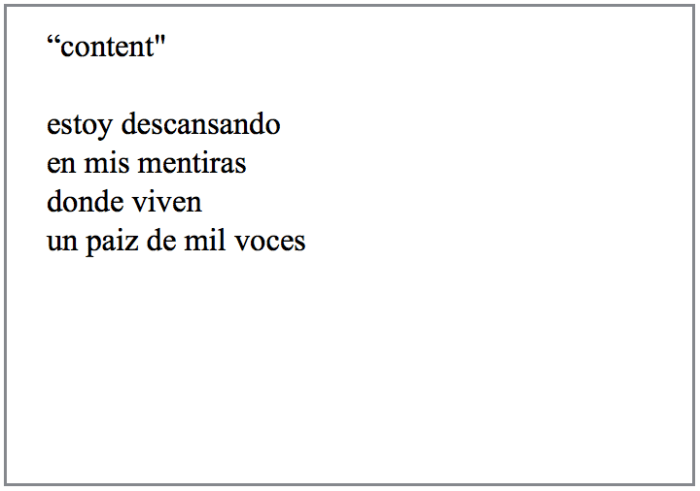
“whiskey breath”

“whiskey breath”

i remember
body parts
skin, stubbly
rough, never soft
sweat
always there
a slip unkind
my fingertips could never quite

grab on

i remember
stomach, stretched
round, pulsing
smell of beer
steak
cologne I loved
faded
bitter
never seemed to

hang on

to these
pressed lips
sloppy mouths
vodka, whiskey
smell of rum
the only way
to feel you

i remember

i felt us shift
months of slipping
we fell and flew
together
asleep
the entire time
we never did

grab on.

“Here You Are”

“Here You Are”

my poems don’t rhyme anymore
they fall and they rise
or they keep falling
or keep rising
they twist your mouth
into uncomfortable shapes
they are awkward
unkind, they make sense
only to me
but still i wrap them
in myself
and gift them to you
the one with bright eyes
squinting in wonder
asking which words
which sounds
fit together
when do you pause
when can your tongue rest
you do not know
but still
here you are

“Images of My Mother”

“Images of My Mother”

I want to tattoo my body
with the image of my mother
watch my hands master spices
see my calves grow in size
so I too can run marathons
with four babies on my shoulders

When my voice turns into hers
My tongue will grow heavy
with tastes of herbs and te amo‘s
watch my whispers soothe cyclones
remind all daughters to breathe
again and again

When I crawl into her skin
and I taste the church’s wine
I see God underneath my eyelids
feel the lord’s blood join our own
and the darkness would feel warm
for the first time

I want to tattoo my body
with the image of my mother
so when I look in my reflection
I can finally believe
I too have the strength
of a thousand women

Sincerely, A Suffolk Student

Sincerely, A Suffolk Student

This post is a response to Yvonne Abraham’s Boston Globe article and has been emailed to her directly

Dear Yvonne Abraham,

When I first read the line “Congratulations, you’ve been admitted to Suffolk University!” three years ago, I was ecstatic. However, after your article this line has been tainted. As a Suffolk student, your editorial piece recently published in the Boston Globe felt unprofessional, patronizing, and belittling to my experiences here.

Before writing this, I spent quite a few hours trying to authentically encapsulate an honest response to your piece. However I do admit, it only took the first few seconds to recognize my disgust. When I noticed the satirical tone of your first paragraph I was critically intrigued. Your use of satire may have worked if it wasn’t so unfocused, unorganized, and seriously unfunny.

Respectfully, I am extremely curious on what exactly lead you to use words such as “we” and “our” when talking about Suffolk in your article. Even if this was a literary tool based out of satire, your ownership of this university is insulting. For someone who did not go to Suffolk and doesn’t understand what it truly means to be a Suffolk community member, it is uncalled for you to tell our prospective students to look the other way.

As a first generation college student I have developed a commitment to my school and its reputation. My involvement with Suffolk has allowed me to criticize the school’s politics out of love and care for this university. In my opinion, your lack of involvement with the Suffolk community has produced nonsense. On behalf of those actually affiliated with my university, we demand an apology.

I am not critical of your entire piece, there are parts of it that touch on what is really happening politically at Suffolk. I do think you understand the surface level reality of the politics in my university. You’re right, the board is corrupted with corporate greed, Regan had no right to call McKenna “that woman,” and students/faculty did protest against the foolishness of the board. However, what you get completely and utterly wrong is mixing the status of Suffolk politics with the dignity of the Suffolk community. In addition, mentioning these student/faculty protests right before calling Suffolk a “basket case” (which is incredibly ableist) completely devalues the movement following Suffolk’s reputation downfall in the media earlier this year.

Since you are not Suffolk affiliated, you may not know so I will take a moment to explain to you the power of being a Suffolk community member. After various media outlets criticized Suffolk’s credibility, my university gathered as many community members as possible and marched, rallied, and protested through the snow to show the world that the Suffolk community did not condone the actions of the Board of Trustees. Along with the march, the Suffolk community rallied in other ways and committed countless hours to get the media’s attention and turn the conversation away from the Board and back to the real pillars of any university: their students. We had alumni fly thousands of miles to rally with us, professors postpone their classes, students walk out, and we started a university wide campaign to promote community (see hashtag: #WeAreSuffolk).

So… when you ask in your article “…is this really the kind of place you want to spend the next four years,” the question undermines the power of student activism and community. When you ask “is this really the kind of place you want to spend the next four years,” you intentionally pour countless dollars and hours invested in our degrees/jobs down the drain. When you ask “is this really the kind of place you want to spend the next four years,” in under twenty words you have single handedly insulted future and current lawyers, doctors, accountants, CEO’s, journalists, artists, physicists, well rounded, educated, and inspired individuals.

On your page in the Boston Globe, I stumbled upon a video of you introducing yourself as a columnist. You mention that you are open to having an ongoing conversation with readers who believe your points are wrong so take this letter as an invitation to come to Suffolk University and meet the wonderful people that make this Suffolk community my home. Come to our little corner of downtown Boston and find out why Suffolk will continue to be my home for a lifetime, not merely four years.

Respectfully,

Tiffany Martinez

An Actual Suffolk Community Member

If you wish to contact her with your thoughts the email is yvonne.abraham@globe.com. If you want to contact me, comment below. 

Love & Service in Maryland

Love & Service in Maryland

The frizz in my curls, grime under my nails, and the rips between my jeans faded away in the mist of northern Maryland. Last week, I was weightless. Surface burdens were cured with love, service, and a new family.

Eight days ago, twelve strangers gathered in a crowded airport at 5 in the morning. At the time, the only thing we had in common was a gate number and the commitment to use our spring break to bring a little bit of light into a community. What we didn’t know was exactly how much light we would bring into ourselves.

I fell in love with service 10 years ago in the Dominican Republic. When I was a little girl my cousin took me with her to see this elderly woman who lived in the village. She was frail, thin, small and wore a dress with tiny daisies. She sat on a wooden rocking chair in her living room that had pictures of disciples, saints, and a colossal rosary hung by the doorway. The room was small and all the windows were open. A faint tropical breeze eased the heat we endured from the walk through the village.

“Por qué estamos aquí?” I asked, confused on why my cousin took me here.

“Ella se esta muriendo,” she responded. The woman was dying. “We are here to say goodbye.”

We were not the only ones in the living room that sweltering hot afternoon in the Dominican Republic, the room was packed with relatives, friends, a pastor, and the sound of children laughing in the nearby farm. In this impoverished village with limited electricity, unkept dirt roads, and in the face of death, the one in the rocking chair in the stained daisy dress seemed to be the happiest woman alive. She was among those she loved and that was enough.

 It may seem unrelated, but for me the connection from this and my love for service is clear. I have devoted my entire life to love and community. When I wear a daisy dress and sit back in a rocking chair I want my final glimpse of life to be full with people who can smile in the face of sadness. I do service because everyone deserves to have the opportunity to live in happiness and among those they love despite their circumstances.

 In Maryland, we slept in a church’s attic for six nights. With no showers, we drove to the YMCA every day to wash after long days working for Habitat for Humanity. Together we power washed porches, installed dry wall, did trail work, scraped flooring, painted ceilings, poured cement, swept floors, fixed windows, and most importantly found love within ourselves. Our little group of strangers, through sweat, service, and enclosed spaces turned into a second family as our hearts swelled with joy from the satisfaction of the work we were doing.

On the third day of our Maryland service trip I met a woman who has been volunteering with Habitat for seven and a half years. Every Wednesday, she takes a day off from being a nurse to care for the community she lives in. After only speaking with her for a few moments, I felt a sensation unlike any other. I was in the presence of someone who truly understood the power of love and humanity. For six days out of the week, she professionally takes care of other people. She watches people die, babies born, cares for the sick, love for those who need love, and still after all of this volunteers every Wednesday. This woman does not see service as a box to be checked off or something on her to-do list. She unapologetically loves others for a living. If each human on this planet took a day to live like this nurse does, even for a few moments, the world will instantly become a kinder place to live in.

I live through the words of Cornell West: “…social justice is what love looks like in public.” I will never stop doing service because I will never stop loving. What is important about service is to remember that it does not live in the boundaries of a few days, but it must survive in each of us. I do service because for me community service is not only a trip or an extra bullet on a resume, it is a responsibility that comes with being human. The power of community does not end in an airport on the last day of an alternative spring break trip because the love in a community never ends. Community service is more than an Instagram post. It is more than a hashtag. It is a lifestyle with a balance of self love and selflessness. In order to serve we must rise like the mist in Maryland and love like the woman in a daisy printed dress.

A Declaration of Self Love

I’m familiar negotiating who I am to please others. Some may call me inauthentic, I call this self-protection. However, I have burned through my shields. Too tired to be exhausted, this continuous disguise has faded. It’s time I accept myself and no longer sacrifice self-love for overall acceptance.

The mask I wear runs deeper than my foundation, and so today I decide to shift my narrative. I am no longer a finished product of what I’ve been through, I am a project continuously craving care, love, and attention. Today, I am proudly high maintenance. I must treat my body with the ultimate fragility. I understand I am the only constant character in my life. I will contribute only to my self preservation. Tonight, in my sweat pants and coiled hair I am nothing less than a Queen.

I deserve to be heard. I deserve to be loved. I deserve to be royalty.

12:46am, February 28th, 2016 the minute I unapologetically decided to love myself