What the McNair Scholars at Suffolk University Did to Keep Their Space
EDIT: PROOFED/REVISED, MARCH 1st
As a first generation college student and U.S citizen, I have navigated the streets of Suffolk University on my toes. Living in the body of a low income person of color on a campus overflowing with privilege, living unapologetically is nothing less than radical. It is unusual to meet administrators, faculty, and professors that openly ask to embrace the culture of myself and people like me in an academic environment unless you were in the arms of the McNair Scholars program. As a McNair, I was taught to believe my future PhD was less a dream and more an upcoming reality even as a Latina sin complejos. The office has grounded myself and multiple others as students free from fear and lack of access. However, Suffolk University clearly did not understand the power of students and student activism when they decided to take away the McNair space. We as students had no other choice but prove what the recently liberated are capable of. This is our story.
Before I get started, a little background: the McNair Scholars are a part of the TRIO program funded at 151 institutions in the US that is reserved for students with historically disenfranchised identities. This means that most of the McNair scholars are first generation college students/people of color. En otras palabras, son mi gente. Raised in a family that emigrated from la República Dominica, my skill set is broad but not necessarily tailored to be successful in an American private institution such as Suffolk University. The McNair Scholar program facilitates mentorship that helps people like me attain the cultural capital needed to pipeline us into PhD programs that will change the course of our lives forever.
In Suffolk, I consistently find myself negotiating with those in power in order to have some sort of agency on campus. What the higher administration needs to understand is that I should not be negotiating my worth with people who do not care to learn my story, my talents, or my experiences. They should be asking me and my peers what we need. This is a concept that non-first generation students learn way before stepping on campus. They learn that it is ok to talk to your professors after class when you have a question, they have family members who’s been reviewing their resumes since high school, they know to send thank you cards after a job interview… a gesture I learned only last year. After I became a McNair Scholar, I ascended from the “minority of the minority.” Inside the Center for Academic Access and Opportunity, I am treated as a future colleague by the advisors and directors who’s main goal is our success. In the Center, we are finally able to breathe. When we speak about our lives and our experiences, we are not pitied. We are empowered. Our one “down” identities don’t feel very down anymore.
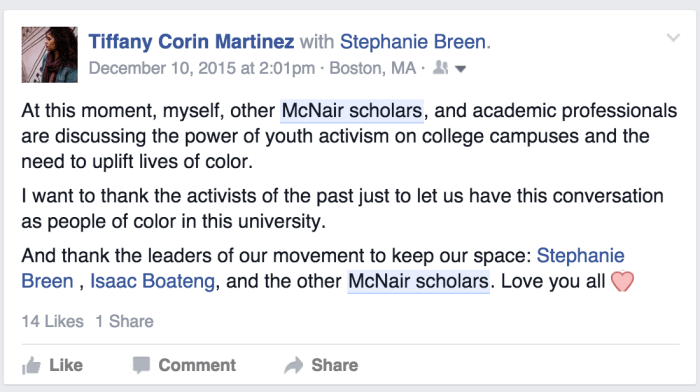
In the middle of November, I received a message from a fellow scholar at the center with word about the status of the program we love. Suffolk decided to implement an open-door floor plan transforming a set of departments into an open community for offices on campus to share resources. This would push the entire Center into a tiny corner with absolutely no chance for privacy. Offices for one on one students would need to be reserved and there would be no space for showcasing student research. This set up was not conducive for students who needed one on one care and private resources. We knew we deserved an entire building, and they were only giving us a few square feet. Our space, our privacy, and our home would be at jeopardy if the students didn’t do anything about it. This was a clear representation that the importance of our program was not properly acknowledged by the university and our value was being looked over. It was a my responsibility to respond to that text with action and so the movement began. If the administrators in the office decided to do what I did, or anyone paid by the University spoke up and demanded a change in plans they could lose their positions so the McNair Scholars began communications about how to make them listen to us and give us our space back. We needed to stop negotiating, and start demanding. Flowers need space to bloom.
Activism requires vulnerability. Before using the power of all the McNair Scholars to demand action, I decided to share my own narrative to professionals to make them understand how much the program meant to me and why we were so passionate about keeping the space we had. As a young child, I was told every day by Mamí that I could do whatever I wanted as long as I had paciensia and inteligencia. Young, wide eyed, and hopeful I believed her. When we were priced out of our New York home, I believed a little less. When I didn’t do well in school, I believed a little less. When my dad died, I almost didn’t believe at all. I physically could feel myself lose trust in the potential I had, and learned how much harder I had to work to fight the statistics stacked against me. I needed to mentally build myself back and believe that I was not only capable of escaping government welfare paperwork, but I was worthy enough to lot my experiences define me. I defined my experiences.
I learned about privilege in 2013, when I slept over my friend’s house and saw the dad doing the dishes. Eating a toasted bagel with strawberry cream cheese, I watched my friend’s mother sip coffee and thought about the realities of students who didn’t have to translate their school paperwork for their parents. Some students didn’t have to buy a calling card to talk to their father. Some students didn’t walk straight to the clearance rack. Some students didn’t try to fit in, they just did. The envy started in my chest. It took years to break down this ugliness and realize that regardless of my background I am still the one controlling my future. I learned to cherish my story and take it with me to the Suffolk campus the following August. When I stepped in the library for the first time, I remember looking around and realizing that I was literally on the same playing field as all my peers. That my background, income, nor clothes could dictate my future.. Unfortunately, I slowly realized I was playing a card game where I never learned the rules. My naiveté was exposed, but the McNair Scholar program caught me when I was falling into a dangerous place.
This is why the McNair Scholars decided to refuse the disrespectful offer to decrease our space. Too many students like me step onto these campuses with these experiences and I am not scared to demand affirmation rather than invisibility but that took time of growth. Speaking to someone who never experienced living without, they would have never seen the absolute terrible idea of combining the center with other departments. The first step the McNair Scholars took included meeting and deciding exactly what we were going to do. We met in a conference room and wrote out all the plans and timelines. The objective was to maintain the McNair space and receive written confirmation before the Fall semester ended. We would send out an email and ask for support from administrators in the CAAO, then contact a high level administrator with enough power to give us what we wanted. In addition, we would only allow two days for a response from the high level administrator since we were working on a very time sensitive timeline (less than a month before Winter Break) in addition to meeting with someone who decided to move our office. The last resort, if these emails and meetings were futile would be to organize a sit-in on the 7th floor.
The emails went beautifully and when the administrator decided to meet with us, they limited the meeting to specific scholars: Stephanie Breen, Isaac Berko, and myself. The meeting started off simple, the administrator smiled at us and welcomed us into a conference room on the highest floor of the building. The hallways had windows in place of ceilings, and the sun’s rays illuminated the translucent navy blue and gold ridged doors. It was the most beautiful floor I’ve ever seen on campus. I remember thinking the irony of three first generation people of color walking onto this floor, professionally dressed and significantly prepared we were the ones in charge now. With the support of the McNair administrators behind us, Stephanie, Isaac, and I started fighting for our lives.
When the administrator tried to convince us we would be “better off” with a smaller space because they had had more windows than we did, Stephanie quickly revoked his statement and said we were fighting for space not for lighting. When they tried to tell us the open-door concept worked on the Suffolk Madrid campus and would be an upgrade, we thanked him for the upgrade but politely declined. When they talked about privacy taking away from the community on the floor, I made it very clear how privacy suggests safety something that can not be promised to people like us on this campus unless the right resources are provided for us. Half an hour into the meeting, you can tell the administrator was frustrated and so were we. Surely, the administrator did not expect us to be so prepared and respond to all of their points con paciensia y inteligencia.
In that room, we used our personal experiences, our honesty about campus inclusion, and our wit to stand our ground. Together we emphasized our need for privacy, the impracticality of the open floor concept, the importance the McNair program had in our lives, and the disrespect we felt when we found out our office would be condensed. The administrator responded with bewilderment. They did not understand how much this meant to us. I still do not think they understands how a group of students were able to organize and fight for a few hundred square feet on campus. In all honesty though, how could we ask them, in that hour, to understand the discomfort we feel every day holding the identities we hold? How could we ask of them the importance that our voices were to be heard? Universities nationwide take pride in being student-centric, but this becomes a facade when students are not represented in areas on a campus that make the most change. If a university is meant to serve students, than as students we have every right to ask what we need and expect these demands to be filled.
At one point, the administrator told us since we rejected the “upgrade” (as they put it), we should consult with the scholars and send them a list of resources that we need in order to feel satisfied in this moving transition. The scholars responded the following Monday with an email that included the following resources for our ‘dream space’: a kitchen, bare walls for posters, conference room, private offices with doors for administrators, a lounge, a couch, a computer lab, an office for the office assistance, a welcome desk, and ample space for gatherings. We strategically decided to send this because it included all the resources we already had and knew was impossible to replicate in an open concept floor plan. We were scholars after all. The administrator responded with merely two words: “thank you.” Empty. Brittle. Unproductive.
Stephanie, Isaac, and I have decided that the sit-in would need to happen as soon as possible. It was clear that our voices were being silenced and the McNair Scholars were ready to fight. Immediately, I started to contact various organizations to co-sponsor the sit-in and right before I had my first meeting with a club interested in helping us get more people participate in the sit-in, we contacted President McKenna for support. The President of Suffolk Unviersity
Below is an excerpt from the letter:
“When we say “us,” we are the marginalized, minority, historically disenfranchised, underrepresented students in this University who need the most support from people like you. After consulting with other McNair scholars we do not believe the new space will be worthy of our potential. Consistently campuses nationwide are telling us we don’t matter via budget cuts, vandalized cultural centers, and ignored pleas for action. The relocation decision is supporting the trend these campuses are falling into and we would like to set up a meeting with you to discuss our concerns.”
Soon after this email was set, we heard back from a woman on campus who held much more authority than the administrator we previously met with. She told us our voices were heard. She told us we were keeping our space. Students have rallied, fought, and won this battle. For the next few years, we can be comfortable sitting in our center and knowing it was our activism and our strategy that was able to convince faculty, administrators, and even the President McKenna that we are done negotiating. We are announcing our worth and our power on this campus. We knew change was going to happen because we would take not stop until we were satisfied. It is imperative for students to realize how much power they really have on campus. We learned throughout this process that we do have to work harder than anyone else to get what we need, and in that hard work comes more reward for the people after us. If I was an administrator, sending these emails and potentially organizing a sit-in I would have immediately been terminated. Your status as a student actually protects you on campus. Although we made people angry, sacrificed hours planning, and sent countless emails, the time was anything but lost. We won. Valió la pena.
 TIFFANY MARTÍNEZ