My name is Tiffany Martínez. As a McNair Fellow and student scholar, I’ve presented at national conferences in San Francisco, San Diego, and Miami. I have crafted a critical reflection piece that was published in a peer-reviewed journal managed by the Pell Institute for the Study of Higher Education and Council for Opportunity in Education. I have consistently juggled at least two jobs and maintained the status of a full-time student and Dean’s list recipient since my first year at Suffolk University. I have used this past summer to supervise a teen girls empower program and craft a thirty page intensive research project funded by the federal government. As a first generation college student, first generation U.S. citizen, and aspiring professor I have confronted a number of obstacles in order to earn every accomplishment and award I have accumulated. In the face of struggle, I have persevered and continuously produced content that is of high caliber.
I name these accomplishments because I understand the vitality of credentials in a society where people like me are not set up to succeed. My last name and appearance immediately instills a set of biases before I have the chance to open my mouth. These stereotypes and generalizations forced on marginalized communities are at times debilitating and painful. As a minority in my classrooms, I continuously hear my peers and professors use language that both covertly and overtly oppresses the communities I belong to. Therefore, I do not always feel safe when I attempt to advocate for my people in these spaces. In the journey to become a successful student, I swallow the “momentary” pain from these interactions and set my emotions aside so I can function productively as a student.
Today is different. At eight o’clock this morning, I felt both disrespected and invalidated. For years I have spent ample time dissecting the internalized racism that causes me to doubt myself, my abilities, and my aspirations. As a student in an institution extremely populated with high-income white counterparts, I have felt the bitter taste of not belonging. It took until I used my cloud of doubt and my sociological training to realize that my insecurities are rooted in the systems I navigate every day. I am just as capable if not more so than those around me and my accomplishments are earned.
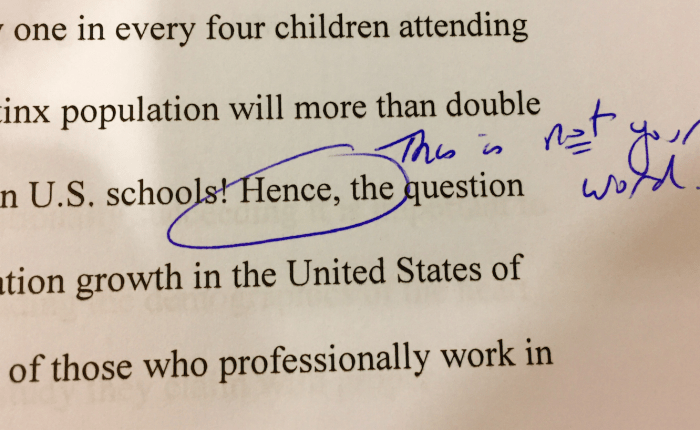
This morning, my professor handed me back a paper (a literature review) in front of my entire class and exclaimed “this is not your language.” On the top of the page they wrote in blue ink: “Please go back and indicate where you cut and paste.” The period was included. They assumed that the work I turned in was not my own. My professor did not ask me if it was my language, instead they immediately blamed me in front of peers. On the second page the professor circled the word “hence” and wrote in between the typed lines “This is not your word.” The word “not” was underlined. Twice. My professor assumed someone like me would never use language like that. As I stood in the front of the class while a professor challenged my intelligence I could just imagine them reading my paper in their home thinking could someone like her write something like this?
In this interaction, my undergraduate career was both challenged and critiqued. It is worth repeating how my professor assumed I could not use the word “hence,” a simple transitory word that connected two relating statements. The professor assumed I could not produce quality research. The professor read a few pages that reflected my comprehension of complex sociological theories and terms and invalidated it all. Their blue pen was the catalyst that opened an ocean of self-doubt that I worked so hard to destroy. In front of my peers, I was criticized by a person who had the academic position I aimed to acquire. I am hurting because my professor assumed that the only way I could produce content as good as this was to “cut and paste.” I am hurting because for a brief moment I believed them.
Instead of working on my English paper that is due tomorrow, I felt it crucial to reflect on the pain that I am sick of swallowing. My work is a reflection of my growth in a society that sees me as the other. For too long I have others assume I am weak, unintelligent, and incapable of my own success. Another element of this invalidation is that as I sit here with teary eyes describing the distress I am too familiar with, the professor has probably forgotten all about it. My heartache can not be universally understood and until it is, I have to continue to fight. At this moment, there are students who will never understand the desolation that follows an underlined “not.” There are students who will be assumed capable without the need to list their credentials in the beginning of a reflective piece. How many degrees do I need for someone to believe I am an academic?
At this moment, I am in the process of advocating for myself to prove the merit of my content to people who will never understand what it is like to be someone like me. Some of you won’t understand how every word that I use to describe this moment was diligently selected in a way that would properly reflect my intellect. I understand that no matter how hard I try or how well I write, these biases will continue to exist around me. I understand that my need to fight against these social norms is necessary.
In reality, I am tired and I am exhausted. On one hand, this experience solidifies my desire to keep going and earn a PhD but on the other it is a confirmation of how I always knew others saw me. I am so emotional about this paper because in the phrase “this is not your word,” I look down at a blue inked reflection of how I see myself when I am most suspicious of my own success. The grade on my paper was not a letter, but two words: “needs work.” And it’s true. I am going to graduate in May and enter a grad program that will probably not have many people who look like me. The entire field of academia is broken and erases the narratives of people like me. We all have work to do to fix the lack of diversity and understanding among marginalized communities. We all have work to do.
Academia needs work.
 TIFFANY MARTÍNEZ
Hmmm. A couple thoughts:
I do think you should talk to your professor and clarify what they were trying to imply. It seems like a very odd way to accuse someone of plagiarism. I would think you would just flunk them and report them, right? I wonder if perhaps they were trying to express that they thought the language you had chosen felt forced or stilted. Of course, perhaps they are a vicious racist who humiliated you in front of your peers. But perhaps you should not reach sweeping conclusions without talking to them.
I would suggest you bear in mind imposter syndrome is something many of us struggle with, and it is doubtless worse for people from marginalized people, but it is something most of us have to grapple with.
Certainly you have a bright future as an academic, as you are both an accomplished scholar and quite facile with the vocabulary of identity politics and the art of aggressively politicizing your self-pity. All useful skills!
LikeLiked by 2 people
Except that this professor questioned where she copied and pasted. That does not give me an indication that he was implying the voice she was writing in was forced. It tells me he assumed she plagiarized. Either way, this was an entirely inappropriate and unprofessional way to handle even a legitimate issue. I teach at the university level and this simply doesn’t fly.
LikeLiked by 2 people
It does seem inappropriate if that’s what is being implied. It still seems to me that the first stop should be the professor — is that really what they were trying to say? Or by asking her to show the cut and pastes were they asking she keep a record of her edits in response to the critique?
The instructor may be totally, outrageously in the wrong here. But in part because what they are described as implying seems so over-the-top inappropriate, I would give them an opportunity to clarify (or dig themselves in deeper, as the case may be) before launching the crusade.
LikeLiked by 1 person
Robert, are you serious? Your words are condescending and straight up mean. Given the context, that makes them racist.
Do you know the term gaslighting?
Seriously, man, rethink this.
LikeLiked by 3 people
“Your words are condescending and straight up mean. Given the context, that makes them racist.”
Interesting that you think so. I disagree. Your immediate resort to ad hom allegations of racism is noted. Thank you for your feedback.
LikeLiked by 1 person
Like the professor….you are now just as guilty for not asking before accusing the writer of their use of words and the meaning of them.
LikeLiked by 1 person
No. I am not speaking about this individual’s intentions, I am speaking about the impact of their words. And the impact of those words is racist. That is different than ascribing an intention.
LikeLike
I’m amazed, Robert, that you could doubt he was accusing her of plagiarism when he asked her to mark where she had copied and pasted. The impulse to correct people’s report of their own experiences masquerades as a sense of charity, but it’s lopsided charity, which isn’t charitable at all. Why not give even half the benefit of the doubt you’re giving to the professor to the person whose report of the situation you are reading?
LikeLiked by 4 people
Here’s my question: why in dozens of responses from a self-described academic audience was I the first person to suggest that the instructor’s words might have another possible interpretation? Shouldn’t things like considering alternate explanations for the facts, seeking all perspectives, being aware of the ambiguity of language and the possibility of misinterpretation kinda be as natural as breathing in this crowd?
LikeLiked by 1 person
Tiffany,
Thank you. I need the reminder that this crap still happens. You are on the path and it is good. That feeling when you “let” people create self doubt is a useful one. Every time. It’s our opportunity to find the place where a wrench was already thrown into the works long ago. That part of you didn’t just break down in that moment–it was vulnerable to it all along. Remove the wrenches of sabotage as they are revealed. Recalibrate. Soar.
Robert,
You cannot possibly be serious. You write yourself into the joke with this. Tiffany knows exactly what happened to her. You… don’t. But, congratulations. “Aggressively politicizing your self pity.” That’s gonna stay with me for a while.
LikeLiked by 3 people
My words were not an ad hominem attack. I did not say that you “are a racist,” I said that your “words are racist.” Understand the difference.
LikeLike
I understand, and I’m sorry that this happened. Thank you so much for sharing. Much love — keep going.
LikeLiked by 3 people
Young lady, don’t give up hope. Please continue to strive and don’t let this slowdown your plans to succeed. You will be successful.
Also, as a Student Conduct Administrator and
Academic Integrity Officer, you are entitled to due process. A professor should meet with you when they suspect that you cheated or plagiarized. If you are accused, like in this case, you have a right to plea your case. Consider meeting with the Department chair or Academic Dean. Also, ask your professor to prove that you cheated by having him/her use on line tools like Turn It It or Safe Assign. Lastly, no school official is allowed to share your academic records with anyone who is not of special educational interest or a third party, without your consent. That’s a violation of federal law. Request a hearing to plea your case. Best of luck and keep moving forward.
LikeLiked by 3 people
Dear Tiffany,
This evening I have been overcome by both the beauty and strength of your writing, and the horror of what happened to you and what was written on your paper. Thank you for being brave enough to share it.
Please don’t let this into your soul. The professor who did this isn’t worthy of the name. I wish I could tell you such people are rare but they sadly aren’t. You and your brilliance are a threat to their way of seeing the world. Stay strong and keep your belief in yourself.
LikeLiked by 3 people
From one student of color to another who is also going to teach, who is also going to prove the world wrong (and prove our ancestors right). I stand with you and see you. What your professor doesn’t know, and what we do, is that she is right. These are not our words. Our words have been taken from us, they have been devalued, colonized, corrupted, and removed from the academy. Our words our rounder, deeper, wider, more feeling, more intellectual; and she would not be able to understand our words. So we have to tone it down, to write in the colonizer’s tongue, to write in the way that they would understand, yet they still are unable…
They tried to bury us, they didn’t know we were seeds.
LikeLiked by 5 people
Agreed. Im with you on this. Hopefully, we will do more breaking down of the binary English language and how it inhibits the flow of our intuitive intelligence. We have not experienced true intelligence until we incorporate cyclical or Africanist thinking (non western or european) into our vocabulary whether praying or speaking it will create Biblical type results we have not witnessed. There has to be balance and right now we speak and think in English over 95% of the time.
LikeLike
That professor is racist and stupid. You, Ms. Martinez, are clearly a skilled writer who can produce flowing prose at will. I am so sorry that this happened to you. As a white person, I find this type of behavior by the professor (who I am guessing is white) to be DEPLORABLE and an offense worthy of a firing.
I sincerely hope that you will not allow this nonsense to keep you from pursuing your goals. You have displayed character, grit, determination and talent, and I hope that the ignorance of this one f***ing troglodyte will not slow you down.
Much love,
Dave
P.S. While you should not have to do this, there are online services which can prove that your work is original. Here is a link to some: http://mashable.com/2012/08/29/plagiarism-online-services/#kb_seSgCkkql
LikeLiked by 2 people
Hi, Thanks for this great piece and I hope that you were able to find some resolution with this. I am a biracial (Asian/White) PhD holder who has recently left academia in part because I had an unfortunate graduate school experience that had a lot do with my identity and background. I understand you want to be an academic and the path to getting a PhD can be fun and exhilarating, but I’m just here to say that yes, academia “needs” people like you, but won’t necessarily treat you like it does. It might and it might not. Many of the people above are telling you to make sure you identify a mentor because that will be crucial to your success. But I also just want you to know that there are other options. As I found out, academia can be an extremely conservative work environment. The rhetoric can be revolutionizing, but the practice can often be not (this will depend on your specific field, institution, and locale). Compounded with stuff from graduate school, I found it simply depleting.
There are smart people everywhere (this I think you already know), but also a lot of work available that a smart person can be content with, even happier with, and also a lot that is out there that is actually research or very research-like. I just wanted to present this to you as an alternative. Academia is not the only place for smart articulate and hard-working people seeking to change the world.
LikeLiked by 3 people
What are those other places?
LikeLike
Too many to name. If you stay within the U.S. many companies (which encompasses a vast field) actually do quite interesting work and there are also governmental jobs as well as non-profit/non-governmental jobs. If you go abroad, the picture changes again. The world is HUGE and there is a lot out there and I can’t really be more specific without you getting a bit more specific.
LikeLike
Thank you. And you are not alone in leaving the academic plantation. There is more to us!
LikeLiked by 1 person
When I was a junior in high school trying to register for senior year classes I asked the advisor to take Calculus AP and the counselor gave a me a surprised look and asked me are you sure you can handle it !!!!! And I was thinking to myself you think because I am an immigrant and have an accent I am stupid !!!!! Don’t doubt yourself doubt them.
LikeLiked by 3 people
Reblogged this on evoL = and commented:
Racism persists. Please pay attention.
LikeLiked by 2 people
So much love and support to you. As a woman of color who fled academia I know your struggle is real. It’s exhausting. But you are an inspiration and I am sure you will prevail.
LikeLiked by 3 people
Tiffany, I came across your entry on a friend’s Facebook page tonight. I’m outraged by the tenor of the allegation. I’m also Latina, a first generation college graduate, a former McNair Fellow, and an aspiring professor. I’m pursuing my PhD in English, and over the course of my higher education, I have had the displeasure of meeting more than a few professors and peers that have made me question my writing, intelligence, and presence in academia. I hurt for you, Tiffany, because like recognizes like. I see you. I hear you. I support you; and many others support you, too. I took the liberty of sharing your entry on the Latinas Pursuing Doctorates page on Facebook. And guess what? They are many more of us out there. The most recent comment on my post reads: “keep being strong and continue to do your best!! you are brilliant!! keep shining!!!!” You are not alone, hermanita. Your battle for academic freedom and struggle against racism and censorship is our lucha, too.
In solidarity,
Anahí
LikeLiked by 4 people
Where I teach (Miami Univ), there’s a specified procedure for reporting allegations of academic dishonesty. Suffolk has similar rules, as you probably know: http://www.suffolk.edu/studenthandbook/61096.php
It is a serious violation of professional ethics (and Suffolk’s rules, per the above link) to inform a student of an allegation in front of a classroom.
If you do file a complaint, you may want to figure out in advance whether you (and any classmates who serve as witnesses) will be adequately protected from reprisal by this professor.
Meanwhile, I’m thrilled to read your writing and your plan to work in academia. “Academia needs work.” (op.cit.)
LikeLiked by 2 people
(Tiffany, in thinking about how to proceed, you might want to submit a TurnItIn analysis of your essay. Various profs could arrange to do this for you, I would think. — HG)
LikeLiked by 1 person
Hi, Tiffany. I read your post after it was shared on my facebook network. I am a McNair Scholar from Beloit College and currently a doctoral student in the school of education at the University of Wisconsin-Madison. After looking at your blog, It seems like we have similar research interest. Let me know if I can be of assistance!
LikeLiked by 3 people
You write beautifully, and you are shaking foundations.
We need you in academia!
From,
Latina J.D., Ph.D. candidate
LikeLiked by 4 people
I am an instructor at the University of Georgia. And I’m first-gen college student whose father was a Choctaw Nation citizen.
In 1997, poet Joy Harjo (Muscogee Creek) and Gloria Bird (Spokane) edited a collection of contemporary Native American women writers, called “Reinventing the Enemy’s Language.” Clearly, as evidenced by the eloquence in this blog, you have made “[h]ence” your own word. (And that you also know that the function of a conjunctive adverb is “connect[s] two related statements” shows me exactly that.) That your professor can’t acknowledge that is his lack, not yours.
I agree with Eric Johnson’s comment above. Citing a single common word is not evidence of plagiarism. He is obligated to provide more than that. It is your right to challenge his assertion and your grade.
It may feel like you’re swimming upstream, but stay strong. I have often taught students of color who tell me stories of teachers who doubted their writing abilities, and it frankly pisses me off. For my part, it makes me doubt their teacher’s ability to teach, not that student’s ability to learn.
One text I’d recommend, if you don’t already know it, is a book by Linda Tuhiwai Smith (Maori), “Decolonizing Methodologies.” It focuses on her experience as a Maori scholar, but it speaks more broadly to the issues of people of color in academia and strategies to challenge systems of power that have historically excluded them.
Academia needs to learn. And we need folks like you to teach us.
LikeLiked by 4 people
Thank you for writing this. Many of us feel the same. I am tired and exhausted too. Thank you for inspiring me to keep going.
LikeLiked by 3 people
Tiffany, I am heartsick to read your account, and I hope that you meet with the department chair. What happened to you was unethical and unprofessional, and it should be addressed by the administration.
As a professor who has been a McNair mentor and advocate, I cherish the opportunity to work with all students, and I cannot even imagine holding these sorts of views. That said, I have seen professors act in this manner, and as someone from Flint, Michigan, I have seen folks make assumptions about me, prior to getting to know me.
My hope is that you will become a professor and help to change the academy. That said, I do not want to dismiss the emotional exhaustion that comes from being in your situation. The institutions that have allowed this kind of behavior to go unchecked need to be reformed, and it is up to allies to also speak up and to work to make that change happen. Please know that there are many of us in the academy who would love to work with you and who are cheering you on.
Best wishes in your academic endeavors.
LikeLiked by 2 people
Hi:
Curious if you were able to talk to the professor regarding this and if there was an update. The only way we can fight back against stuff like this is if we speak up and stand up to those who do against us.
LikeLiked by 2 people
Reblogged this on Ink and Vein and commented:
This is a crucial read. All throughout my graduate career, I’ve been continually struck by the amount of racism that’s inherent in academy. For me, it’s been disillusioning. For the marginalized, it’s so much worse than that.
LikeLiked by 1 person
Dear Tiffany,
Hold tight to your rudder. This is just one of the storms that you will pass through – and you will pass through.
LikeLiked by 2 people
Just read your post and as an aspiring academic and woman of color, my heart breaks that you were treated this way. From this post alone, I can tell that you are a stellar writer and also from your many accomplishments, you are certainly MORE THAN CAPABLE of producing phenomenal research. Academia is very hard and eight thousand times as hard for us women of color. Know that you are not alone and keep being the shining star that you are.
LikeLiked by 3 people
Tiffany,
Your post hit me so close to those insecurities I still have from my time in academia and those that I fight every day to keep at bay. Reading your essay reminded me of a professor I had in my PhD program–a man of color so very “down” with decolonial politics–that told me, “I don’t know why we keep accepting people like you.” People like me. People like the magna cum laude, accepted early to medical school, university and national wide fellowship winner. That kind of person is not who my professor saw and your professor is unfortunately one of perhaps many you may encounter. The person they see is not our whole person–the person who works multiple jobs to send money home and pay for college is also the person who is a Ford and Mellon Fellow. People like them do not see people like us as whole people and complex people. They cannot fathom the depth of us. I will not tell you to work harder to prove these kind of professors wrong. That kind of bootstrap mentality has done us no favors. I will tell you that I am tired. That I was so tired that I left academia. I am happier, and yet, I wonder if people like me and you are exactly what would make the difference for those WOC coming up behind us.
LikeLiked by 3 people
Dear Tiffany,
Our lives “ain’t been no crystal stair.” As a McNair Scholar and professor of critical cultural studies, I overstand your situation. I stand in solidarity with you. I also offer my mind, body and spirit in accomplice-ship. If you are comfortable releasing the course title and name of the professor, I would be willing to bet their are countless academic women of color who would gladly send an email, letter printed on letterhead, or call your professor and their chair on a timeline of your choosing. Perhaps it is after you have won your appeal and grades have been recorded. Maybe it is now because you feel you have nothing to lose with this human at this point. You let us know and allow us to inconvenience some folks with out truth. This won’t be the first or last time things like this will happen, so let’s use this to mobilize.
In solidarity.
Amber. Saint Louis University
LikeLiked by 3 people
I’m a (young, female) professor and I’m so sorry this happened to you. I just wanted to echo a previous commenter and urge you to share this story with the chair of the department, or dean, depending on how your institution is structured. Your institution may also have an ombudsman, which would be another good resource. I always want my students to know that they wield much more power than they realize in these types of situations!
LikeLiked by 3 people
Reblogged this on Ron Brooks.
LikeLiked by 2 people
Reblogged this on Tilted Halo & Living By Grace and commented:
This is why I do the work I do. Why I talk about the intersection of race and faith and culture and…and… This has to stop. In Academia and everywhere. Sending love and prayers to this brilliant student!
TMLG
LikeLiked by 3 people
I love you back. As an immigrant and first generation college student and now professor, I re-lived the pain with you. I hear you. I see you. I stand with you on this long and arduous journey. Mi’ja your professor was wrong.
LikeLiked by 3 people
I’m sorry that this happened to you. Your teacher is a jerk.
LikeLiked by 3 people
I’m so glad I found this post, and so glad you wrote it. Academia can be such a minefield, particularly for someone who doesn’t ‘fit the mold,’ and your unpacking of all the pieces and parts of what happens is so articulate and thoughtful. It kills me that this fight still needs to be fought, but it gives me hope that you see so clearly and are willing to continue to fight the fight. Also, that professor is an ass.
LikeLiked by 3 people
Fuck the academy. Get your PhD and do better than they ever could.
LikeLiked by 2 people
Tiffany, thank you for writing about this and making others aware of this issue. I hope you will post an update if there are any changes in this situation.
LikeLiked by 3 people
I hope you would consider sharing this experience with your university ombudsman. Change requires action. I wish you the best.
LikeLiked by 4 people
As a fellow “unapologetic” Dominicana… 🇩🇴I hear you, I see you and I stand with you. Please keep going forward, you’re needed in higher ed. Im about to apply for my PhD in higher ed for the same reasons you mentioned. In order for change to happen we need to dismantle the system from within. So I hope to meet the future Dr. Martinez someday. Keep on fighting! ✊🏾
LikeLiked by 4 people
As a professor, I am ashamed of my colleague. Your writing here is is nuanced, complex and beautiful.
Additionally, this is such a violation of ethical teaching practices and also, federal law–FERPA. All academic institutions have very care policies and procedures for addressing suspected plagiarism and this, this is not it. I strongly encourage you to go to the Chair of the Department and the Dean if necessary and file a formal complaint. I’d be happy to lend you any support necessary.
I look forward to welcoming you as a colleague soon!
LikeLiked by 5 people
Unbelievable (but not surprising). Stay strong. Academia is tough enough for anyone but I’m so sorry that you have been wrongfully accused based on such horrendous racial bias. I’ve had peers question my intelligence based on my background (I’m Mexican), but never something as frustrating as your story, and from a professor who should act as a professional and raise up students. It seems you have a good head on your shoulders though. Don’t let them steal your shine. The language of academia belongs to us as well.
LikeLiked by 3 people
I hope you kept all your rough drafts, and all your notes, and you walk in to whatever meetings that come next hold your head up high and tell them where to shove it…. tactfully of course. I am enraged for you and I am doing everything I can in my role as a college writing instructor to dispel these myths and beliefs and horrible assumptions. I hope there is a happy ending follow up to this post.
LikeLiked by 4 people
Hang in there, little sister! I see you! You can do this, hermana. Many of us have made it through and are waiting for you on the other side. We’ve got your back. You are bigger than this. You will succeed because you are powerful, diligent, and unrelenting. I am so proud of you! No te dejes joder! From Associate Professor of Anthropology, Dr. Adriana María Garriga-López.
LikeLiked by 3 people
Sending much admiration and grateful for your gift of expressing so vividly this cruel reality. You shine, you are talented and strong.
LikeLiked by 3 people
I’m so sorry you had to go through this! I hope you take this up with the dep chair. This is unacceptable.
LikeLiked by 4 people
You are brilliant! Report this to your department chair and to an administrator who oversees diversity on your campus.
LikeLiked by 5 people
Dear Tiffany,
I am so sorry this happened to you. As a Black woman I know the feeling. I also know this wasn’t the first time someone invalidated your intellectual labor because of their own racism.
Your writing is beautiful, and your analysis reveals that you have potential to be an amazing sociologist. I hope you continue to do this work, whether as an academic or elsewhere.
LikeLiked by 4 people
Tiffany, Stay strong and hold on to your dreams. We need more critical academics like yourself. Do not let this one person define you. You know who you are. Trust that. And please follow the advice of those above. Find WOC academics to be your mentor (we’re here for you) and report this to your chair. This is unacceptable and the institution needs to know about this (and likely violates college policy).
LikeLiked by 3 people
Tiffany, I think it’s clear from this post that the academy would be lucky to have someone as insightful, analytical, and righteous as you.
But what’s also clear is that your instructor’s behavior was terribly inappropriate. Not just the assumption of plagiarism, but the failure to do any work to substantiate that assumption and the calling out of a student for such a serious matter in front of the class. I urge you to take this matter up with the department chair. Doing so is well within your rights, and any attempt to discourage you from this, or to use it against you later would only result in further sanctions against your professor.
Obviously, this is your own decision and I can’t know all the factors involved. I think that any course of action that allows you to keep believing in yourself us valid. But what your instructor did was not right. There are ways to deal with this, and it would be to the academy’s benefit for this kind of awful behavior to be sanctioned and encouraged.
LikeLiked by 7 people
Thank you for posting this. Academia does need work. I’m a Latina getting a PhD and when I look at my own field, I don’t see a lot of folks that look like me. In fact, I read recently that Latinas only make up 2-3% of PhD recipients. We can only do our part- earn our degrees and go work in higher ed institutions so that this doesn’t happen to someone else. I’ll be praying for you. Good luck with everything!
LikeLiked by 5 people
Hi Tiffany,
As a former McNair Scholar and a current professor, I am sorry this happened to you. You are a stellar writer. Sometimes professors are wrong.
Keep pressing.
LikeLiked by 6 people
Just a shout-out from someone else who was a 1st generation college student, who did MAs and PhD work at predominantly white, private, and at times elitist institutions. I’m a WoC professor in a predominantly white department at a predominantly-white university. This mess is hard. The struggle you describe is real, and in all honesty this kind of thing will probably happen again, in some form or another. But you are not alone. I hope you find strong mentors (WoC and otherwise) who will have your back. And I hope you continue to stand up and speak out when these things happen to you.
LikeLiked by 13 people
I am so angry at your professor. Please don’t let the ignorant bias of anyone keep you from your dreams!
LikeLiked by 4 people
Tiffany, I am a college professor too. I look forward to having you as a colleague someday, and I apologize for my entire profession that you were disrespected.
LikeLiked by 9 people
Me, too!
LikeLiked by 3 people
Please, please go see the chair or someone above this professor and report it. This behavior is NOT acceptable. If they thought you had plagiarized, they should have had you come see them in their office, not called you out in front of everyone. I am so sorry this happened to you.
LikeLiked by 11 people
Agree!
LikeLiked by 2 people
I agree I would not let this go. This is blatant racism.
LikeLiked by 1 person
Tiffany,
Congratulations on your many accomplishments. Stand tall and stay proud. Academia does need work, always, but not all of it is this way. You will find support, you will find mentors, you will build friendships.
Very best wishes to you and your family,
(professor) Dominique
LikeLiked by 5 people
This means a lot!! Thank you so much.
LikeLiked by 1 person