My name is Tiffany Martínez. As a McNair Fellow and student scholar, I’ve presented at national conferences in San Francisco, San Diego, and Miami. I have crafted a critical reflection piece that was published in a peer-reviewed journal managed by the Pell Institute for the Study of Higher Education and Council for Opportunity in Education. I have consistently juggled at least two jobs and maintained the status of a full-time student and Dean’s list recipient since my first year at Suffolk University. I have used this past summer to supervise a teen girls empower program and craft a thirty page intensive research project funded by the federal government. As a first generation college student, first generation U.S. citizen, and aspiring professor I have confronted a number of obstacles in order to earn every accomplishment and award I have accumulated. In the face of struggle, I have persevered and continuously produced content that is of high caliber.
I name these accomplishments because I understand the vitality of credentials in a society where people like me are not set up to succeed. My last name and appearance immediately instills a set of biases before I have the chance to open my mouth. These stereotypes and generalizations forced on marginalized communities are at times debilitating and painful. As a minority in my classrooms, I continuously hear my peers and professors use language that both covertly and overtly oppresses the communities I belong to. Therefore, I do not always feel safe when I attempt to advocate for my people in these spaces. In the journey to become a successful student, I swallow the “momentary” pain from these interactions and set my emotions aside so I can function productively as a student.
Today is different. At eight o’clock this morning, I felt both disrespected and invalidated. For years I have spent ample time dissecting the internalized racism that causes me to doubt myself, my abilities, and my aspirations. As a student in an institution extremely populated with high-income white counterparts, I have felt the bitter taste of not belonging. It took until I used my cloud of doubt and my sociological training to realize that my insecurities are rooted in the systems I navigate every day. I am just as capable if not more so than those around me and my accomplishments are earned.
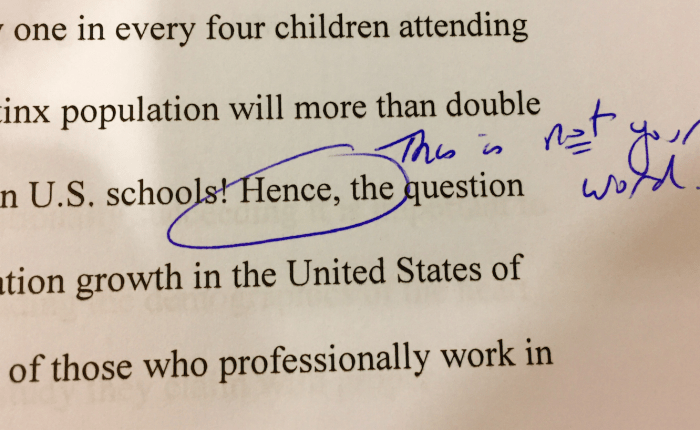
This morning, my professor handed me back a paper (a literature review) in front of my entire class and exclaimed “this is not your language.” On the top of the page they wrote in blue ink: “Please go back and indicate where you cut and paste.” The period was included. They assumed that the work I turned in was not my own. My professor did not ask me if it was my language, instead they immediately blamed me in front of peers. On the second page the professor circled the word “hence” and wrote in between the typed lines “This is not your word.” The word “not” was underlined. Twice. My professor assumed someone like me would never use language like that. As I stood in the front of the class while a professor challenged my intelligence I could just imagine them reading my paper in their home thinking could someone like her write something like this?
In this interaction, my undergraduate career was both challenged and critiqued. It is worth repeating how my professor assumed I could not use the word “hence,” a simple transitory word that connected two relating statements. The professor assumed I could not produce quality research. The professor read a few pages that reflected my comprehension of complex sociological theories and terms and invalidated it all. Their blue pen was the catalyst that opened an ocean of self-doubt that I worked so hard to destroy. In front of my peers, I was criticized by a person who had the academic position I aimed to acquire. I am hurting because my professor assumed that the only way I could produce content as good as this was to “cut and paste.” I am hurting because for a brief moment I believed them.
Instead of working on my English paper that is due tomorrow, I felt it crucial to reflect on the pain that I am sick of swallowing. My work is a reflection of my growth in a society that sees me as the other. For too long I have others assume I am weak, unintelligent, and incapable of my own success. Another element of this invalidation is that as I sit here with teary eyes describing the distress I am too familiar with, the professor has probably forgotten all about it. My heartache can not be universally understood and until it is, I have to continue to fight. At this moment, there are students who will never understand the desolation that follows an underlined “not.” There are students who will be assumed capable without the need to list their credentials in the beginning of a reflective piece. How many degrees do I need for someone to believe I am an academic?
At this moment, I am in the process of advocating for myself to prove the merit of my content to people who will never understand what it is like to be someone like me. Some of you won’t understand how every word that I use to describe this moment was diligently selected in a way that would properly reflect my intellect. I understand that no matter how hard I try or how well I write, these biases will continue to exist around me. I understand that my need to fight against these social norms is necessary.
In reality, I am tired and I am exhausted. On one hand, this experience solidifies my desire to keep going and earn a PhD but on the other it is a confirmation of how I always knew others saw me. I am so emotional about this paper because in the phrase “this is not your word,” I look down at a blue inked reflection of how I see myself when I am most suspicious of my own success. The grade on my paper was not a letter, but two words: “needs work.” And it’s true. I am going to graduate in May and enter a grad program that will probably not have many people who look like me. The entire field of academia is broken and erases the narratives of people like me. We all have work to do to fix the lack of diversity and understanding among marginalized communities. We all have work to do.
Academia needs work.
 TIFFANY MARTÍNEZ
Heh. If they think the work is too good to have been written by you, and it truly is your work, then you’re doing it right.
They’re an asshole, but you’re a good writer (which is also demonstrated in your blog post). Don’t overthink it – you have just been given a gift. Even assholes know that you’re a good writer.
They don’t want to accept it, but so what? that’s on them, not you. You’ll meet a lot of assholes in the world – don’t take it personally. Just silently wish them well, hope that one day they might grow up, and move on with what YOU want to do.
LikeLike
You mean well but I am fighting off assumptions about your identity at this moment based on your lack of acknowledgment for what this post most expresses: just how exhausting living with racism and continuing to self validate while doing so, actually is. I once asked a friend who had been abused why she felt so bad about herself when it was clearly the abusers who were the bad guys. She explained to me ‘when you are treated like shit, you feel like shit.’ I’m white and an academic. I promise to fight racism in myself and in my workplace so that students don’t have to and so that I’m not leaving the heavy lifting of fighting racism to its victims.
LikeLike
I intended this as a reply to another commenter not to the author of the blog post only I screwed up the tech. The ‘you’ that I am addressing is not the author! Apologies.
LikeLiked by 1 person
Any part of us that does not reflect the “norm” is an open target for discrimination. When I was a senior in high school, I went to my counselor to talk about applying for scholarships at a local college. I did not have superior grades in every subject, but I tested in the top 1%. I was poor, very poor, and had tremendous family issues which were known to everyone in the community. My counselor’s reply to my query was, “Girls like you don’t go to college.” I didn’t, at least not then. I know the burn. I know the feeling of being fully invalidated. You’re there. Do not hesitate because of the words of an idiot. Go forward. Show them. Inspire others.
LikeLike
Tiffany,
It could be that your professor is possessed of some type of “neo-biased discrimination.” Or it could that the professor is just an old-fashioned arrogant jack-ass! Having labored in academia for over 25 years I would lean toward the second view. The academy is full of them. To survive you may have to reconcile that all is not what is seems on the surface. Grind off all of the fancy degrees and polish to find that professors are just like the rest of us. You should not feel intimidated or second-class.
LikeLike
I had a professor write nearly exactly those words on a paper very much of my own making, on a topic I felt passionately about. He gave me a ‘B’ rather than the ‘A’ he implied I deserved because of the plagiarism he’d assumed but hadn’t happened.
That was when I was an undergraduate. I now have a PhD. I was a committed academic then and throughout.
FWIW, to this day I regret that I let it go, on the grounds that it wouldn’t change my final grade. As an academic, plagiarism is a serious accusation and I allowed my integrity as an academic (which is important to me) to be maligned. It was wrong, and I wish I could get a do-over.
Thanks for sharing this. Wishing you an outcome you can live with….
LikeLiked by 1 person
The professor is out of line. He is accusing you of plagiarism. He has the burden of proof to show that your work is plagiarized. Every university that I’ve worked with uses the plagiarism detector, Turnitin. Your professor should use this service before he maligns you in front of other students. Do not hold this professor up beyond accountability or criticism. Outside of a university, you could sue him for slander.
LikeLiked by 1 person
My guess is that you have a bright future that will outshine the accomplishments of your bigoted professor. Success should be your best revenge.
LikeLiked by 3 people
I begin to suspect that attending a Land Grant university in New Mexico was actually beneficial. Not one of my professors would have spoken to a student in front of a class like that … except maybe the one forensic anth professor who was Middle Eastern and expressed his disdain for US students over all. While one does tend to want to avoid exclamation points, the word “hence” is just so normal I find it confusing that it would have been singled out and the whole plagiarism accusation is just wrong on so many levels and is never something a professor should comment on in front of a classroom. I do not understand how this happened at all and hope that you continue your career with head held high. I would definitely talk to your academic counselor and report this accusation by the professor because regardless of who you are, such accusations need to be addressed.
LikeLiked by 1 person
I am a former McNair Scholar. I was a white, first generation college student from a low income family. I just happened to be a great writer who loved research and writing. I too was once blamed for plagerizing a paper until the professor ran it through a plagerism website and verified my credibility. I was so hurt. Was this because I was a poor 1st generation college student? I also had a professor tell me she verified my claim that I had a 4.0 GPA because she was shocked that someone who came from my background could do so well in college. It’s disheartening to hear this is happening to students still, especially minority students. We should be building each other up, not tearing each other down.
LikeLike
I had a different experience early on. In the 8th grade I was the last person to complete my essay final exam I history. As I placed my paper on my teacher’s desk she said softly, I’ll bet it’s good. I gave her a puzzled look and she told me that if all her students, I had the best grammar and writing skills. I couldn’t believe my ears since Zohar attended an all Hispanic elementary school and was now in an integrAted middle school. That compliment stayed with me until now, 46 years later. In my career I had Hispanic bosses who would mark all over my documents changing “use” to “utilize”. They didn’t understand that plain English is best. A teacher/professor’s influence can make a great impact. My recommendation is to make an appointment with the professor after you have calmed down and gotten over your anger and discuss the comments. You could help this person become a better instructor. You would also either reaffirm your opinion of him or come ou with different opinion. Best wishes to you on your career.
LikeLiked by 3 people
As a college professor, I am a bit conflicted here. The professor was clearly out of line. “Hence” is a single word, not a full sentence or even a part of that you might plagiarize from. College is there to expand your thought life and vocabulary. He was denying you the right to grow. Public shaming was out of line as well. I would not do that to a student. I hope I never treat my students this way.
That said, we do see a lot of plagiarism. We see a ton of copying. We see poor grammar in one part of a paper with brilliant insight in another part rendered in perfect prose. And all students swear to us that it is their own work, not copied, not borrowed. Even when we do the extra work to search out the original source or pay to have it done — and there are some very successful businesses dedicated to showing or preventing plagiarism — students can swear to us that the paragraphs they crafted that deviate from the original by only a hair’s breadth was their own thought, their own work.
And likely the professors have seen a lot of this. And sometimes we are rude enough to convey our doubts.
Perhaps we shouldn’t. But I have overheard students talking to each other about how to cheat. It makes me, as a teacher, suspicious that cheating is going on.
And yes, sometimes innocent students who do brilliant work get accused unjustly.
So I must ask, do you have a solution for us? It cannot be that we just simply accept all offerings as originals when they aren’t. There is an obvious and undeniable culture of cheating out there that we professors have a responsibility to counter. How can we do this?
Again, I agree that you were wronged here. My comments and questions are not to belittle your experience in the least, but to try, in some measure, to give perspective from other side of the desk.
LikeLiked by 1 person
As a college professor myself, I would NEVER accuse a student unless I have proof. I am often suspicious but I sometimes need to give up my suspicions when, having given it ‘the college try’ I have failed to confirm that it was stolen work.
My solution is to create as many assignments that canno be simply found online (Write a letter to your grandchild about an experience that demonstrated the strength of a particular ethical system …) and I blend tests and assignments so that a student cannot pass a course exclusively on the merit of a purchased paper.
We need to be so careful with our suspicions. We read a lot of stolen work and probably don’t catch all of it. But students need to be innocent until proven guilty.
LikeLike
Shaming isn’t the answer. There are definitely racist undertones here – scratch that – there’s racism in accusing a student of color with such a bright academic record, of humilating her in front peers, of denying her the time to meet and discuss it, to not investigate before accusing… It’s wrong.
LikeLike
“We see a ton of copying. We see poor grammar in one part of a paper with brilliant insight in another part rendered in perfect prose. And all students swear to us that it is their own work, not copied, not borrowed.”
That is not suspicious. As a student, I realize my works have two sides. The part that I begin to do with enough time, to which I devote a lot of hours and resources. Then I feel satisfied, procrastination kicks in, and the last part is done at the end of the deadline, fast and carelessly and with no time for third or fourth corrections.
So, it happens. As for plagiarism… no idea about how you can detect it, because I’ve never done it myself.
LikeLike
Former adjunct professor of academic writing here. I think the first (utterly obvious) solution is to verify. Even if you strongly suspect plagiarism, if you can not find an original source to point to, then I don’t see how you can do anything at all except maybe–MAYBE–speak to the student in very careful terms about what you notice, and why it concerns you. Ask the student to explain her process. See if she has an explanation for any inconsistency. Maybe she ran out of time and rushed some parts. Maybe she didn’t fully understand appropriate quotation and paraphrasing practice. Yes, the student may not be honest with you, but surely you would agree that a hunch is not strong enough evidence to warrant punishment.
But even if you feel you’ve found a clear “smoking gun” source that proves the plagiarism, under no circumstances is it acceptable to call a student out about it in front of their peers. Aside from most likely being a violation of the student’s legally protected privacy rights (FIRPA), it is a completely unproductive way to handle the situation–not to mention simply cruel. In that moment of public humiliation, the teacher has completely sabotaged the delicate feeling of safety students have in a learning environment and may permanently damage that student’s relationship with education. For what? Isn’t your role as a teacher to help your students learn?
LikeLike
Tiffany, I want to caution you on one thing – you had me until you wrote: “There are students who will be assumed capable without the need to list their credentials in the beginning of a reflective piece.” I know this is a true statement, but it seems to point a finger at other innocent people, causing more blame and division among races IN GENERAL. The blame is only and totally due to that individual in power – your professor. This is the, “elite” mind-set that thinks they know everything because they put you in that ‘box of understanding’ they have contrived. I suspect the professor actually thought he or she was declaring your freedom to be the dumbed-down person that they assume your race implies. This is where public education has told teachers how to accommodate mediocracy instead of seeing the true potential in all people and causing them to reach for that. I am disgusted with that stupid professor. Go get HIM or HER and please be careful not to unwittingly implicate others in the process.
LikeLike
Why is your baggage in this room? Privilege is real, and there are students who aren’t scrutinized this way, for every obvious reasons that you are too fragile to grapple with.
LikeLike
I am quite curious to know how it is that you perceived this statement to be pointing a finger at “other innocent people”? Does it not merely emphasize and add context to the sense of otherness and isolation experienced by the author?
LikeLike
I feel your pain, although I am not like you ethnically. In 1965 I was one of four females in a law school. We were ignored, marginalized, and in every way discouraged from participating in the courses. The funny thing was that to earn money, I did the research and wrote papers for the rich jocks in my classes. They invariably got A’s, my papers never got more than a B. After 2-1/2 years I quit. I went into another field and made a financial success in my life. Nevertheless, I bitterly regret having given in to the systematic brow beating I was subjected to daily. My advice is simple. Never give up, give in, give out. Don’t let them win ever.
LikeLiked by 4 people
Great piece Tiffany! Thanks for having the courage to share! You are our country’s hope and pride and I bless you with the fortitude to look people like your professor in the eye and say “Any professor who uses the classroom as a racist bully pulpit is unworthy of their title. Hence, they are disqualified from the true academic discourse that makes true universities one of humanity’s crowning achievements.”
To add farce to tragedy, your “professor” was grammatically incorrect. They should have said ““Please go back and indicate where you cut and PASTED (caps emphasis mine),” not “cut and paste.”
LikeLike
When I read your story, I hear a bright intelligent young woman who is in a world where you feel as if you need to prove yourself to others. It should be enough to know that you know how bright beautiful and charismaticly creative you are! That’s the trick, most people just pretend to be smart, and most people aren’t. Embrase yourself and go for that PhD and get it for yourself not to prove it to anyone but yourself! Your professor picked on you and that makes him biased and stupid in so many ways. Please acknowledge that all people are biased! It’s human, to error is human.
LikeLike
Tiffany, I’m sorry this happened. It’s shitty and unfair that people do things like this. Please don’t give up. And you’re right, you do need work – we all do. But academia needs *a lot* of work.
LikeLike
Although no native English speaker (Dutch), I as well use the word “hence” regularly. Never knew it was a no-go word for foreigners.
LikeLike
I attended Rutgers University where I was an English major, and I had a Professor challenge my English Language Skills because I used the word average as opposed to “normal” in the description of a character trait. I was a writing tutor at the time, and I had to fight for my existence as an American born right in good ol Jersey, with English as my strength… reading this piece brought me right back to that place of insecurity and rage felt at that moment. I cried the rest of that day. I went on to Graduate school where I proved my success as a writer and thinker, and currently work in Academia on the Student services end where I see and hear stories of Professors demeaning students of color and their abilities (specifically writing ) in their classrooms still. Be the light, continue in your path to greatness and the BEST Professor who encourages and validates the experiences and creativity of ALL students. I got you sis.
LikeLiked by 1 person
Dear Tiffany, while I would never want to minimize your grief over the dehumanizing treatment by your professor, please don’t forget that a PhD does not necessarily confer wisdom, fairness, or open-mindedness on its recipient. There are plenty of racist, narrow-minded, arrogant, supercilious, self-righteous jackasses in the world of academia. You should be happy that you won’t be one of them. Best wishes! You have so much to teach the world!
LikeLiked by 1 person
Personally, if it had been me in this situation, I’d have called his/her bluff, and asked them, in class, to show me where I’d ‘copied and pasted’ it from.
As it was in front of an audience, it would be down to the professor to back up their accusation with evidence or be guilty of slander… I’m sure backing for a charge of slander could be raised, if need be, though a grovelling apology in front of the audience might taste sweeter.
LikeLiked by 2 people
Best advice on this thread.
LikeLiked by 1 person
In case you’re reading ALL of these responses, I wanted to compliment you on your achievements, your work ethic, your desire to improve acacdemia in the face of adversity, and lastly, your eloquent writing. I loved your piece and I hope it was as cathartic for you to write as it was inspiring to read.
I will say that maybe, though, your professor wasn’t marginalizing you based on your looks, gender, or race. Maybe, he’s just a dick. (I’m not eloquent enough to think of a better word.) I was a quintessential middle-class, white girl, in college classes with a bunch of other WASPs and I had some professors come at me like that. I’m not saying it’s right, but it may not have been motivated in the ways you thought it was. I think that it’s human nature to see our insecurities as the reasonings behind others’ actions. But, whatever the reason for his inappropriate, degrading behavior, I’m happy that you’re still motivated to persevere.
LikeLike
Or it means a lot of professors are both racist AND sexist. No, he’s not “just a dick” (ie, no, it’s not “just locker room talk”). Nor are any professors who single out white females for excessive criticism and gaslighting, either. It’s bigger than that.
LikeLiked by 2 people
Maybe you should stop telling her what her direct experience was. Congrats on being a middle class white girl; no one gives a fuck and this isn’t about you. Don’t tell someone what is and isn’t racism, dumbass. Your weird defense of it makes you very suspect in my opinion.
LikeLiked by 1 person
Aimee, just stop. Please. By college age and even prior, women of color are well are when someone is being racist and/or sexist. It’s women like you who have no idea what intersectionality is who come in with your own experiences and try to compare it to ours. Just stop. Maybe your professor was just being a dick to you, but this female professor was being a racist to the author. “Insecurities?” She’s not insecure about her ability to use simple words, she’s a writer. This collective attempt of some white people to gaslight people of color has to stop. Let’s start with you. Just stop.
LikeLiked by 1 person
Just like how you’ve learned, through experience, to recognize when someone is treating you differently because you are a woman you also learn to recognize when someone is treating you differently due to your ethnicity. When a poc expresses that they faced racial discrimination it is not because we are paranoid, it is because we are all too familiar with what it looks like. By undermining her interpretation of her encounter you’re essentially doing the same thing her professor did.
LikeLike
Keep pushing. Keep going. Stay excellent. This is a regrettable and seemingly unavoidable part of the journey to the professoriate. Thankfully, you know your skill and haven’t been knocked off course by that professors ugly behavior.
LikeLike
As a fellow minority in academia (I’m currently an NSF postdoc), I’m both heartbroken and infuriated for you. There is no excuse for your professor’s biased unprofessionalism, and it would be completely reasonable for you to issue a complaint with the department or university. However, if you’re comfortable with it, I think a more productive approach would be to try to make this a learning moment for him by sending him an email reasonably explaining how his actions hurt you (send him the link to this post!!). Public shaming and punishment, while definitely satisfying, have been shown to be less effective at actually changing mindsets and dispelling biases since they mostly just set off defense mechanisms. I’ve generally found that most people want to believe they’re good, and will respond well to having an open, compassionate conversation where you give them room to recognize their biases and appeal to their ability/desire to improve. I know this can be exhausting and obviously it’s NEVER your *responsibility* to do that for anyone… but if it’s something you’re willing to take on you have the potential to wake someone to their own biases and help anyone they interact with in the future. It could be especially impactful in this situation, given his position… assuming he responds well to the realization that he was out of line. If not, maybe initiating an official complaint is necessary after all — although keep in mind it would be more to send a message because unfortunately the chances of a complaint like this actually impacting his career, especially if he’s tenured or respected in his field, are pretty much null.
Anyway, regardless of what you choose to do, I hope you’ll continue to use this and any other experiences as motivation for yourself and others as you pursue your path. The best way to enact change in academia is from the inside, and it WILL happen if we stick with it! xoxo
LikeLike
Report him and reveal him to other students so they know to avoid his classes.
LikeLike
As a woman grad student in a non-traditional field I was told before a review of my work that I was too smart, and should tone down my language because it intimidated the professors reviewing my work…and then the advisor suggested I cry during the review because it would be more feminine and make me seem less threatening. He really said this to me.
LikeLiked by 1 person
By the way… everyone insisting that you can find relief in the head of the dept or the provost, doesn’t understand how a college that houses a professor like this works.
LikeLike
Funny, same thing I think about reporting cheating students to the deans at my institution. They don’t care to do anything about it..
LikeLike
Contact a civil rights attorney. If the school is receiving Federal funds (and virtually every college or university does), then this is a blatant violation of Title VI of the Civil Rights Act which prohibits racial discrimination at any educational institution receiving Federal funds. And even if the school doesn’t get Federal funds, it’s probably violating a state statute, too.
Don’t wait until the professor marks you down because he has a gut feeling (that he can’t prove) that you plagiarized your paper. Get out in front and contact a civil rights attorney immediately.
LikeLiked by 2 people
You inspire all the people to work hard and never give up our fight. Really admire you and hats of to you.. I can’t even imagine what you would be going through. All the best..👍🏻
LikeLike
The professor’s comment certainly came across the way you interpreted it. That may not have been what the professor meant. Connective words like “hence,” “because,” “therefore,” “furthermore,” and others are extraneous and convey no actual meaning. They make anyone’s essay sound like they are pretending to be intellectual, regardless of race. You can convey your thought more expediently without them.
LikeLiked by 1 person
Connective words “convey no actual meaning”? Then why do they exist? (Oops, I said “then.” I should have just plopped that sentence in without that offending “connecting word” and leave you to do all the unconscious but tiring work of discerning the flow of my thoughts.) How sad that you need to pile on top of the patronizing of this twerp of an “instructor” with more patronizing of your own.
I’d like to think she had the presence to tell off this presumptuous imposter in no uncertain terms in front of the entire class, grade be damned. Though I suspect she was too shocked and humiliated to be able to in the moment. (I would be.) That’s quite sad.
LikeLike
Agreed, but in that case the prof would have written “Don’t use this word,” or “this is not the right word.” “This is not your words” clearly means the prof doesn’t believe she wrote it.
LikeLike
C’mon, “hence” is every professor’s dream word. I’ve never read an academic paper/book without it or phrases like, “to be sure.” (My field is music, btw).
LikeLike
And what about where he insisted she show him where she cut and paste?
LikeLiked by 1 person
Dude. Please go back and read paragraph 4. “Show me where you copied and pasted this” is pretty unambiguously accusing her of plagiarism. I hope you didn’t sprain anything with that reach.
LikeLiked by 1 person
What a dolt. Never give academic advice again.
LikeLike
I didn’t read the article closely enough. In context with the prof’s other remarks, it’s clear he was a total jerk.
LikeLike
They are all your words. Comfort yourself with the knowledge that you are a success; your professor is the failure. (Unless you’d equate serving as a glittering example of institutional racism with success.) The professor’s job is to teach and to inspire. Instead, he (or she) has encouraged you to abandon your articulate prose in favor of dumbed-down language that coincides better with the way he thinks women who look like you communicate. As far as I’m concerned, the work your paper needs involves walking: please consider walking your paper to the head of the department; to the provost of your university; to the administrator who is assigned to address issues of racism and sexism; and to whatever your school calls its academic freedom committee. Because until you are free to use all the words without accusations of plagiarism, Suffolk University is in big trouble.
LikeLike
As the husband of a college professor, I’m appalled by the lack of professionalism shown by the professor in this instance. If a student is suspected of plagiarism, it needs to be handled in the professor’s office; not in the classroom. He should notate the specific portions of the paper he believes were copied, show the source, and follow the school’s policy handbook in dealing with it. If the writing is not copied from a discernible source, but is simply written at a far higher quality level than anything the student has submitted prior, it’s reasonable to discuss that with the student, but should be done without accusations. It might well be that the student has finally gotten serious about performing to his or her ability.
(As an aside, the first case of student plagiarism my wife encountered was pretty simple and straightforward. The student overlooked a simple principle of research: If you’re going to plagiarize, don’t plagiarize your professor’s Master’s thesis. She will notice and she will recognize it.)
LikeLiked by 3 people
Tiffany, I’m a Suffolk alum, former Administrative Assistant (Humanities department) and former faculty member in the English department. This is unconscionable, and while I don’t wish for you to undergo any more embarrassment than you already have, I hope this goes beyond this blogpost. You have (or someone has) to call this person out. I taught at Suffolk as it transitioned from an institution that focused and sought to cultivate first generation students as part of its identity to one that kept them at arm’s length. However, there is no excuse for this. You’d be doing the university a great service to continue with this complaint. We can only hope they prove worthy of having such a service done for them. I know plenty of people at Suffolk (with whom I will share this). If I can help in reaching out to them, please do not hesitate to contact me. Good luck with grad school!
LikeLiked by 3 people
Remember what Sec. of State Collin Powell said about his early career: If others had a problem with my heritage, I made sure it was their problem — because it wasn’t mine.
Be sure to show some sympathy for the small minded losers as you make your way to the top.
LikeLiked by 3 people
Hello good day
May I reblog this as well as invite you to my show for an interview?
This is more prevalent than people think!!!!
LikeLike
As someone who is studying the world of academia in hopes to be an academic advisor, this hurt me to read how you were treated. Professors should be trained to judge a students work based solely on their work and not what they look like or what the professor assumes is the students point of view. As a graduate student in my program we are trained to encourage diversity and empower students to believe their differences are what makes them strong and unique and embrace those differences. My heart goes out to you that your professor decided to put his biases before the quality of your work. Best of wishes to you and I pray this professor never treats another student in the same manner.
LikeLike
I don’t quite understand what’s at stake, so I am measuring any reaction I have to what you wrote here, and weighing it against what you may risk, should you decide to take this professor to task. Ignorance of institutions and their rules -implied or expressed- is where I’m coming from. Forgive me if it colors my comments here.
I feel for you. I am a woman, and have dealt with dismissal in various forms all my life. I’m a lesbian, and that adds another layer of justification for maltreatment at the hands of others. I, too, shrank from it all. Took it, swallowed it, let it roil my guts and make me a person I did not like. That is until one day when I finally got sick of it.
We find our voices. We become eloquent in voicing our righteous indignation. The alternative is to cuss them out, and let’s face it -that never does us any favors. You’re right, everything you said is valid, and how dare this professor backhand you in such a cowardly way. Unless they can prove your plagiarized, they should not be allowed to assume, and push it back in your face. You’re also right that it would probably never occur to this same professor to critique a “less ethnic” student this way.
Find your voice. Your knees might knock the first few times you immediately challenge rather than shrink from these affronts. But you will grow from the experience, and you will become a person that others will come to respect for your accomplishments. You will learn to not take that stuff personally, and will throw it back where it rightfully belongs: in the lap of the ignoramus who threw it at you. You will school THEM.
Chin up. I wish you well.
LikeLike
Excellent!
Are you sure you wrote this? It sounds as if you took it right out if my mind. 😇
LikeLike
Bitch used “Latinx” and not Latino, which is gender fucking neutral you morons. I’d fail her tbh. But yaah otherwise the professor is shit.
LikeLike
I’m sure you could have worded this much more maturely, instead of spewing hateful things which perpetuate dislike for women, it’s sad you had to resort to name-calling like that……
LikeLiked by 1 person
Nice. While Latino is indeed gender neutral, Latina is a word that’s correct when used specifically for females. I’m glad you’re not the authority, because you’d have failed her needlessly. Also, your use of derogatory language is abrasive, in response to a piece like this.
LikeLike
My fellow McNair Scholar, keep going!! Keep Pushing!! You are need, and you are good enough!
LikeLike
I teach TRIO students at my University and I am a first generation college student myself. I haven’t been able to stop thinking about this since I read your post this morning. Your professor was unprofessional and inappropriate with their behavior. There is no question in my mind that they did not follow the accepted standards of your University (in fact the published handbook for your University confirms that.) I hope you do not doubt for even a moment your capabilities and value. You have an uphill battle, and it isn’t remotely fair. But I dearly hope that you persevere and succeed.
LikeLike
I would have thrown this back in that asshole’s face.
LikeLike
Wow, that is horrible. When I saw the picture that accompanied this blog I thought the professor was trying to say the word hence was grammatically incorrect and I couldn’t figure out why it was grammatically incorrect.
LikeLike
Who do we need to email/call on your behalf. I’m ready to get my network of black and brown PHDs who are professors, corporate execs to make calls on your behalf. Please continue to get your PHD future students will need someone like you.
LikeLiked by 2 people
I agree the professor’s comment it harsh. HOWEVER, I also noticed the exclamation point right in front of the word, “Hence,” This is not what I’d expect from a college sociology essay. So, in some way, I can guess what the professor saw from your writing. What we can see here is a only piece of your writing. We don’t know the whole. The professor may have felt that the word, “Hence” did not fit into others. It’s not only about the single word. If the rest of the whole paper seemed like written by the 8th grade student and the word pops out, the fair inspector will notice and point out. The point of grading is to improve your writing.
You may feel emotional. But not everything is from racism or sexism. Try to make it work for yourself.
LikeLiked by 1 person
When so much stems from just one word, you can infer something bigger is at play. It’s easy for someone who has never experienced racism or sexism to simply say that doesn’t factor in.
In this world, it’s always at play.
LikeLiked by 1 person
I belong to multiple minority groups and English is not even my 2nd language. So I’ve seen them. So, don’t worry. They were “factored in.”
LikeLike
I have PhD. Both my doctoral thesis and published work of mine include exclamation points. And,* I also can use some pretty complex language. ‘Hence’ isn’t complex language.
*And yes, I did start a sentence with the word and. I also split infinities from time to time.
LikeLiked by 1 person
I once responded to a persnickety Star-Trek-loving co-author that it is perfectly fine to boldly split infinitives. Ze did not like it, but the split infinitives remained in the paper. But now that you suggest it, my next goal is to get an exclamation point into a published paper (though it might be hard in the natural sciences)
LikeLiked by 1 person
You really missed the point.
Obviously, there’s no way her paper was written at an 8th grade level otherwise.
All you did just now was invalidate her experience and deliver another slap in her face.
LikeLike
While your comment about the exclamation point has some merit, I believe the remainder of your comment is not well supported, nor the assessment that her paper “seemed written by the 8th grade student.” Constructive criticism needs to be given without any sort of denigration – you fail on that by trying to assert her writing was sophomoric to the level of 8th grade. Perhaps you should have stopped with: The use of the exclamation mark preceding the Hence cripples the strength of your writing. That’s not denigrating, and is much more worthwhile.
LikeLike
Are you serious? You may write like an 8th grader. However, Tiffany’s writing exceeds that level. In addition to poor grammar, your reading comprehension is weak. It was stated that the professor believed she’d plagiarized the piece and used the word “hence” as evidence of plagiarism. The assumption was that her abilities did not fit those demonstrated in the writing.
LikeLike
I would like to provide some feedback to your comment, and if there are some inconsistencies in my writing, I hope you remember this fact: I am a Spanish native speaker and an English as a foreign language speaker. What I would like to share with you in regards of your comment is the following: there is an issue of ethics and moral that this professor has violated. To nurture that statement, let me, in a brief manner, provide more details. Firstly, it is, on a high extent, wrong to provide such personal and direct feedback to one of your students in front of their peers. Moreover, more than marginal comments and a grade, a small talk or interview could have been ideal to go over this aspects in her writing. Finally, as an educator, this professor violated principles of assessment, classroom environment, among others. This professor might have had a tough time in his professional and personal life by then, resulting in this awful action. Nonetheless, it is just not justifiable to react in such way if this happens in a classroom. It only denotes poor strategies for dealing with conflic on the professor’s side. It is just sad. To conclude, I would like to restate that the professor’s action is not acceptable nor desirable. I really hope he apologized with this student.
LikeLike
Where did you read the paper?
LikeLike
This seems to have made /you/ emotional and caused you to rush to defend it and patronize the writer. You seem to have a chip on your shoulder.
PS: As a linguist and college instructor (and former McNair scholar), I assure you that there is absolutely nothing untoward about the occurence of an exclamation point in a research paper, let alone in an assigned review. I strongly suspect that your opinion here is informed by gender bias, which is consistent with your rush to patronize the writer, speculate on her emotional state and deny her experience. The bias the writer discusses is in fact prevalent.
LikeLiked by 2 people
You know, part of the reason shit like this happens is because people like you feel the need to chime in and insist the racist in question had a valid reason. You weren’t there, you don’t know what happened, but you’re going to chime in and explain to her what happened? Buddy, that’s what sexism and racism looks like.
LikeLike
You admit that you’re only seeing a fragment of the essay, and write based on nothing at all that you wouldn’t expect to see the word “hence” used in a college sociology essay? You further speculate, again based on nothing, that the author writes at an eighth grade level, after having admitted that you only see a fragment. I’m afraid whatever university you attended did you a poor service.
LikeLiked by 1 person
As you say, we “don’t know the whole” of Ms. Martinez’s paper. It could be that the professor’s critique was valid to some degree, or even to a great one. Alternatively, it could be that it represented pretty much what the author perceives.
So given that we *don’t* know, it’s interesting that your reply implies a clear belief on your part that credits the professor. That the fragmentary knowledge we do have – exclamatory punctuation of a sentence you didn’t read, and for which you don’t have context – seems to justify a presumption of guilt on your part… well, begs some probing of the foundations of your own position. Following the model of your inference from that exclamation point, let’s see if your writing has hidden implications.
“If the rest of the whole paper seemed like written by the 8th grade student (sic) …” Incoherent structure aside, this snippet is like the poster child for language of privilege. Emotionally inflammatory while remaining logically defensible: (“I didn’t say her writing *was* “like written by the 8th grade student,” dummy, that was just an extreme example for clarity!”) Check. Condescending by association: Check. Ignoring salient context (like the dismissive presumption of plagiarism): Check. Unsupported by anything but the faintest appearance of evidence: Check.
“You may feel emotional.” I hope the problems with saying this in this context are obvious in retrospect to anyone well-read enough to be making remote critiques of someone’s college essays.
“But not everything is from racism or sexism.” Again, a logically unimpeachable statement, kind of like “Not all men are rapists.” Both are really rhetorical shell games, utilizing the appearance and associated emotional import of revelatory “truth to power” form to obfuscate the relevant and critical truths: Yes, but some things are, let’s weigh this one on its merits.”
In the end, your scant offered evidence of scholastic shortcomings seems outweighed, for me at least, by other factors in your argument. Perhaps I’m guilty of an ecological fallacy, and I’m inappropriately using those indicators in your writing to tie you to a larger group who share those indicators, when you do not in fact share their ethos. That would kind of suck, right?
For my part, I think the tendency of some people to make an assumption counter to the author’s perceptions, without actual evidence either way, supports the author’s central thesis at least as well as her experience with the professor might.
LikeLike
You are assuming a lot. How can you possibly determine the level of her writing based on a punctuation mark? Should I judge your writing based on the number of errors visible in your writing. Based on what you presented, you clearly should not be critiquing scholarly work or determining whether someone is producing college level work.
LikeLike
Thank you for sharing this! It was shared in one of my teacher blogs and I am not trying to figure out a way to make this accessible to my high school students. I teach in a community where most students are of Mexican descent, there are some very low-income areas, and gang problems are on the rise. Although I am in a brand new program, I just opened it this week, I taught in this community from 2004-2007 and found that a lot of students had a lot of internalized prejudice towards themselves. I often heard statements like, “Well I can’t do that because I’m from Watsonville.” At the time I was teaching only math and it was challenging to bring in discussions of prejudice and institutionalized prejudice, however, I am now teaching all subjects and am excited to tackle these types of subjects. Thank you for sharing your experience, it is very powerful!
LikeLiked by 1 person
If you have a professor or academic advisor you trust, please go to them. I am sorry for your pain. You’ll sail past it in time. Keep challenging everyone–especially the academy.
LikeLike
Thank you for sharing your voice! As a former college film student, I pitched my film project to my Journalism professor about the black experience on a white campus. He responded, “You couldn’t think of anything else? Race is so overdone.” I felt belittled and silenced. I didn’t respond.
How do you plan on confronting this professor about his stereotypes? Did you retype the paper?
LikeLike
I can’t believe this. I have definately had a somewhat similar conversation with students, because sometimes someone who is just starting to learn English (as in, a few months ago they started) comes up with an essay that seems far beyond their level, far too good for a first year, and it is quite frustrating to spend my time correcting someone else’s work. So on the one hand I understand the frame of mind the teacher was in.
On the other hand, I can tell you that as a teacher of English as a second language I would not see anything odd whatsoever in an absolute beginner using the word “hence”. It might not be in their textbooks but it is everywhere, including dictionaries and thesauruses. That is absolutely ridiculous. And you are not a beginner. You are a native speaker, like your teacher. Did s/he want it written in colloquial language!?
You wrote something that was so good people assumed you must have had help – like every decent female writer in history. They see diversity as disability. Screw them!
LikeLike
*Definitely
LikeLiked by 1 person
Thanks! . appreciate proof-reading, especially when it’s free – I know it’s not easy. My blog could really use proofreading, if you care to click on my name and check it out. Thanks again! 🙂
LikeLike
I feel uncomfortable about your “definately” you being a ESL teacher. Just sayin’
LikeLike
an****
LikeLiked by 1 person
Ha ha. Oh yes, I know well that teachers are not expected to make mistakes.
LikeLike
I attended City College in 1985. I am white, female. I turned in a slide presentation to the song “Dear God,” for an art history project. I searched out each slide through various art libraries – many of them iconic images, master art work. It was excellent. After showing it to my professor and class he said it was superb and where or whom did I get it from – it was clearly not mine. He said in no uncertain terms, it was too good to have been done by me. I said it was. He never believed me.
LikeLike