My name is Tiffany Martínez. As a McNair Fellow and student scholar, I’ve presented at national conferences in San Francisco, San Diego, and Miami. I have crafted a critical reflection piece that was published in a peer-reviewed journal managed by the Pell Institute for the Study of Higher Education and Council for Opportunity in Education. I have consistently juggled at least two jobs and maintained the status of a full-time student and Dean’s list recipient since my first year at Suffolk University. I have used this past summer to supervise a teen girls empower program and craft a thirty page intensive research project funded by the federal government. As a first generation college student, first generation U.S. citizen, and aspiring professor I have confronted a number of obstacles in order to earn every accomplishment and award I have accumulated. In the face of struggle, I have persevered and continuously produced content that is of high caliber.
I name these accomplishments because I understand the vitality of credentials in a society where people like me are not set up to succeed. My last name and appearance immediately instills a set of biases before I have the chance to open my mouth. These stereotypes and generalizations forced on marginalized communities are at times debilitating and painful. As a minority in my classrooms, I continuously hear my peers and professors use language that both covertly and overtly oppresses the communities I belong to. Therefore, I do not always feel safe when I attempt to advocate for my people in these spaces. In the journey to become a successful student, I swallow the “momentary” pain from these interactions and set my emotions aside so I can function productively as a student.
Today is different. At eight o’clock this morning, I felt both disrespected and invalidated. For years I have spent ample time dissecting the internalized racism that causes me to doubt myself, my abilities, and my aspirations. As a student in an institution extremely populated with high-income white counterparts, I have felt the bitter taste of not belonging. It took until I used my cloud of doubt and my sociological training to realize that my insecurities are rooted in the systems I navigate every day. I am just as capable if not more so than those around me and my accomplishments are earned.
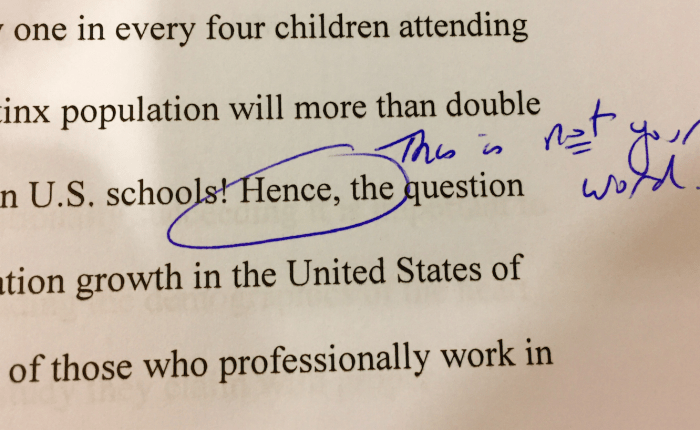
This morning, my professor handed me back a paper (a literature review) in front of my entire class and exclaimed “this is not your language.” On the top of the page they wrote in blue ink: “Please go back and indicate where you cut and paste.” The period was included. They assumed that the work I turned in was not my own. My professor did not ask me if it was my language, instead they immediately blamed me in front of peers. On the second page the professor circled the word “hence” and wrote in between the typed lines “This is not your word.” The word “not” was underlined. Twice. My professor assumed someone like me would never use language like that. As I stood in the front of the class while a professor challenged my intelligence I could just imagine them reading my paper in their home thinking could someone like her write something like this?
In this interaction, my undergraduate career was both challenged and critiqued. It is worth repeating how my professor assumed I could not use the word “hence,” a simple transitory word that connected two relating statements. The professor assumed I could not produce quality research. The professor read a few pages that reflected my comprehension of complex sociological theories and terms and invalidated it all. Their blue pen was the catalyst that opened an ocean of self-doubt that I worked so hard to destroy. In front of my peers, I was criticized by a person who had the academic position I aimed to acquire. I am hurting because my professor assumed that the only way I could produce content as good as this was to “cut and paste.” I am hurting because for a brief moment I believed them.
Instead of working on my English paper that is due tomorrow, I felt it crucial to reflect on the pain that I am sick of swallowing. My work is a reflection of my growth in a society that sees me as the other. For too long I have others assume I am weak, unintelligent, and incapable of my own success. Another element of this invalidation is that as I sit here with teary eyes describing the distress I am too familiar with, the professor has probably forgotten all about it. My heartache can not be universally understood and until it is, I have to continue to fight. At this moment, there are students who will never understand the desolation that follows an underlined “not.” There are students who will be assumed capable without the need to list their credentials in the beginning of a reflective piece. How many degrees do I need for someone to believe I am an academic?
At this moment, I am in the process of advocating for myself to prove the merit of my content to people who will never understand what it is like to be someone like me. Some of you won’t understand how every word that I use to describe this moment was diligently selected in a way that would properly reflect my intellect. I understand that no matter how hard I try or how well I write, these biases will continue to exist around me. I understand that my need to fight against these social norms is necessary.
In reality, I am tired and I am exhausted. On one hand, this experience solidifies my desire to keep going and earn a PhD but on the other it is a confirmation of how I always knew others saw me. I am so emotional about this paper because in the phrase “this is not your word,” I look down at a blue inked reflection of how I see myself when I am most suspicious of my own success. The grade on my paper was not a letter, but two words: “needs work.” And it’s true. I am going to graduate in May and enter a grad program that will probably not have many people who look like me. The entire field of academia is broken and erases the narratives of people like me. We all have work to do to fix the lack of diversity and understanding among marginalized communities. We all have work to do.
Academia needs work.
 TIFFANY MARTÍNEZ
Needs work. Two words that truely capture the reality of the academic attitude. You have my sincere hopes that you beat the system. Let nothing stop you. This is your Everest. Godspeed.
LikeLike
Tiffany, be thankful for this. It, along with so many other difficult moments, is what will make you not just a good, but great professor, writer and human.
Also, I thank you for this. As someone who is currently scrolling through a Facebook feed, dreading the enormous pile of grading that awaits, you remind me of what a powerful mode of communication grading is.
LikeLike
Oh Tiffany. If you can translate your written articulations into on-the-spot verbal ones, the profs wouldn’t stand a chance. The secret is in a socratic accountable method of questioning such comments and assumptions so that your persecutor corrects themselves. I strongly encourage you to connect with Erica at https://moontimewarrior.com/ You are kindred spirits on a perilous journey. Hang in there! 😀
LikeLike
Something similar happened to me in high school. It wasn’t racist or sexist, it was because I was a kid who read a lot, mostly over my teenage “level.” As the wife of a uni-level teacher and friends with several others, I suggest you take a deep breath and realize that MOST students do not use highly intellectual language and MOST of the time, it’s cut-and-paste, if not outright downloaded plagiarism. Your professor’s assumption was not without precedent. You speak eloquently of your own reaction to the criticism, but you don’t say whether this prof treats all students in a similar way.
I’m sorry you were so devastated by this, but if you mean to go into academia as a profession, be prepared for this sort of criticism and worse. Academic politics can be as nasty as anything you find in DC.
LikeLike
It doesn’t matter if MOST students don’t use highly intellectual language. You cannot accuse someone of plagiarism based on a mere assumption. You need to carefully scan the text yourself and/or make use of plagiarism checker software so that you can identify the actual instance(s) of plagiarism and point it/them out to the student. It is not okay to make allegations based on speculation. Plagiarism is a very serious offense that can get a student kicked out of schools, and any professor worth their salt should know better than to accuse a student of it without having evidence to back it up.
LikeLike
In my current role as the Manager of Writing Centers at a community college, this kind of systemic privileging, the hegemony, of Standard English and all that it implies, by many academics, is something that I am very aware of and am trying to confront. In fact, it is a part of the current writing center conversation nationally. Last weekend I attended the regional writing center conference (PNWCA-TYCA) in Oregon that challenged this very hegemony, and next weekend the National Conference on Peer Tutoring in Writing will confront the same issues of inclusivity and diversity in academic writing and writing centers. Know, therefore, that it is a part of the conversations happening now and that there are many people within academia–including faculty–who are actively addressing these issues. But yes, we all have work to do.
LikeLike
I understand your disappointment wholeheartedly… When I was in HS, I asked my favorite professor to write me a recommendation letter. After finding out it was for my application to the same university as his daughter which happened to be the top public university in the state, he instead said that I would be better off in beauty school. My guess is that he could not imagine that a Puerto Rican girl from the hood could merit and occupy the same space as his privileged daughter. I was crushed and ran to the girls’ bathroom to cry my eyes out. Like you, that unexpected disappointment only served to fuel my dreams. Like you, I became a McNair scholar and – like you will soon do – I obtained my Ph.D. Stay focused and sigue ‘pa lante.
LikeLike
Please update us on this journey
LikeLike
Tiffany, your professor was quite unprofessional to have made unproven comments in front the entire class. It sounds like he/she thinks shaming will “teach” you and your classmates not to plagiarize. A misguided pedagogy at best. As a graduate professor, he/she should see you as a junior college and, if he/she suspected any student of plagerism, should take the time to have a conversation about plagerism with that student in private — as a mentor not as a scold. The Academy is full of people who have weak, outdated, or nonexistent social skills. It is also full of narcissist, both benign and pathological. Unfortunately.
If I were you, I’d address his/her accusation directly, and include the department chair. I’d keep it simple. Indicate that your professor may have made an incorrect assumption about plagiarism because it is the first time he/she has seen your work and didn’t know that you are a highly capable writer. You might not want to bother with the latter point, but do face his/her accusation directly.
You have a strong voice to offer the Academy, and I suspect a rigourous mind and a courageous heart. Becoming a professor these days is harder than ever because Higher Ed has changed dramatically in the past 25 years. You will get many bumps and bruises along the way, but if it is your passion then it is worth it. Don’t make your decision based on this one unprofessional person, or his/her very callous and privileged behavior.
LikeLike
Outrageous Tiffany. How dare he. As are the assertions that you must now expose this behavior so it won’t be repeated. Well good luck with that cause it will be a thankless task, at least, and might even place a target on your back at worst.
LikeLike
Pffft…
What you look like, what your name sounds like, how pale or dark your are, whether you are male, female, or something undefined…
… No one gets to police your language, and the BS of calling you out for a single word? Dude deserved a swift smack upside the head.
Or in terms he might understand better from a guerro… His actions, as uncultured and biased as they were, deserved nothing more than a swift and satisfying smack upside the head.
Ignore the jackass. Language is yours to use, anyone tells you different should return their degree to the crackerjack factory they got it from.
LikeLike
Inasmuch as I live and grew up in a region of great diversity, I am astonished that anyone could make it into the world of academia and not know that you would use the sort of language to which, especially as a serious scholar, you have become quite accustomed. I don’t know whether you were raised using the word hence; I was not, though I come from an intellectual family, yet no one knowing me would wonder that I use it on occasion, when I see that it is warranted. Had you been at school with me, I know of no teacher who would have questioned your use thereof; overall your vocabulary is more sophisticated than mine. I can only conclude that that particular instructor is not yet well enough experienced for the position he or she has been appointed. Furthermore, he or she is unable to make the kind of sound judgment required to fill in the role of instructor of anything for students of any age level. This I take from observation of instructors from nursery school in the sixties, to the U.S. Navy, some college, and exchanges with educators and academic authors since college.
LikeLike
Sharing your story. I am so sorry you went through this experience, and ones like it. I can’t help with legal advice like some of the people commenting, but if you’re comfortable with the idea, I’d like to express outrage to your university. I just wanted to confirm that it’s Suffolk.
LikeLike
Tiffany, thanks for writing this. It’s infuriating. and more so because I hoped that things would have changed by now when they let me in the ‘academy’ more than a decade ago. But – no.. not much. Work, yes, there’s work to do. But I don’t want us to have to work at being accepted, at proving ourselves. We need spaces where we can be authentic intellectuals for ourselves and for each other and our peoples, w/o having to be validated by systems which are oppressive by design. This happens through our research, our writing, our critique (thank you for what you bring!), and it won’t happen w/o struggle. So – yes, sue the university and have it set a legal precedent. Other avenues will be needed too…. In solidarity, ~m
LikeLike
Tiffany, I am an Emeritus Professor of Applied Linguistics at the University of Oxford, one of the oldest universities in the world and this year’s top university in an international poll. If I can be of any help to you, please call on me. I was so angry reading what happened to you that I shouted at the computer. Do you want to send me your paper and let me analyse it and write to your professor to tell them that a forensic linguistic analysis indicates that it is the work of a single person?
LikeLiked by 5 people
The good intent is so palpable. I believe Tiffany is not flummoxed at how to prove ( yet again) that of course it her work, her thought, her creativity. She does that. What she is telling us is that she is wearied to death by this crap!.. which is not new and she knows is going to go on, throughout graduate school and likely after that, professionally. This insidious pervasive stuck like glue to the very language utterances and thought processes of ignorant people who are many of them totally unaware that their bias is bias ( that is the way the brain works, right and is the problem of “inference”) that.. this ..the instructors thought processes under line here.. his thought processes.. that need attention, NOT another defense of the brilliant work of Tiffany in yet another paper, or discussion, or thesis, or any other particular iteration of her and her work.
Anyway, guess what…. “Proof” will never prove it, the thing that needs to be proved to the racist mind, or sexist mind or any “ist” mind. I am. convinced that being ” disturbed” is essential to the change, disturbed and shaken perhaps about one’s own blind” ism” and then being able to feel the effects of one’s racism another person , like Tiffany. Those two things are required.
Racism is tolerated and allowed and (Tiffany makesthis point very well)
is INTERNALIZED by the victim who suffered self doubt, self discrimination and loss of self confidence about her own gd work!
You we othersmay have an external encouragement role to remind her that her work is excellant. ( Another affect of race discrimination is that Tiffany of course really does get to be anything less than an academic star at any point in the process lest she seal the assumption of “lower competence” her skin color saddles her with in yeah oh so many minds she has encountered, and will encounter. The chance to do less than great work once in awhile and still advance to graduate school is largely a white privilege. ( no heavy footfall of a stereotype confirmed need teoubke a white student who
” blows” a paper .
But I digress- She did not “blow” the paper. She wrote well enough that her clueless ,racist professor thought she plagerized it.
The entire point here is the professor be made aware of and feel the social consequence his probably unconscious but harmful racial stereotypes and inappropriate manner of dealing with his concerns, arising from his own demons upbringing experiences or lack of experiences. HE is the problem , not her or prove ing her authorship. Sure. Assure yourself she is the author if you like, but for gods sake, focus your effort on the REAL problem, the only one that, in a confrontation exercised a few million times in a few million situations by people of color and their white ALLIES, may change this.
LikeLike
It is clear that your Professor needs to review and learn the subject of equality and diversity. Shocking! In the UK your professor would have been suspended from his position and further investigations made. This is disgusting behaviour, you must speak to someone in higher authority. You might want to remind your professor:
What are equality and diversity?
What are equality and diversity, and how can we promote them?
Map of the world
What is equality?
Equality is ensuring individuals or groups of individuals are treated fairly and equally and no less favourably, specific to their needs, including areas of race, gender, disability, religion or belief, sexual orientation and age.
Promoting equality should remove discrimination in all of the aforementioned areas. Bullying, harassment or victimization are also considered as equality and diversity issues.
What is diversity?
Diversity aims to recognise, respect and value people’s differences to contribute and realise their full potential by promoting an inclusive culture for all staff and students.
How can we promote equality and diversity?
We can promote equality and diversity by:
treating all staff and students fairly
creating an inclusive culture for all staff and students
ensuring equal access to opportunities to enable students to fully participate in the learning process
enabling all staff and students to develop to their full potential
equipping staff and students with the skills to challenge inequality and discrimination in their work/study environment
making certain that any learning materials do not discriminate against any individuals or groups
ensuring policies, procedures and processes don’t discriminate
This article was published on Sep 8, 2015 (The University of Edinburgh)
Stay strong. Not everyone is like this and those that are will receive their ‘just desserts’.
Normally I am interested in the building industry as I manage my husbands web page. However, your post really grabbed my attention, I am a Clinical Nurse Supervisor by profession and this behaviour is unprofessional, unacceptable, in any environment or situation……..truly shocking!
LikeLike
Not sure if anyone has offered this idea yet: but you should check and see if your university has a bias response team that you can report this to. Further, I would consider going to the chair or possibly dean (depending on who the chair is and if they’re amiable) of the department this professor works in. Not only is the comment itself a problem but that the professor handled it in the way they did is a problem. Filing a formal complaint is completely within your right.
Also, if you have a Multicultural Resource Center, or administrative arm of Student Life focused on diversity and inclusion, I would go talk to someone in either/both of those programs. This behavior is completely unprofessional and unallowable from a professor, and you deserve to have as many people on your team, supporting you as you can get. They’re there to support you as a student, so definitely go talk to people in those programs if you feel comfortable.
You absolutely belong in academia, and if this blog post is any evidence, your writing is not only well-structured but lovely to read. You’ll make a wonderful professor one day!
LikeLike
Now, I don’t have the context of the entire work and I can say professionally, I would never handle an accusation of cheating in front of a class (that’s a “could we speak for a minute after class” conversation). In this case, the professor might have at least a little point.
On the particular comment you highlighted, it is possible what the professor was trying to tell you was that your use of “hence” is inappropriate in the context. Not, “this is not your word” on a personal level, but rather, “this is not the word you’re looking for. It’s used incorrectly.” In my case of many years of grading AP and university work in two languages, and academic advising, the latter is what I’d be trying to tell you. I would not be saying, “this use of hence is so amazing you could not possibly have come with it.”
Thus, therefore and hence are final conjunctions. They should not be used to begin a sentence in formal writing. Your use of hence is incorrect, your writing does need some work, everyone’s does. Even famous writers have editors. The other comments implying cheating are hard to evaluate without the context of the paper. Does your university subscribe to a service where they scan papers? Many do now and they tell the professors to what degree the work is original. I would strongly advise taking advantage of the professor’s office hours and see if you can get more insight on their perspective on your paper.
As a female with a mixed heritage background, I can share that working in academics will continue to be a struggle for females of all races as far as I can see, sadly. You will need the ability to advocate for yourself in a professional and courteous, but assertive manner. Don’t be afraid to use office hours. It humanizes you, which is a necessity in large classes with academic biases. I’ve worked in 3 different fields and academia is the most old- fashioned, macho, euro-centric of the bunch. You’re going to need to be as strong as a salmon to swim up that river. Start flexing those muscles now. Good luck!
LikeLike
“Your use of hence is incorrect, your writing does need some work, everyone’s does.”
That is a run-on, which invalidates any claim you could make to being an expert on the subject of writing.
LikeLike
She did retain the ability to make a useful point, however, unlike you.
LikeLiked by 1 person
So, you’re going to completely ignore the written and spoken accusation of plagiarism that accompanied the phrase “this is not your word,” in a desperate attempt to excuse it? It is BLINDINGLY obvious that the grader intended to communicate that they did not believe the author could use such a sophisticated word, and your attempt to pretend otherwise is baffling and sad.
LikeLike
As a professional writer (26 books published, 27th in production, 28th in progress) , I find your condescending and snippy response to this post objectionable. Your eagerness to correct Ms. Martinez blinded you to the context and the main thrust of her post.
Quote: “…my professor handed me back a paper (a literature review) in front of my entire class and exclaimed ‘this is not your language.’ On the top of the page they wrote in blue ink: ‘Please go back and indicate where you cut and paste.’ The period was included. They assumed that the work I turned in was not my own.”
In other words, it was clear from the post that the professor openly, in front of the class, indicated that the paper was plagiarized because “this is not your language” and accused her of “cutting and pasting” without formally quoting. In that context, the underlined “hence” and “This is not your word” clearly refers to plagiarism, not to the usage of “hence.” The professor was revealing racial/cultural bigotry issues, assuming that Ms. Martinez did not have the command of language to write what she had written, that she took that phrasing from somewhere else. That is the issue, not a lesson in correct grammar.
Finally, “hence” is listed as an adverb, not a “final conjunction” in all my dictionaries. It is one shorthand for “reasoning from these facts” (“thus” is another) and is acceptable in a discourse involving proof of a concept. In a longer chain of reasoning, it may be inconvenient to put it mid-sentence, so using it at the start of a sentence may be the best choice.
LikeLike
I’m sure there are style guides out there that discourage the use of hence at the start of a sentence, just as some say you should not spot infinitives, but in fact there are many places where such usages are not only acceptable, but in fact preferred.
I’m also not convinced that hence can appropriately be categorized as a conjunction, since it frequently is used together with true conjunctions (and hence must occupy a distinct syntactic position). In at least some uses, it’s adverbial.
See e.g. the list of uses in the MW dictionary: http://www.merriam-webster.com/dictionary/hence
Several examples of sentence initial hence are there, including at least one published in a journal.
LikeLike
I don’t understand how you could possibly think that’s what the professor meant. If they thought “hence” was the wrong word to use in that instance (and it’s not; it makes perfect sense where it’s placed), they would have noted that the word choice was incorrect. I also don’t know any professor who would care that she began a sentence with “hence.” If you don’t take some creative liberties with academic writing, it becomes impossible to tolerate. The only thing I would have done is put a mark through the comma because it doesn’t belong there.
LikeLike
DO NOT ENCOURAGE STUDENTS WHO HAVE FACED DISCRIMINATION TO GO SIT IN AN OFFICE WITH SOMEONE WHO JUST USED PUBLIC HUMILIATION AGAINST THEM BASED ON A RACIALIZED ASSUMPTION.
That is not useful or healthy advice to give, and I question your own training on working with and advocating for students. We don’t ask them to go sit and deal directly with a professor who is being unduly harsh and even harassing of them. The professor needs to be spoken with first, and then a mediated conversation needs to happen. If, and only if, the student then feels comfortable should they be encouraged to go into a closed space with someone who has power over them in the structure. Do you also encourage students who have had male professors make shitty comments about their bodies to go and sit in a closed office with said professors? Really now.
Further, the writer gave you full context of what happened. That you choose to disbelieve her and preach at her about how her use of hence is wrong… It’s gross and shows little more than you actively trying to find a way to discredit what she has said. As you yourself note, you cannot edit without full context, so why are you choosing to edit her work which was neither requested, and cannot be done without her paper in front of you. You have no idea where that ‘hence’ fell in the paper, and sound fairly prescriptivist in the use of it which, actually, is little more than a grammatical rule the same way y’all don’t want us to use “them” or “they” as a singular pronoun.
Go read anything in social sciences to check. We use thus, hence, and therefore to close out ideas or claims specifically. The placement of them in the sentence can, thus, come at either beginning or end. We like to play with language in this area of scholarship, and tend to frown on mindlessly prescriptivist uses given that prescriptivist grammar offered as some historically and socially untethered standard belies histories of racism and classism bound to and bounded by language. Thus, you’re offering poor advice that serves to further undermine a student who is already getting poor support from academics. It also is out of place given that the discussion here is not on the use of hence, but one whether or not the manner in which the professor addressed all of this was ever appropriate (it was not). The student is not being unduly sensitive, she’s responding in a reasonable manner to an unreasonable professor.
Oh, also, your sentence “should not be used to begin a sentence in formal writing” is perilously close to this sentence “it should not be used at the beginning of a sentence in formal writing, according to the Chicago Manual of Style.” from here: http://english.stackexchange.com/questions/18909/can-hence-be-used-at-the-beginning-of-a-sentence. Given that you did not note that you were referencing a specific standard, or even the near exact phrasing of the Chicago Manual of Style, you both undermined your own suppositions as well as failing to cite what is little more than partial paraphrase. Which is, as we now, often viewed as a minor form of plagiarism.
Now, one could argue that it is common knowledge, but actually it’s not taught commonly even within grammar classes in higher ed (given that these often neither exist nor are requirements of degree programs) so in fact you should not reference the standard for thus, hence, and therefore without also noting that you are using phrasing found specifically, and written originally within, the Chicago manual. Now, I don’t actually believe this, given that I find fault with the process of citations on the whole being an unconsidered and ultimately flawed method of codifying and reifying certain (and only certain) types and sources of information, again favoring the traditional white, male, Anglo, textually oriented type within academia. But I think it’s useful for you to be reminded that the rules you trot out to make yourself feel important or correct, can and do actively harm others in their prescriptivist uses. You’re clearly not plagiarising in any meaningful way, and there’s an argument to be made about whether or not it is ultimately plagiarising. But still, it counts, and following the rules is all that matters, right?
LikeLike
Tiffany, I am so sorry. No one deserves to be treated like that. Even if you didn’t have the credentials that you do, no instructor has the right to accuse a student in front of the class or do it without speaking to you first. You deserve better. Academia needs to do better. You’re an eloquent and professional writer and I admire the way you handle yourself. You are leaps and bounds ahead of this instructor – know that and run with it.
LikeLiked by 1 person
I grant that I don’t know you. And I don’t know your professor. You may be COMPLETELY right in your assertion that his comments were race-derived.
However, you’ve only given us one example of what he didn’t feel could possibly be YOUR work. “Hence”. Going off only this, as the reader, my initial thought at someone using that word had nothing to do with race… it had to do with age. I can’t even remember the last time I READ it in a book that was not old.
Who uses “hence” anymore? I can’t remember the last time I heard that word in normal conversation. It may be never. I’m certainly not used to reading it. My initial reaction to “hence” was … “old person”. People used that word in older books. Moby Dick old.
It is conceivable that THIS is the reason your professor felt the writing was unlikely to be yours? Are his other underlined examples words that people of your racial background would not use… or are they possible words that people of your GENERATIONAL background would not use?
Just a possible alternate explanation.
LikeLike
Hence is commonly used in academic writing. As is thus, and a whole host of other arcane and archaic terms. Academic writing does not follow rules of novel writing, or even journalistic writing, it has its own internal rules including a particular voice that junior academics are trained to mimic. Further, the secondary bit of the professor’s requirement, that the student shows the professor where a “copy and paste” happened does mean that the professor assumes the student plagiarized. That is a request you make of a student when sussing out plagiarism.
LikeLiked by 1 person
Interesting, Mike, that you assume the gender of the professor involved was male. I feel Tiffany’s careful treatment of word choice was demonstrated in her not revealing the professor’s gender. In doing this, Tiffany told her story with a focus on the professor’s own assumptions; attributing an assumed range of vocabulary to Tiffany with no evidence. Kind of like what you did, Mike, in assuming the professor was male.
LikeLike
There is no “possible alternate explanation” for this behavior. No academic professor should, or would, make such a claim in front of the entire classroom. Not only this but there are multiple resources available for a professor to check for plagiarism. Also, as a grad student (who’s also a millennial (ooooh, shocking)), who has a Literature Review being overlooked by a board of professors for publication, hence is a common word in academic writing.
LikeLike
That is how denial works.
LikeLike
Stick with it. You will change the system when you get there. And don’t take any crap along the way. The prof was so out of line it isn’t funny. Signed, Janice Wilberg, Ph.D. University of Wisconsin-Milwaukee, 1986 (also known as a time when there weren’t many women in Ph.D. programs – not the same as the stereotypes about you but I still get it).
LikeLiked by 2 people
Good Lord …. where do you live that is so backwards? What has race got to do with intelligence or academic achievements? Nothing at all. I’m really sorry that you have to endure such discrimination. I should rephrase that …. you don’t need to endure it ….. you are clearly rising above it.
I would report this professor to his superiors though. His behaviour is not tolerable.
LikeLiked by 2 people
Tiffany, I can relate somewhat. I was one of the first two women to attend Lincoln Institute at Northeastern U in the 1960s. One of the professors told us on Day One that the work was too complicated for girls – he could not in good conscience allow us to pass his course.. I aced my first exam in AC/DC theory and was accused of cheating. The dean doubted my word, too, when I challenged my “failing” grade. He had me take a prior year first semester exam under his direct supervision. I aced that one, as well. That professor did not return to teach the second semester. I was a pariah to – but respected by – the other instructors. My discomfort was palatable. My only advocate throughout the EE program was the other wonderful woman, who claimed she owed her degree to my due diligence. So: good for you. Never back down no matter how painful – and truly sad – your path is. You are clearing the way for those of your culture who will follow you. Blessings on your journey, Dear Heart. Baraka Bashad.
LikeLiked by 2 people
In, I think, 1911, my g.g.g. aunt, Adelaide Hobe of San Francisco went to work at the James Lick observatory.
Years later, a physicist and his wife (I am sorry to say I know nothing about her academic quality ) came to ask me, as a resource about her. I found from them that she was instrumental in proving the validity of the Theory of Relativity.
So much for girls can’t.
It’s a shame your professor didn’t know the truth.
LikeLike
I’m a professor. Over the course of my career I’ve marked thousands of papers–hundreds per semester for over twenty years. Sometimes papers written by students seem too good compared to all the others. Generally I have the writer of such papers in for a chat. More often than not the writers of such papers have plagiarized–sometimes out of naïveté, sometimes blatantly. The fact of the matter is that the majority of students do not arrive at university wih the ability to write at the level of a professional writer. So the fact that this prof leapt to an assumption when seeing excellent writing is not surprising. Moreover, unless I have misunderstood the situation (and if I have, I apologize), this prof did not directly announce to the class that he thought you had plagiarized. He wrote his assumptions as comments on the paper for you alone to read. Only someone sitting immediately beside you looking purposely at your paper would see the words the professor wrote. Yes, he should have had you in for a private meeting instead. Perhaps he will learn a lesson from your situation and, as a consequence, be more considerate with someone else in the future. Professors can, on occasion, be wrong with plagiarism accusations. They’re wrong on the occasion that a brilliant student writer shows up unexpectedly. The fact is you are such a writer, one who is clearly more skilled than most of the other students this particular professor generally sees. Your summary of writing experience at the beginning of your post speaks to these skills. So go to him and explain. Show him some of your other work. Show him your blog post. I’m willing to bet that his accusation came from a place of burnout and fatigue from marking thousands of poorly written papers. Surprise him with the truth. And, years from now, send him one of your books.
LikeLiked by 1 person
Edit: I see now that you mention the professor “exclaimed” that the words were not yours. I agree that this aspect is reprehensible.
LikeLike
Why do you assume her professor is male?
LikeLike
I thought she had said “he” at one point. I am a woman. I know there are woman professors. When writing a long comment on one’s phone, it’s tricky to go back and reread. Yes, I should have read the original post a few times before responding to ensure complete accuracy. But I stand by the main point of my post.
LikeLike
“This morning, my professor handed me back a paper (a literature review) in front of my entire class and exclaimed “this is not your language.”
It appears the intent was to humiliate.
LikeLiked by 1 person
Yes, I noticed that and posted an edit comment. I can’t find a means of editing my original post.
LikeLike
“Over the course of my career I’ve marked thousands of papers–hundreds per semester for over twenty years.”
If that were actually true, you’d know when to use “over” versus “more than.”
LikeLike
I apologize that I made a minor grammatical error when posting an online comment via my phone.
LikeLike
In comments section
Dandru can’t see the forest
for the trees. So sad.
LikeLiked by 1 person
Did you read the article before commenting? He said it in front of the Class.
LikeLike
Yes. I did read it. But I read it only once. And I had missed the word “exclaimed,” which I already mentioned in an edit comment immediately after my post.
LikeLike
Condescending denial.
LikeLike
How is it “condescending denial” to 1) speak from extensive career experience, 2) suggest that professors can be wrong about plagiarism, and 3) suggest that someday the brilliant writer of the blog post will someday have a book published?
LikeLike
Wow. I’m so very angry with your professor! That is not right. Stay strong.
LikeLike
I want to blatantly plagerize your comment. I couldnt agree more!!!
LikeLiked by 2 people
Love you and proud of you.
LikeLike
As someone who has graded hundreds of papers at the post-secondary level, I can assure you that even if your work was plagiarized (and I don’t believe for a second that it was) accusing you in front of your classmates goes against your institution’s policy regarding how professors handle cases of potential academic dishonesty. This is as clear cut an example as possible of when you need to go above your professor and bring this to the attention of admin. Do not sell yourself short here and think this is something you just have to push though: it isn’t.
LikeLiked by 2 people
Thank you for giving voice to the struggles all those academia implicitly marginalizes. I’ve had few similar experiences and sadly allowed them to raise so much doubt in me that I have wasted years looking for the courage and will to continue. I didn’t really understand what I was feeling nor did i want to accept that those I looked up to could be so complicit and complacent. I read a book called “Working class women in acadamia” and cried my way through each page. Your story could have easily been a chapter. Sadly 20 years later nothing has changed. Please persevere and never forget. We need people like you in high places.
LikeLike
I’m a former McNair scholar, and I’ve been a college instructor. This is awful, and unfortunately things like this happen frequently to minorities and women in academia all too often. I’m very white so I was spared this particular issue in college, but many of my peers were not; I was however accused of plagiarism many times before college by teachers who knew I was poor…
Please consider talking to your McNair faculty advisor and grad student mentor about this incident. I would encourage you to bring it to the attention of your McNair program advisor. The director of my program was excellent and receptive, and arranged impromptu panels and worshops several times when we brought these issues to her. Things like this are going to come up again and again. You guys need to be prepared for this and how to address it. It is very likely that when you get to grad school, things like this will be worse. Some programs are better than others, but the culture in most academic programs is very clickish and homogeneous even if there is superficial variety. Falculty are looking for people like them, and most of them come from privileged backgrounds. Difference gets noticed, and misinterpreted. It’s more subtle and insidious than what has happened to you now. It’s something though that you McNair scholars would likely benefit from tremendously to discuss, both for your undergrad and graduate experiences.
LikeLiked by 2 people
I am very sorry for the way you were mistreated. I am incensed that a professor in an respected university would be so mindless. I do hope you see this through to the end.
LikeLiked by 1 person
Do I need to slap a professor?
LikeLiked by 2 people
Thank you for sharing your thoughts. As a woman of color who teaches at a university, I was moved by your piece from the perspective of a professor and from encountering the same experience you had, as a student. Please do not give up on your pursuit of knowledge and desire to give back. WE need you in academia. I did not understand the POWER of my presence in front of a classroom until several students of minority and underrepresented background told me that my presence inspires and validates them. Every day I stand before all my student, I am honored and I remember my purpose. It also heals some of the wounds of being treated as “other”.
LikeLiked by 5 people
I couldn’t get past the opening of your second paragraph. Racism is perpetuated by people that wallow around in it. Watch the short video I produced of the most recent city Eggstravaganza event. We are very mixed. The only people not mixing (of any group) are people that are choosing to stay separate. They come from all corners.
LikeLike
This isn’t the place for free advertising. Be a grown-up and go promote yourself somewhere else. Oh, and update your concept of racism!
LikeLiked by 2 people
Oh thank you Joseph for man splaining that to us all that racism only exists for people “who tolerate or allow it” And your qualification to TOTALLY diminish discount Tiffanys experience and the experience of millions of people of color, is.. YOUR experience? You are male and white privilege personified, knee jerk driven and sounding off, again. You are the problem. This IS the problem.
LikeLike
I couldn’t get past the first sentence of your comment. Racism continues to exist whether you choose to ignore it or not.
LikeLike
> I couldn’t get past the opening of your second paragraph
Then you probably shouldn’t have commented.
LikeLike
Joseph you are the epitome of racism and sexism yourself and you clearly do not even know it.
LikeLike
Have your teacher watch Finding Forrester the movie. Seems like the same scenario! Very sad! If you have not seen it, please watch it!
LikeLike
i was taking an online course and papers were subject to review by other students. twice, a male reader accused me of plagiarizing, when it was not true. i cited my sources when there were quotes and everything else was my own words. the teacher of the course didn’t even check my paper, just told me i was off the course. so easy to accuse, so hard to prove a negative.
LikeLike
When you say, “off the course” do you mean the professor wanted you to refocus on something else, or just simply kicking you out of the class for this “so called” plagiarism.
LikeLike
beautiful. ❤
LikeLike
This is absolutely outrageous…How dare he assume what “your” language is? To my knowledge, language is not “owned” by anyone….This bigot needs to be reported.
LikeLiked by 2 people
Tiffany, thank you for this piece because you have so eloquently articulated thoughts and feelings that so many of us have felt as we continue on our educational journey’s. Believe me it doesn’t get better as you begin your professional career. You must remind your self that you are capable, that against extraordinary odds you have made it to where you are, and no one and nothing can take that away from you.
LikeLiked by 1 person
Who you are is not defined by what others think of you. What matters is that you stay focused on your goals and what you want (and it may be that they change, in light of this).
I challenged a tenured professor when I was an undergrad. It didn’t have the outcome that I wanted, but it proved that just because he had job security didn’t mean he sat on a throne.
Whomever did this to you in front of your peers lacks normal social intelligence and should not hold the position of leading and educating. I will fly out to Boston and walk with you into the Dean’s office and try to rectify this. Publicly, naturally.
LikeLiked by 1 person
And you will do that because YOU can “take care of this little matter” for Tiffany? How about you encourage a sister not belittle her again by assuming she needs a rescue walk into the office with an EFFECTIVE companion to ” do it for her” she is telling you about it SO YOU and every liberal or conservative f__ing know this is how it is.
LikeLike
Don’t let the haters stop you. Continue to let it fuel your hunger to prove them wrong.
LikeLiked by 1 person
Dear Tiffany, you are in the middle of academia. You are probably reading a bunch of academic literature. You never stop acquiring language. You are picking up what you read. I never used the word “thus” in a formal speech or paper until I saw it used a few times. The same happened to me in Spanish (my second language)–I really didn’t get the hang of the subjunctive until I heard native speakers use it. Be strong. Don’t let the haters get to you!
LikeLiked by 1 person
You totally missed the point. Re read! – she used ” hence” correctly. That is why she was being accused of plagerism. Duh.
LikeLike
You write very well. Your eloquence and command both testify that you own the entire English language. Your professor is an example of the lizard mid-brain leaping to conclusions and bypassing the rationality of the professor’s cerebral cortex.
LikeLiked by 1 person
Sorry, whatever the neuro science is in racism, it needs to stop. Neuro plasticity at any age which we now know is a fact, argues IT can stop. It has to be unacceptable.
LikeLike
Para empezar te quiero decir que
Tu eres una Chingona
Tu sabes lo inteligente que eres
Toma lo asumido por ese racista
Como un trofeo
Como un reto que ese profesor ve en ti
Un reto que amenaza su racismo, y sus
Privilegios
Un guerrera como tu llega al empiezo
De la batalla ya triunfante
Y se impone porque de tras de ti vienen nuestras
Pequeñas y pequeños
En los últimos dias escribí un poema
Pienso que viene al caso de la “fritanga”.
_____________________________________________
¬¬¬¬¬¬¬¬¬
In the garden of the most beautiful flowers
Ever seen by the naked eye
You will find the kind of flowers that no matter
How many times evil cuts them
They will always flourish
In the garden of the flowers that have the power
To cure with their properties
You will find the ones that does not matter
How many times you destroy them
They will always find a way to come back
Because they have the Creator’s medicine
In the garden of the most amazing flowers
There are those flowers that have been invaded
By plague and Genocide
But they are warriors that continue to fight
And they always survive
In the marvelous land of the Creator
These flowers never die
Because they are at home
Because they belong to this earth
Because they are the true flowers of this land
Payers to these flowers
Because it will be a day where they will flourish
Not just to survive but to stay free and wild
As the wind
As the fire
As the land
As the water
As the most magnificent creation ever seen by the naked eye
Dedicated to the warriors defending our water all over the world
And beautiful flowers like you, en la jungla de concreto.
Coche
LikeLiked by 1 person
Flowery bullshit from unmistakably someone who has not been there.
LikeLike
I hope you file a formal complaint with your university. We can be as incensed as we like, but if you don’t bring it to the attention of the administration it will not stop.
LikeLiked by 5 people
Yep. And so should the colleagues who know about it, other students and professors.
Only in that way.,
LikeLike
Reblogged this on Stella Samuel – Author and commented:
Academia needs work. This is our broken society.
LikeLiked by 1 person
First, let me say I apologize that you feel marginalized and discriminated against. It really is a cruel world out there and no one should ever feel the way you do especially when possessing such amazing gifts.
With that said, I am a doctorate student and I do have a few questions.
When I submit everything from my small assignments to my research proposals my work is run through a plagiarism checker and have since undergrad. Is this a requirement for your school? Admittedly, you go to undergrad at a far more pretigious university than I did so I am not sure what the protocol is. Furthermore, is there any way you could post the entire sentence/paper? You’re an eloquent writer and I’d love to run the sentence in question through the plagiarism checker I use to check my work to help further build your case. Also, did you meet with your professor to understand this weird scrutiny?
Best of luck.
Kevin
LikeLiked by 2 people
Papers handed in on paper and not through an online submission form (like Blackboard or Course Works) are not usually run through any software – because they’re hard copies. Not every institution requires it, especially at the undergraduate level. I rarely hand in papers online and thus they rarely end up through detection software. And I attend a CUNY school.
LikeLiked by 1 person
Whaaat?
LikeLike
I agree with Kevin, it would be interesting to know whether usual plagerism checks were undertaken before this comment was written on your paper. I can imagine this is very frustrating, I wish you the best of luck rectifying this with your university.
LikeLike
Are you going to run the word “Hence” through your plagiarism checker? I think you’ve missed the point.
LikeLiked by 1 person
Exactly. Point clearly missed.
That is how indidious racism is. Other white students cannot see it even in PLAIN SIGHT.
LikeLike
Your professor is an abuser and needs to be reported to both the diversity and equity office (if they are separate at your institution, they are in mine). They will do this again and again until they are stopped.
LikeLiked by 6 people
Reblogged this on Goals Go Global.
LikeLike
Thank you for sharing this and making your voice heard. This is all types of unacceptable and I hear that this is a recurring issue with POC in academia. It needs to stop. I hope this is pursued further. I support you all the way.
LikeLiked by 1 person
I hope you went to the Provost’s office. If you haven’t, do so and tell them you’re getting a lawyer.
LikeLiked by 3 people