My name is Tiffany Martínez. As a McNair Fellow and student scholar, I’ve presented at national conferences in San Francisco, San Diego, and Miami. I have crafted a critical reflection piece that was published in a peer-reviewed journal managed by the Pell Institute for the Study of Higher Education and Council for Opportunity in Education. I have consistently juggled at least two jobs and maintained the status of a full-time student and Dean’s list recipient since my first year at Suffolk University. I have used this past summer to supervise a teen girls empower program and craft a thirty page intensive research project funded by the federal government. As a first generation college student, first generation U.S. citizen, and aspiring professor I have confronted a number of obstacles in order to earn every accomplishment and award I have accumulated. In the face of struggle, I have persevered and continuously produced content that is of high caliber.
I name these accomplishments because I understand the vitality of credentials in a society where people like me are not set up to succeed. My last name and appearance immediately instills a set of biases before I have the chance to open my mouth. These stereotypes and generalizations forced on marginalized communities are at times debilitating and painful. As a minority in my classrooms, I continuously hear my peers and professors use language that both covertly and overtly oppresses the communities I belong to. Therefore, I do not always feel safe when I attempt to advocate for my people in these spaces. In the journey to become a successful student, I swallow the “momentary” pain from these interactions and set my emotions aside so I can function productively as a student.
Today is different. At eight o’clock this morning, I felt both disrespected and invalidated. For years I have spent ample time dissecting the internalized racism that causes me to doubt myself, my abilities, and my aspirations. As a student in an institution extremely populated with high-income white counterparts, I have felt the bitter taste of not belonging. It took until I used my cloud of doubt and my sociological training to realize that my insecurities are rooted in the systems I navigate every day. I am just as capable if not more so than those around me and my accomplishments are earned.
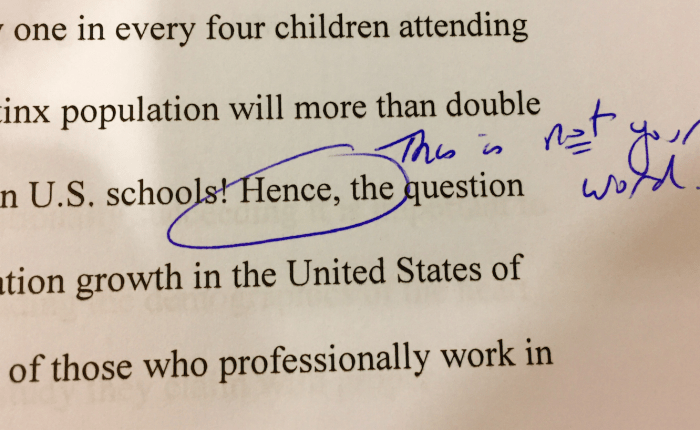
This morning, my professor handed me back a paper (a literature review) in front of my entire class and exclaimed “this is not your language.” On the top of the page they wrote in blue ink: “Please go back and indicate where you cut and paste.” The period was included. They assumed that the work I turned in was not my own. My professor did not ask me if it was my language, instead they immediately blamed me in front of peers. On the second page the professor circled the word “hence” and wrote in between the typed lines “This is not your word.” The word “not” was underlined. Twice. My professor assumed someone like me would never use language like that. As I stood in the front of the class while a professor challenged my intelligence I could just imagine them reading my paper in their home thinking could someone like her write something like this?
In this interaction, my undergraduate career was both challenged and critiqued. It is worth repeating how my professor assumed I could not use the word “hence,” a simple transitory word that connected two relating statements. The professor assumed I could not produce quality research. The professor read a few pages that reflected my comprehension of complex sociological theories and terms and invalidated it all. Their blue pen was the catalyst that opened an ocean of self-doubt that I worked so hard to destroy. In front of my peers, I was criticized by a person who had the academic position I aimed to acquire. I am hurting because my professor assumed that the only way I could produce content as good as this was to “cut and paste.” I am hurting because for a brief moment I believed them.
Instead of working on my English paper that is due tomorrow, I felt it crucial to reflect on the pain that I am sick of swallowing. My work is a reflection of my growth in a society that sees me as the other. For too long I have others assume I am weak, unintelligent, and incapable of my own success. Another element of this invalidation is that as I sit here with teary eyes describing the distress I am too familiar with, the professor has probably forgotten all about it. My heartache can not be universally understood and until it is, I have to continue to fight. At this moment, there are students who will never understand the desolation that follows an underlined “not.” There are students who will be assumed capable without the need to list their credentials in the beginning of a reflective piece. How many degrees do I need for someone to believe I am an academic?
At this moment, I am in the process of advocating for myself to prove the merit of my content to people who will never understand what it is like to be someone like me. Some of you won’t understand how every word that I use to describe this moment was diligently selected in a way that would properly reflect my intellect. I understand that no matter how hard I try or how well I write, these biases will continue to exist around me. I understand that my need to fight against these social norms is necessary.
In reality, I am tired and I am exhausted. On one hand, this experience solidifies my desire to keep going and earn a PhD but on the other it is a confirmation of how I always knew others saw me. I am so emotional about this paper because in the phrase “this is not your word,” I look down at a blue inked reflection of how I see myself when I am most suspicious of my own success. The grade on my paper was not a letter, but two words: “needs work.” And it’s true. I am going to graduate in May and enter a grad program that will probably not have many people who look like me. The entire field of academia is broken and erases the narratives of people like me. We all have work to do to fix the lack of diversity and understanding among marginalized communities. We all have work to do.
Academia needs work.
 TIFFANY MARTÍNEZ
How many degrees do I need for someone to believe I am an academic. – I wish I could give an American Dream response but I can’t because I’m you. You’ll get it for the rest of your days. You might as well think of some responses that reflect the ignorance you will encounter away from you. You have to deflect that hurt because ultimately it becomes lodged inside you. You have to be a ninja with your response! Instead of doing what you love you end up making a career about someone else’s stupidity. I call that racism on remote. While you question yourself they’re off pursuing the next prize.
Adelante, always…
LikeLike
Hang in there. This was common place for me. Comments like; you speak very well and have such a good vocabulary. Yeah, the gift this will give you is a strength of character that many will never know or own. The time will come when you will be able to own them. – Magpie
LikeLike
Ugh. I also love academia and I’m so sorry that anyone should have to struggle just to be allowed to be present in it. For race, class, health, and other reasons. I would probably put out my left eye to be allowed back into grad school. I’m really sorry that this is happening to you.
And, uh, being in a literary environment would teach anyone to pick up the word “hence” even if they weren’t already intellectual to begin with (which you obviously were). Or is the prof simply admitting that they don’t think they can have any influence on students? Because unless that’s what they want to imply about the effectiveness of their own teaching, that’s not so smart of them.
You’re better than that. Don’t let them trick you. Don’t be fooled. Some professors are good, and some are just worms.
LikeLike
Tiffany… This is the first time I go to your blog. I am so sorry you have go through that horrible situation, it must be both upsetting and embarrassing. On the other hand, it means you are smart enough that the professor couldn’t tell you if you’re a student or an experienced master already. Please, keep doing your thing. I also experienced a discrimination against my skin earlier this week, it hurts me so bad.
http://www.sabrinaenjoys.net
LikeLike
Hang in there because your future students need you.
LikeLike
Grading like this is why I switched to an astrophysics major.
LikeLiked by 1 person
I’m so sorry you had to go through this. I guess there is a reason they call it the “ivory tower.” I hope that you get resolution to this issue in whatever way feels best to you.
LikeLike
I’d like to see this paper in its entirety. There are other ‘blue marks’ of correction on the parts we can see, and I wonder if you are as great an academic as you claim to be. If that professor had to correct simple errors, then saw you using words like ‘hence’ s/he may have had reason to be suspicious. There are plenty of students who are guilty of plagiarism; why are you so special that you are beyond suspicion?
LikeLike
You are just proving her point and missing the message she is trying to convey. I would say shame on you but your probably as ignorant as the professor.
LikeLiked by 1 person
Based on the writing of this article, I believe you can safely infer that Tiffany has the intelligence and verbal ability to use a simple transition word. The fact that a professor specifically circled a word and emphasized that the word was not hers is a ridiculous assumption. Even if there were other reasons to believe that the paper was in any way plagiarized, it was not appropriate to call a student out in front of the entire class in order to chastise her in front of her peers and inflict feelings of shame. As a school and educational psychologist, this form of punishment is not effective and does little to support a student’s educational growth.
LikeLike
And this, right here, is EXACTLY what she was talking about. Smh.
LikeLike
Talk about missing the point Letta!!! The words and the usage are not incorrect!!! The point is that he doubted she knew the meaning of such words!!!
LikeLike
Probably because the professor has access to several search engines that could tell if it was likely that the work was plagiarized.
Probably because everyone makes mistakes, and it doesn’t necessarily mean work is plagiarized.
Probably because everyone’s paper had “blue marks” of correction as well, but she was the only one accused of plagiarism aloud.
Probably because there are policies about reporting plagiarism that do not fall in line with public announcements and unfounded/uncontested claims (she does get a chance to defend herself you know).
Probably because our justice system and the systems it has influenced (including trials investigating plagiarism) should operate under the assumption that one is innocent until proven guilty?
LikeLike
The air gets thinner as we climb, and the heat gets hotter, but the fires we walk through make us better prepared to handle tribulations than many of the people who criticize us along the way. Don’t try to blend in — MAKE THEM FEEL YOU. Reach out if you ever feel the want or need to; I’m easy to connect with and know the path you are walking very well. From one child of the Bronx to another, I look forward to welcoming you to the next level. Peace.
Maliq Matthew, PhD
Assistant professor of sociology
University of Cincinnati
LikeLiked by 3 people
Reblogged this on Edwin Roman and commented:
For many, their first and only impressions of people unlike themselves is from television and movies. Images have mythic power and don’t require reading. So if you’ve spent most of your life only seeing Latinos and other people of color portrayed as maids and criminals, and have never had meaningful interaction, that can be your sole frame of reference. Unfortunately, even intellectuals are not immune to this. They should be; after all, their critical thinking skills should be far more developed.
LikeLiked by 1 person
I am a white(ish) female, who works with multiple ethnicities and genders every day in medicine, where cooperation is necessary. I see how patients regard darker people than my self as less than experts. Coming for me hold more weight. Mis by the way are treated differently and with more respect. Keep it up Ms Martinez ” the times are a changing”
LikeLike
Tiffany, please let us know if there is an update to the situation. Stay strong!
LikeLike
Reblogged this on Kaila Philo.
LikeLike
For many, their first and only impressions of people unlike themselves is from television and movies. Images have mythic power and don’t require reading. So if you’ve spent most of your life only seeing Latinos and other people of color portrayed as maids and criminals, and have never had meaningful interaction, that can be your sole frame of reference. Unfortunately, even intellectuals are not immune to this. They should be; after all, their critical thinking skills should be far more developed. Hang in there and don’t give up—you are the desperately needed role model.
LikeLiked by 1 person
My husband is a white man teaching English and history in a rural Nevada town made up mostly of Mexican immigrants. We moved here to teach when the job was offered because the white communities where we are both from have reduced the pay of teachers so much that we cannot afford to pay a mortgage on a teacher’s salary. We’ve lived in this community for 15 years and we’ve liked it very much.
When we go home to visit, without fail, my husband get’s asked if the Mexican kids care about school at all. It’s assumed he’s a frustrated teacher, always chasing them to finish their homework, or even come to class, or the room is full of pregnant teens, or teens that are high, or teens that will steal everything not nailed down.
When he replies that there are studious kids and lazy kids and great kids and challenging kids, and it has nothing to do with their culture or skin color, there is a lot of cognitive dissonance.
These assumptions have gotten so bad that we outright refuse to attend his extended family reunion anymore because they’ve asked it consistently for 15 years. Sometimes when the question is asked we answer, “Why in the world would you ask me something so dumb?”
I’m sorry that this is what you have faced. I am not in a place to understand it completely as a white woman, but I do try.
LikeLiked by 4 people
I hope you continue to grow and to keep pursuing your dreams. You have a lot of courage, and you also come of age during a time when education is very broken! I do want to point out a piece of one of the replies above, and to ask that you consider this as a useful critique, minus any questions of invalidation of your emotions (and I don’t doubt that you experience plenty of discrimination, we’ve got a long ways to go!): “But, given the screen shot you offer of the offending comment (taken out of context), it seems there is a strong possibility that the word “hence,” is actually used incorrectly. And, the fact of the matter is … you misuse a number of words (vitality and transitory among the most obvious); and thus, while you may be a gifted writer, you may not be a disciplined one.”
I don’t know if your relationship with this professor is salvageable, but do keep open to the possibility of finding other mentors who will be able to create a safer learning environment. I encourage you to keep working on your craft and seek different perspectives, and thank you for posting this. Don’t give up, academia needs you!
LikeLiked by 1 person
It is outrageous that your professor made this accusation in front of your classmates. If he or she had a concern about academic honesty there is likely a policy that describes how they are supposed to proceed (likely reporting it to an honor board or speaking to you directly about what they were concerned by).
Is there another professor in the department you know well who you can talk with? An advisor?
I would try to get an acknowledgement of their behavior and rationale (for suspicion and addressing this in front of other students) in writing. You could just write them a short email that says “In class on ….you said….. However, I did not….and found this very embarrassing. Can you please precisely answer the following two questions?” Then, if they persist in accusing you (or say, don’t reply to your assertion that they were wrong) I would send this to the chair of the department and maybe their Dean.
LikeLike
Dear Tiffany,
I hope you get what’s coming to you, which in my belief should be a full, written, and highly publicized apology at a minimum. I have tutored many undergraduate university students and am constantly surprised by their diction and how it changes with the use of the synonym button in microsoft word, an open browser window set to google, and even a hard-copy thesaurus. I have asked them who helped them with their papers, because those words are not theirs. Or I should say, those words were not theirs. But they claimed them as they (and their knowledge) grew.
We judge and assume much of people, and I’m sorry this happened to you. From the sounds of your resume, it was ludicrous of this professor to question your integrity and verbal skill, and humiliate you in front of your peers. At all. Especially if the professor had seen your previous work, it seems highly illogical that they would have come to this conclusion. I hope your writing here spreads widely, and reminds everyone to practice their intelligence.
LikeLike
In 1992 I was attending a law school. One assignment was to write a law about a specific topic. Days after it was handed in, I was called to the Dean’s office. He demanded to know from where I’d copied the law. He said he’d been up all night trying to find the source.
I hadn’t copied it, of course. It was my own work.
I am a white male. So was he.
Maybe this isn’t necessarily racist bias. Could be, but maybe it’s just stupidity or someone with a chip on his shoulder.
Just saying.
LikeLiked by 1 person
When I went back to school later in life, I had two professors that were critical of my work. One was algebra. The professor was critical of my work and insisted I did not even try or study. I spent over 20 hours in one week while working full time. I am white and he was white. He insulted me as he did not even care how hard I tried. The other one was an African American that was working on her doctoral degree. She was very harsh on me, but I ended up with a B in her class. My point is, when you graduate and work in the field in which you study, you will encounter those above you that will be critical of your work. You must get tough and work towards letting criticism roll off your shoulders, or you will not succeed.
LikeLike
Why must white people ALWAYS come to a post like this and explain why something that you have experienced is, in fact, not racist or due to bias. This is something that I will never understand. Your experience is not her experience. She does not need your validation nor does she need your help interpreting her own experience.
LikeLiked by 1 person
No, but this is the United States of America, and everyone has a right to an opinion, regardless of the way they look.
LikeLike
Agreed. Your experience is not my experience is not her experience. Stop already.
LikeLike
I sincerely don’t understand your reaction. I’ll be humble and acknowledge that maybe I don’t understand your feelings because I’m white, but the truth is that I think you’ve drawn the wrong conclusion. It seems that your professor was only criticizing the quality of your writing, not your ability to write academically as a Latina. I want to give you my honest opinion as a writer, editor, and fellow academic: from this blog post, I can see that you do have a certain amount of writing ability, but what you’re producing can’t yet be called good academic writing. Your verb tenses are sloppy (“Their blue pen was the catalyst that opened an ocean of self-doubt that I worked so hard to destroy”), your vocabulary is good but not great (“vitality” means “vigor,” not “importance”), and overall your prose is stiff and overly formal. You write like most college students: unnaturally, operating under the belief that using big words or challenging syntax makes your writing more compelling. It doesn’t. Good academic writing is, above all, clean and precise. It doesn’t draw attention to itself, so that the merit of an analysis will rest only on the content conveyed by the words. Next time, when you receive a negative critique about your writing, scrutinize your writing before you scrutinize your critics.
By the way: No, “hence” is not your word. It’s not any 21st-century person’s word. It belongs to the realm of old-fashioned academia, and is just another one of the traps that students fall into while trying to make their writing sound more elegant.
LikeLiked by 1 person
Go fuck yourself, mansplainer.
LikeLiked by 2 people
Go crawl under a rock… You haven’t half the class of the person who wrote this piece.
LikeLiked by 1 person
“Go fuck yourself, mansplainer.”
Absolutely empty of value, especially as a dissenting opinion, but even as an exclamation of frustration. Witless, petty, and unoriginal.
D-
LikeLike
This isn’t an argument, it’s just an emotional reaction. There is no such thing as “mansplaining”. Cameron is just outlining (rationally, I’d say) his own argument, whether he’s ultimately wrong or right. I happen to agree with him since this blog entry here really isn’t all that impressive in terms of Tiffany’s writing chops. But in any case, if you can’t come up with a counterargument then you’re just wasting your time here and not doing anything for anybody. People who can’t think outside of the framework of identity politics need to be open to the idea that maybe, just maybe, you either counter somebody’s argument, or you don’t. Ad hominem attacks often expose the attacker as someone who has nothing rational to add to any discourse. This holds true here since you didn’t follow up with anything.
Having said that…I’d like to generally respond to this piece by saying that the professor sounds like an ass clown for assuming Tiffany plagiarized anything, and for doing this shit in front of the classroom rather than asking her about it one-on-one.
LikeLike
I’ve published quite a bit, in excellent venues, and I use “Hence.” It is my word, it is her word…
Instead of so readily dismissing her words, you might benefit from listening to them and learning from her perspective. Otherwise, all our words mean nothing.
LikeLiked by 1 person
You, sir, are part of the problem. It might help you to find a dictionary and look up the term “mansplain”; you clearly have a lot to learn about critiquing others’ work.
LikeLiked by 1 person
Try reading what this person actually said instead of just trying to silence them by using a garbage term.
LikeLike
Since you’re a critical expert, would you mine explaining what he could have done better? Or should we just assume that he was wrong because he wrote something you didn’t like…
If you’re not going to critique his critique, then what good is your comment?
LikeLike
I use this word in writing all the time, and have for years. Perhaps you should acquaint yourself with more than the 800 words typically used by most people, Cameron.
Using a word is not a license to accuse someone of plagiarism, even an unusual word, and even if I accept the flawed argument that this word is not common to the 21st century. You need to get out more.
LikeLike
This statement was reasonably thoughtful. Too bad the nutcase crowd is jumping on you.
LikeLike
This was to Cameron.
LikeLike
Do people like you?
LikeLike
Fair comment. In addition the use of “hence” along with similar language is frankly an example of people in academia using words which mean nothing whatsoever and add no value to the point being conveyed. However, the written comment on the paper coveys a message which frankly reeks of the very point made by the student – an assumption made by the writer that the student is using copied language.
LikeLike
Dear Cameron,
As a “writer, editor, and fellow academic,” your critical reading ability and the quality of your textual analysis is shocking. To begin with, the issue is not a criticism of the author’s writing ability. It is an accusation of plagiarism—one that is based on little evidence and expressed in a way that violates academic ethics.
Moreover, as linguists have explained on this thread before you voiced your self-proclaimed expert opinion, people who speak English as a second language are likely to use different vocabularies. What you see as “old-fashioned” may be colloquial for them.
Finally, even if we accept your pathetic accusations to be true, one text by an author may not be on the same level with another text they produced in terms of grammar or vocabulary. Especially if one text is a course assignment and the other one is a blog post written to express trauma.
I would strongly recommend you to stop working as a writer, editor, and fellow academic (presuming that you actually do), move to your parents’ basement and spend a few years reading books and communicating with people offline. That will help you succeed if you decide and manage to go back to the academia/.
Hugs,
Jason
LikeLike
You get in a nasty remark about living in the parents’ basement and conclude with hugs. You sound confused. Everyone has a right to their opinion, regardless of whether or not you agree with it. Keep it civil, and let the dialogue flow. You may just learn something…
LikeLike
http://www.iup.edu/writingcenter/writing-resources/grammar/common-problems-with-however,-therefore,-and-similar-words/
LikeLike
I could be naive, but I would hope that if the professor wanted to address any issues with her word choice they would say just that. “Poor word choice,” “incorrect usage,” “cite your sources.” Good academic professors probably know that their writing should be clean and precise, no? Otherwise, the intended readers may not understand them. Your critique, for instance, was very clear. (Whether I agree with it is another issue, but it was clear.)
We may not have the full context, but it is reasonable to interpret these comments in the way many of us have. The comment did not indicate that “hence” was used incorrectly or even that it was an “old-fashioned” word. The comment was that it was not her word. Likewise, the comment at the top of the paper did not remind her to cite her sources (which would have indicated she quoted text or facts that she did not cite). It said “Please go back and indicate where you cut and paste.” The professor said, “This is not your language.” They did not say it was incorrect or needed work. Consider also that there was no private meeting beforehand for the professor to get more context about the paper.
This indicates that the professor was positive Tiffany plagiarized the paper because it was not her language.
Again, we do not have the full context. There is probably negative critique marked on the paper as well. However, this is not at the top of the paper, and that isn’t what the professor said aloud. Is it possible that there is some serious miscommunication going on? Of course. That’s the case for every interaction we have. I do worry that the professor who is allegedly only critiquing her language (instead of accusing her of not writing her paper) is vague and unclear (which is how the comments read if you interpret them as you are).
Here’s the thing Cameron: you say “I’ll be humble,” but not a bit of your comment was humble. You write as if you are the only authority on what good academic writing is and immediately jump to the professor’s defense with conclusions drawn from the writing of Tiffany’s blog post instead of the comments from the professor. Your entire argument is essentially, “Her writing isn’t good, so I cannot believe that the professor accused her of plagiarism. The professor simply offered much needed critique.” Meantime, you found nothing lacking in the professor’s comments. What guidance does “This is not [doubly underlined] your word” provide? At best, this only tells her to avoid the word – not why to avoid it or advice on how to replace it. I request that you consider why you found no fault in that. I could assume that it is because – as you respectfully (but not humbly) conceded – your experience is not that of Tiffany’s.
You can learn a lot from the comments here. Several stories white people and people of color noticing how often others assume negative stereotypes are true. Even you spent a lot of time examining Tiffany’s writing as opposed to the professor’s comments. I’m not saying her writing is perfect or above critique. It bothers you to see prose that is so “stiff,” “overly formal,” and “unnatural” from students (*emphasis on this word*). Doesn’t it also bother you to see comments that don’t provide insights students can apply to achieve good academic writing – particularly as a fellow academic and editor? That is, if you interpret those comments as negative critique on her word choice…
If you are still unconvinced that anyone could interpret this as disbelief in her ability as a person of color to write academically , then I would encourage you to consider why a professor would doubt that someone with writing that is so “overly formal” and uses big words could possibly use the word “hence” – much less generate a paper like that without cutting and pasting. Why would this professor say “This is not your language.” rather than “Your language is overly formal and stiff?” Whether you believe her writing is good or not, surely you must agree that it is her language.
In my own life, I have had several people try to discover where I was “actually from,” express utter shock that I graduated from my “prestigious” alma mater (and in several instances they explicitly told me this shock stemmed from my racial identity and from my ethnicity), and refuse to believe that the little girl holding my hand in the gift store was my niece and not my daughter (when I was a teenager at a museum, mind you) in spite of the other pairs of young people shopping without adults. Quite frankly, I think that it is extraordinary and unfair to dismiss every single instance of this type of experience as isolated, out of the ordinary, or even misinterpreted. Many of us get a lot of “that’s not you” and “that’s not yours” in life with little say in the matter.
My point? Maybe you truly don’t understand why anyone would interpret this situation in this way, but that doesn’t make it unreasonable for others to do so.
By the way: “They” is an acceptable gender-neutral pronoun in both its singular and plural forms. As other people have indicated, several style guides approve of its use in this manner particularly because not everyone limits themselves to a male or female identity. You may not prefer it, but it is as personal a choice as comma usage, calling a self-portrait a “selfie,” or using the word “hence.”
LikeLiked by 1 person
I love this response!! Thank you, thank you so much for writing it! I would never have the patience to keep my temper for long enough to explain all of this. And you said it all magnificently! It sucks that it has to be broken down and explained in the first place, but you were thorough – and actually humble!
LikeLike
I don’t know about the rest of the accusations BUT I’d like to say that “hence” is a “final conjunction” and should not be used at the beginning of a sentence as she used it. Other final conjunctions are so, therefore and thus. (According to the Chicago Manual of Style which profs most often use). I wonder if this is what the prof meant.
LikeLiked by 2 people
Doubtful. If he did he would have said so. “This is not your word” doesn’t mean anything related to grammar.
LikeLike
According to this source below, final conjunctions CAN be used to begin a sentence; however, it certainly wasn’t encouraged when most of us learned to write; and it’s probably the comma after the Hence is incorrect, unless it’s one of two bracketing a subordinate phrase.
“A final conjunction may also be used to start a sentence that draws a conclusion from the preceding sentence—for example:
Good writing is always about clarity and insight, precision and accuracy. Therefore, this confusing name calls into question the very quality of the writing instruction that will be given in the new department. [Inside Higher Ed]
The second sentence, introduced by the final conjunction therefore, draws a conclusion from the first sentence.
And here’s one more example:
Our current system provides individuals with little market power in the purchase of health insurance. As a result, they typically pay exorbitant premiums. [The New Republic]
Here, the sentence beginning with as a result shows what the conditions described in the first sentence lead to. – http://grammarist.com/grammar/conjunctions/
LikeLike
http://www.iup.edu/writingcenter/writing-resources/grammar/common-problems-with-however,-therefore,-and-similar-words/
LikeLike
Don’t assume racism when the problem might just be that your prof is an idiot. And I strongly suspect that’s the case here.
LikeLike
Turns out one can be both an idiot AND racist. News at 11.
LikeLiked by 1 person
Thank you Mr. Cunningham! I love it when white folks come to tell POC what is and isn’t racism.
LikeLike
It’s infuriating to hear that you have experienced this. Particularly at an academic institution that is supposed to represent higher learner. This happened to me during my freshmen year of college. I was in a senior level psychology course and turned in a paper. My white professor assumed I didn’t write the paper due to my age and Latino ethnicity. Looking back I should have gone to the dean of humanities. If I were in your position i would talk to someone who is the chair of the department and voice your concern. By doing so, you will not only voice your opinion but also maybe make this professor aware of their inherent discrimination towards minorities.
LikeLike
I am so sorry this happened to you, Ms. Martínez. False accusations of plagiarism in academia are awfully jarring experiences, especially for those of us constantly fighting against imputed negative biases.
When this happened to me last year, I sought objective advice from a few professionals removed from the situation. They all urged me to do something I hadn’t even considered: to collect my feelings of anger and frustration, and schedule a meeting with an administrator/supervisor to report the allegation against me.
This might seem like the most counterintuitive action imaginable at the moment (why would you want to subject yourself to further scrutiny by this broken system??) — it certainly seemed that way to me before I did it — but I would like you to seriously consider this option.
For me, bringing this matter before my accuser’s supervisor resulted in a thorough administrative review of my work for any sign of academic dishonesty (shocking! none turned up). Furthermore, it was made clear to me the accuser faced consequences for their highly inappropriate behavior, and they were compelled to issue an apology.
It is not fair in the slightest that you may have to take extra steps to resolve this abhorrent situation – but I’d like to reiterate once more that this may be an effort worth pursuing. Best of luck.
LikeLiked by 1 person
I deeply hope that you have reported this.
LikeLiked by 1 person
I’m a former English professor of color. My advice: go to the head of the department and complain and make sure you get the grade you deserve!
LikeLiked by 1 person
Reading your piece, I highly doubt you would have plagiarized. Something about the story just seems odd. What evidence is there that this is racism? Everyone likes to jump to rage so quickly. I look forward to the result of the investigation.
LikeLiked by 1 person
White losers like yourself writing fifty comments arguing that this is not racism is what makes it racism. ❤
LikeLike
Love you too Jason. Feelings are not the same as evidence. How do you know I’m white?
LikeLike
And once again, this is the United States of America. Everyone has a right to their own opinion regardless of the way they look.
LikeLike
Dear Tiffany, I am sorry my people (whites) think we own all the words and can tell your people which words are “yours” and which words are “ours.” So many of “our” words are appropriated from other races and cultures, that those of us who purport to be knowledgeable, like your professor, ought to at least pause before we start the language-shaming routine.
LikeLiked by 3 people
Whites think they own all the words. Keep it classy…
LikeLike
It hurts to read about your encounter with your professor and the challenges which present to you in your daily life. I share similar experiences living as a ‘person of color’ in a ‘white country’.
‘…my insecurities are rooted in the systems I navigate every day.’ I couldn’t have put it better than those words.
Thank you for sharing! Keep up your good work! I’m rooting for you!
LikeLike
don’t ever let anyone silence your voice, your letter was sad but encouraging, I’m just a high school graduate,
but I now the difference between right & wrong, I will be 58 soon & have seen a lot of this. Again don’t let any take your dreams and your voice from you, stand tall, it’s not what’s on the out side that matters, it’s the content inside, and from what I read you are a strong, smart, wonderful person. Good luck with everything you do , because I see you going far in your life!!!
LikeLiked by 1 person
Surely not “cut and paste.”
Such would have destroyed the original. Very sloppy (ab)use of language of which the Prof. should be aware; notably when trying to avoid complicated words like “plagiarism”.
Trust me: I’m an injunear. I no this things. 😉
LikeLike
I’m really sorry this happened to you, and I sincerely hope that you continue to pursue your dreams of entering academia!
I had a rough experience with a professor who couldn’t believe I capable of work after mostly ditching his class that semester. I hunkered down and worked with a tutor to draft an assignment, but was ultimately accused of cheating. Even after the department chair intervened, I was only granted a C, so I simply gave up.
I deeply regret backing down, so I hope you don’t either!
LikeLike
Just adding to the voices of praise and support saying I’m so glad you’re pursuing a career in academia. The professoriate will be better with you within their ranks. Congratulations on your accomplishments and with your intellect and perseverance, it’s only the beginning. Good luck and thank you for sharing.
LikeLike
Omg, grow up
LikeLike
Yes, that professor needs to grow up and believe in the students. Accusing a student of plagiarism because of using the word “hence” is ridiculous.
LikeLike
U grow the hell up🖕🏻
LikeLike
Heartless, eman.
LikeLike
Sometimes I wish the whole world was stricken with blindness for an entire generation maybe when our vision returned we would value what we feel more than how we see it ….. Sorry this happened to you…. Don’t give up
LikeLiked by 1 person
I’ve thought about this for the last few hours.
You are absolutely correct that academia needs work; I don’t know anybody that would disagree with that.
I’ve taught writing for more than a decade. Among the many things that I’ve learned, is that writing happens in a context (as does responding to student writing). And, the fact is, we don’t have the context for this discussion, or the context in which this paper was written.
You claim that this accusation against you was made in front of the class; but you don’t give any context for how, or why, your instructor would make a public spectacle of this. I’ve known some terrible teachers, but none of them have made a public spectacle of things like this. How, and in what context, did this utterance happen in front of the class? If that’s true, it’s awful.
Your credentials are wonderful, and I have no doubt that you are a thoughtful student, and a gifted writer. But, given the screen shot you offer of the offending comment (taken out of context), it seems there is a strong possibility that the word “hence,” is actually used incorrectly. And, the fact of the matter is that, in your rant against your professor, you misuse a number of words (vitality and transitory among the most obvious); and thus, while you may be a gifted writer, you may not be a disciplined one. Given that this is our only context for making sense of your writing, we are forced to assume that this is a pattern. Perhaps this professor clumsily suggested that the word “hence” was not the right word for that context by saying that it was not “your”word, just as you clumsily used a number of other words.
And, while you are absolutely correct that Academia needs work, the microagression that you articulate here is not necessarily evidence of that fact.
LikeLiked by 4 people
Jesus Dan, why don’t you ask her what she was wearing while you’re at it? Your mental gymnastics here read like someone downplaying a rape or defending racism. Just for funsies, try to come up with a context in which tacitly accusing a student of plagiarism in front of her peers is appropriate. If you can, let me know where you teach so I can warn others to avoid your institution.
LikeLiked by 4 people
Seconded. If I were to read this piece without any context of the background from this story – I would have come to the same conclusion. Who is to say you aren’t guilty of making the same accusation as your professor – of making judgements based on a situational bias? Her questions and comments don’t seem to question your credibility as an academic. What they do suggest is a somewhat insensitive approach from your professor to tell you your writing needs work.
LikeLiked by 1 person
It’s not about Tiffany “making judgements”, it’s about the damage that her professor’s racist assumption did. It’s not the job of people of color to defend their aggressors or make excuses for them. In fact, no one should be doing that. In this interaction, what’s important is the IMPACT on Tiffany, not the INTENT of her professor.
LikeLike
Thirded. I think people are making the mistake of blaming rather than understanding. As a white person, we don’t always clue into how what we say may affect another person regarding their race. I think that’s shared among everyone from time to time. From my experience as a student, all teacher’s have a different opinion of how language should be used. I think the professor was foolish in his choice of words, but I highly doubt he even realized what he was saying could be perceived in a different way, other than, “wrong word choice.”
LikeLiked by 1 person
I find it horribly offensive that you are equating my attempts to contextualize this piece of writing with rape; it diminishes the severity of sexual assault, and somehow aggrandizes my inquiry. I am, admittedly, responding to this question from a position of relative power, but your hyperbole is absurd.
LikeLike
maybe you could go and think about it for another few hours but this time without focusing on ways to baselessly contradict her about her own experience.
LikeLike
Agreed
LikeLike
Are you having trouble with your reading comprehension? How is it that you want to pile on the student who is pointing this out? “If that’s true, it’s awful.” So in addition to piling on, you are basically calling the student a liar. It seems very passive aggressive of you to leap to the defense of an unknown professor and discount the student’s experience as something that couldn’t have happened. This student has invited you into her writing, and you are putting your feet up on the coffee table and spitting on her.
LikeLiked by 1 person
Seriously, Dan? Invalidating and questioning the experiences of people of color is pretty racist. I know it can be hard not to feel defensive when someone’s experience doesn’t fit with the way we with racial privilege see the world, but the least we can do is listen. Next time, try to sit with it for a while before defending the white supremacist system we live in, okay?
LikeLiked by 1 person
In what possible way is closely reading the documents presented to me white supremacist? And how is it not racist of you to assume my race? Troll…
LikeLike
Closely reading one document, one that narrates a recent traumatic experience, to make assumptions about the quality of course assignments may not mean that Dan is racist. But it surely means he is an absolutely ignorant person who has little understanding of the basics of linguistics and writing yet is more than willing to share his opinion due to a sense of entitlement.
LikeLike
You’ve done exactly what this professor was doing, assuming she doesn’t know enough to recognize what the professor meant.
If it was merely incorrect, he would have made the appropriate diacritical marking. Instead, he assumed this was “proof” of plagiarism, as she couldn’t possibly own this word in her own vocabulary. I trust you remember that “your” indications ownership.
I’m glad I never had somebody such as yourself as a writing teacher. You’re either too stupid to get the implication of the choice of how to criticize, or you’re too interested in the status quo to teach effective writing.
LikeLike
No, you’re right. Trying to thoughtfully contextualize a sweeping allegation based on a very limited sample size is equivalent to victim blaming.
LikeLiked by 1 person
No, they’re totally not equivalent. you know how you can tell?
I can tell because you did the second, not the first.
The question isn’t whether or not WE can tell the difference, but whether or not YOU can. The evidence on this thread indicates that you cannot.
LikeLike
Dan, your reply is arrogant and a great example of mansplaining. I’d like to copy it to use in the future.
LikeLike
Any time a man disagrees with a woman they’re mansplaining!
LikeLike
I’m sorry that you feel that way. I feel that it was a thoughtful analysis of the data presented to me. I’m sorry that we disagree on this matter.
LikeLike
Nope. You’re right. Context doesn’t matter. Careful, engaged reading doesn’t matter either. The only things that matters are gut reactions, sweeping allegations, and personal attacks.
LikeLike
Dan, you’re one of the few commenters here with any brains.
LikeLike
http://www.iup.edu/writingcenter/writing-resources/grammar/common-problems-with-however,-therefore,-and-similar-words/
LikeLike
To contextualize my comment: I have never (as a student or a teacher) been in a classroom in which the instructor has read out the comments written on a paper. I’ve never even heard of such a thing in which an instructor would read out the comments on a paper in front of the entire class. This is the root of my incredulity.
LikeLike
The root of my incredulity is that a person who reads a blog post about a person’s traumatic experience for grammar, and makes assumptions about their academic writing has actually been employed as a teacher.
LikeLike
This morning, my professor handed me back a paper (a literature review) in front of my entire class and exclaimed “this is not your language.”
I know that you question the manner in which the professor publicly humiliated the student, so let’s replace “exclaimed” with the neutral “said” for argument’s sake. When you consider the comment about “hence” and “Please go back and indicate where you cut and paste,” this rings as an accusation of plagiarism. Wouldn’t the professor run searches as soon as this person suspected it was plagiarized? That would be the easiest way to settle the matter and proceed with the academic policies. If so, nothing turned up, indicating the paper was (most likely to the most skeptical of people) not plagiarized.
As others have said, it is pretty hard to believe that a professor would not have more specific notes, such as “cite your sources” and “incorrect usage,” if that is what was intended.
What else does the professor know about this student to assume this is not “her language?” Class assignments, class participation…It seems most likely that these would be consistent with her paper. Similarity to a different paper or to a different person’s writing…the search would have indicated it was unlikely (at least not something published. If this professor suspected a different student wrote this, the professor would try to discover who that was.). Apart from that, it appears that all this person can tell comes from her name and appearance. Given that may be this professor’s only context for making sense of her writing, we believe it is racism.
LikeLiked by 1 person
First, I am NOT criticizing your comment, but the “this is not your language” galls me to no end.
I’d be tempted to turn in my NEXT paper written in Spanish, just to be a pill.
But that’s just me, being a bitch.
LikeLike
I heart you ACM.
LikeLike
The people who are the most skeptical about the existence of unfairness and racial prejudice tend to be the people who have never seen such a thing first hand. This is why people are reacting so negatively toward your comment. It oozes with an inability to see the student’s viewpoint as potentially valid or accurate. Realizing that others’ life experiences do not mirror our own is an important step in understanding the world.
LikeLike
I cannot stand when things like this happen, it makes me so incredible angry. Keep on keeping on, darling.
LikeLike
I got this in college on an essay I wrote on 1950s feminist activism for an undergraduate history course. Really annoying. I refused to back down and got graded as if I didn’t write the paper myself. (I think a solid ‘D’. Lowest grade of my college career—outside organic chemistry.)
LikeLike
You are a great writer! Don’t be discouraged 🙂 I’m an English student from Argentina and I wish I wrote half as good as yo do ❤
LikeLike
Hey Sis keep doing your thing. Sometimes you get hit with the b.s., just hang in their and keep handling your business, moving forward and succeeding at all cost over all obstacles.
LikeLike
Reblogged this on womanwithvalue.
LikeLike
Maybe your professor assumed this wasn’t your word because the rest of your grammar and word usage is so terrible. “Their blue pen” and “I believed them” when referring to a single person is incorrect and an elementary mistake. I wouldn’t want you to be my kids profrssor.
LikeLike
*professor
LikeLiked by 1 person
The absolute irony in you not being able to type out a basic sentence without an error is bemusing. The singular they has not only been in use since the mid-18th century, it has been more recently affirmed as grammatically correct and acceptable by a panel of 400 linguists with the American Dialect Society.
It’s unfortunate that your children will have to unlearn your arrogant ignorance as they move through their academic careers.
LikeLiked by 5 people
Dear Julia,
Both the Washington Post and the Baltimore Sun have officially endorsed the use of the singular “they” to refer to an individual person. The APA Style Guide (as well as its supplement) has also approved of this stylistic choice. If you would like to argue, please save your time and use Google instead to verify everything I’ve just stated. Ms. Martínez’s grammar is impeccable – and you are unimaginably rude.
LikeLiked by 4 people
Kids’/kid’s…….choose one. No one is perfect.
LikeLiked by 1 person
Ha Ha Ha
LikeLike
Don’t be a pedant. They is commonly used as a gender neutral third person singular.
LikeLiked by 3 people
You’re an asshole. How’s my grammar?
LikeLiked by 4 people
perfect.
LikeLiked by 1 person
kid’s professor — please edit your comment too, Julia. ‘Their blue pen’ and ‘I believed them’ are correct — read more so you’ll know when nouns are made singular or plural as referents of an idea. Your racism is so clear.
LikeLiked by 2 people
Not true. Using “their” and “them” as a singular non-gender specific pronoun is perfectly acceptable and is certainly less clunky than using “his/her” or “him/her”
LikeLiked by 2 people
Plus, it also includes those with other gender identities.
LikeLiked by 1 person
They, their, and them are all allowed to be used as singular gender neutral pronouns and it was grammatically fine. She probably chose to use them to avoid disclosing any information about the professor. You might want to make sure you’re right yourself before scrutinizing her grammar usage.
LikeLiked by 2 people
*kid’s or kids’
LikeLiked by 1 person
What? ‘They/them/their’ is a gender neutral pronoun. Its usage in the article is correct.
LikeLiked by 1 person
Seriously? It is obvious that she did that purposefully, to avoid assigning gender to the professor. While it is not technically correct, it is a generally accepted way of doing it – see https://www.washingtonpost.com/news/wonk/wp/2016/01/08/donald-trump-may-win-this-years-word-of-the-year/?0p19G=c
LikeLiked by 1 person
I believe this student’s usage, once considered incorrect, reflects the new use of gender-inclusive pronouns. This is now considered acceptable, if this was her intent.
LikeLiked by 1 person
excuse you.
this woman’s english is stunningly perfect and conveys a sincere range of emotion; none of her phrases feel stilted, and “they/them/their” is, in fact, a gender-neutral singular pronoun, which is popularly debated in many non-academic communities, but widely accepted in academia, because clearly, non-professors know so much better than professors.
in fact, the singular they is popularly accepted as common English in general, and is considered a descriptively correct grammatical choice by many linguists and English practitioners and professors. in assuming it’s a mistake, you’ve just shown you have no idea what you’re talking about.
meanwhile, Julia, you can’t spell or check your work well enough to spell ‘professor’. you don’t understand apostrophes well enough to realize that if she were your kids’ professor, you would put an apostrophe after kids’.
don’t try and attack other people when you clearly don’t understand your own language well enough to even write a formal criticism on someone else’s use. you chose an incredibly weak point to criticize her on, that wasn’t even an actual point against her, and then promptly made two incredibly prominent errors.
Julia, I hope you’re not planning on homeschooling your kids. because your writing looks like an even further travesty to me, and if your kids don’t learn how to use the conversational singular they, they’re probably not going to understand most conversations these days.
LikeLiked by 3 people
The singular “their” is generally accepted now… but “stunningly perfect,” this is not.
LikeLike
“Stunningly perfect” is grammatically correct, Dan. Please try to mend your broken ego somewhere else. ❤
LikeLike
I am not sure what a “kids professor” is. Are you sure that your kid’s (or kids’, since I don’t know how many children you have) parent is a good enough writer to critique the author?
LikeLiked by 2 people
Modern usage, anonymizing gender is appropriate.
LikeLiked by 1 person
The singular they is perfectly acceptable English and has been for at least 500 years. Even though style guides say it isn’t, they hardly have an iron clad grip over the language. You’ve almost certainly used it today without realising, because he/she is one of the most awkward constructions to fall out of a perceived failing of English.
There’s also the politics behind it. How relevant is the professor’s gender here?
Just because you dislike the singular they, it doesn’t mean it’s incorrect. There are no apparent grammatical errors in this essays.
LikeLiked by 1 person
Except that using the plural instead of “his or her” or “him or her” is now accepted by most style guides due to the lack of a suitable neuter gender in English grammar.. The times they are a changing.
LikeLiked by 1 person
It’s actually not a mistake. “They” is a gender-neutral pronoun that is recognised as correct, so “their” and “them” are also correct.
I would be very happy to have someone like this, who strives for excellence and sees the world differently than most, to teach my children or myself.
LikeLiked by 2 people
She is using their so as not to identify the gender of the prof. Perfectly acceptable modern usage.
LikeLiked by 1 person
Exactly. Very ethical of her.
LikeLike
Hey! First, your ethos is void if you’re trying to correct someone else’s grammar but can’t proofread your own comment. She is totally right to use “they/their/them” to refer to a professor; it can also be considered a singular pronoun (do your own research!).
Lastly, I know she’s going to be an excellent professor. If I claim to know anything about academia, it would be that experience and hardship make a better professor than a professor who got their education on a silver platter.
Be excellent to others, Julia. You’re only furthering her point.
LikeLiked by 2 people
Julia, all I see in this comment is your own ignorance as the argument about using “they” as a singular pronoun has been debated and dictionaries such as the Oxford English, Merriam-Webster and American Hertiage Dictionary all support the use of singular they, as well as acknowledge its use since the 1300s by many including respected writers such as Shakespeare and Dickens.
Your kids would be lucky to have a professor such as the author to counteract all of the misinformation and nonsense I’m sure you’ll teach them in their youth.
LikeLiked by 1 person
What if you’re not specifying the individuals gender? “Them”, “They”, “Their” & “They’re” are all perfectly correct used as neutral individual pronouns.
How do you tend to refer to an individual whose gender is as yet unknown or concealed? Consider a conversation where you meantion you’ve made a new friend or acquaintance, the other person might well enquire as to whether THEY were male or female, or what THEIR name was. An alternative I recall used by some old writers was to refer to people as “It” or “It’s”, which always struck me as somewhat cold and rude.
LikeLiked by 1 person
I think that was a conscious choice; in the same way as she chose not to name her professor, she probably didn’t want people to infer who they were through their gender. Singular they is maligned by prescriptivist but linguists recognize it as grammatical. https://en.m.wikipedia.org/wiki/Singular_they
LikeLiked by 1 person
Always hilarious when someone tries to contradict a professional expert in their own field of study, without actually doing their homework.
All you end up doing is making yourself look foolish. Like you did here!
LikeLike
Gender neutral pronouns are commonly accepted today. Perhaps your kids would benefit from an instructor who is up to date on modern language and grammar usage.
LikeLike
The author’s use of they/their isn’t incorrect.
From the Chicago Manual of Style, section 5.46:
“A singular antecedent requires a singular referent pronoun. Because he is no longer accepted as a generic pronoun referring to a person of either sex, it has become common in speech and in informal writing to substitute the third-person plural pronouns they, them, their, and themselves, and the nonstandard singular themself.”
Also, what is a “profrssor”? And perhaps you forgot an apostrophe? It’s understandable, that’s quite an easy mistake to make–especially when one is writing about something they clearly feel so passionately about.
Perhaps you were angry, and wrote quickly. Perhaps the author was hurt, and wrote deliberately.
I hope the author continues on her path. I would be honored if my son became her student one day.
LikeLike
Seriously, so I guess she doesn’t feel bad enough, so you thought you’d help. WOW.
LikeLiked by 1 person
Actually, Julia, the singular “their” is now accepted as a gender-neutral pronoun. You apparently aren’t up on the latest in grammar — elementary mistake. Before you arrogantly try to condescendingly correct someone’s grammar, be sure that you actually know what you are talking about. You don’t.
Maliq Matthew, PhD
LikeLike
Certainly the occasional typo is not a big deal. But, while this author is generally a decent writer, there is a lot of room for correction in this piece. It reads like a student writer that is too enamored with a thesaurus; as a result there are a number of awkward moments, and misused words (see: transitory and vitality among others). To be fair, neither of those mistake are a big deal, but given the context, they seem relevant.
LikeLike
This is so horrible. The word hence is commonly used in essays, it is everybody’s word. To deny you the right to a simple word and accuse you of cheating because of it is outrageous. I am so sorry that you experienced this. Words belong to us all.
LikeLiked by 1 person
I’m given to use “hence” in casual conversion, and I would hardly describe myself as an academic! Though I must confess that I’m given to using a somewhat old fashioned or overly formal turn of phrase on occasion, so I may not be the best example. :p
The point is, it’s hardly an unusual word in context, as you pointed out. 🙂
LikeLiked by 1 person
I use hence in conversation too.
LikeLike
Use the course evaluation. Make a specific reference to this event (indicate the date) and this becomes part of the instructor’s file, and he/she will have to address the issue in his/her annual review or promotion/tenure review. (That assumes that your institution takes student evaluations seriously.)
I am sorry for your experience, but I hope that you have had (or will have) experiences with excellent instructors who inspire and challenge you. Some of us really do care about our students and strive diligently to provide open, collegial environments for students with all backgrounds and experiences.
LikeLiked by 2 people
I know that I can never know the exact pain you’ve experienced, but I am hurting for you. If the professor tries to say you have plagiarized, it is on him to provide burden of proof.
LikeLiked by 1 person
I am a law professor of color. I understand and see these things happen not only in college but throughout academia. That said, I hope your aspirations to be a professor is not tainted, but rather, spurned on by this incident to provide corrective, empowering and meaningful voice for the voiceless in classrooms when you teach. Your voice is valuable. Your voice is needed, your intellectual contributions matter and there is no excuse for this kind of thing, despite the apologist tone I have seen in some responses. I encourage you to keep holding your head high and know there is a place for you in the academy. When you are ready, we welcome you.
LikeLiked by 1 person
it is completely inappropriate for your professor to treat you this way. if he or she had any concerns, this could have been accomplished with a private conversation. additionally, there are programs to check for this online. there was no need for this type of humiliation. if it had been checked, the professor would have found that he or she had no basis for the suspicions and had erred.
do not allow this professor’s actions to have any hold on you. it is easier said than done but you need to remind yourself that individuals such as these are only blips on your way to success. the one lesson that can be learned from this is to not be like this professor when you have your own classroom.
i hope this matter gets resolved quickly. i hope this professor will learn to be less judgmental and gets reprimanded. i hope you continue to pursue the path you are on.
LikeLiked by 1 person