My name is Tiffany Martínez. As a McNair Fellow and student scholar, I’ve presented at national conferences in San Francisco, San Diego, and Miami. I have crafted a critical reflection piece that was published in a peer-reviewed journal managed by the Pell Institute for the Study of Higher Education and Council for Opportunity in Education. I have consistently juggled at least two jobs and maintained the status of a full-time student and Dean’s list recipient since my first year at Suffolk University. I have used this past summer to supervise a teen girls empower program and craft a thirty page intensive research project funded by the federal government. As a first generation college student, first generation U.S. citizen, and aspiring professor I have confronted a number of obstacles in order to earn every accomplishment and award I have accumulated. In the face of struggle, I have persevered and continuously produced content that is of high caliber.
I name these accomplishments because I understand the vitality of credentials in a society where people like me are not set up to succeed. My last name and appearance immediately instills a set of biases before I have the chance to open my mouth. These stereotypes and generalizations forced on marginalized communities are at times debilitating and painful. As a minority in my classrooms, I continuously hear my peers and professors use language that both covertly and overtly oppresses the communities I belong to. Therefore, I do not always feel safe when I attempt to advocate for my people in these spaces. In the journey to become a successful student, I swallow the “momentary” pain from these interactions and set my emotions aside so I can function productively as a student.
Today is different. At eight o’clock this morning, I felt both disrespected and invalidated. For years I have spent ample time dissecting the internalized racism that causes me to doubt myself, my abilities, and my aspirations. As a student in an institution extremely populated with high-income white counterparts, I have felt the bitter taste of not belonging. It took until I used my cloud of doubt and my sociological training to realize that my insecurities are rooted in the systems I navigate every day. I am just as capable if not more so than those around me and my accomplishments are earned.
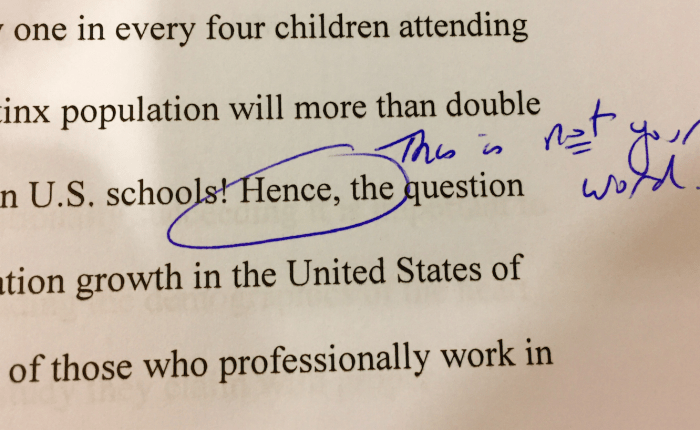
This morning, my professor handed me back a paper (a literature review) in front of my entire class and exclaimed “this is not your language.” On the top of the page they wrote in blue ink: “Please go back and indicate where you cut and paste.” The period was included. They assumed that the work I turned in was not my own. My professor did not ask me if it was my language, instead they immediately blamed me in front of peers. On the second page the professor circled the word “hence” and wrote in between the typed lines “This is not your word.” The word “not” was underlined. Twice. My professor assumed someone like me would never use language like that. As I stood in the front of the class while a professor challenged my intelligence I could just imagine them reading my paper in their home thinking could someone like her write something like this?
In this interaction, my undergraduate career was both challenged and critiqued. It is worth repeating how my professor assumed I could not use the word “hence,” a simple transitory word that connected two relating statements. The professor assumed I could not produce quality research. The professor read a few pages that reflected my comprehension of complex sociological theories and terms and invalidated it all. Their blue pen was the catalyst that opened an ocean of self-doubt that I worked so hard to destroy. In front of my peers, I was criticized by a person who had the academic position I aimed to acquire. I am hurting because my professor assumed that the only way I could produce content as good as this was to “cut and paste.” I am hurting because for a brief moment I believed them.
Instead of working on my English paper that is due tomorrow, I felt it crucial to reflect on the pain that I am sick of swallowing. My work is a reflection of my growth in a society that sees me as the other. For too long I have others assume I am weak, unintelligent, and incapable of my own success. Another element of this invalidation is that as I sit here with teary eyes describing the distress I am too familiar with, the professor has probably forgotten all about it. My heartache can not be universally understood and until it is, I have to continue to fight. At this moment, there are students who will never understand the desolation that follows an underlined “not.” There are students who will be assumed capable without the need to list their credentials in the beginning of a reflective piece. How many degrees do I need for someone to believe I am an academic?
At this moment, I am in the process of advocating for myself to prove the merit of my content to people who will never understand what it is like to be someone like me. Some of you won’t understand how every word that I use to describe this moment was diligently selected in a way that would properly reflect my intellect. I understand that no matter how hard I try or how well I write, these biases will continue to exist around me. I understand that my need to fight against these social norms is necessary.
In reality, I am tired and I am exhausted. On one hand, this experience solidifies my desire to keep going and earn a PhD but on the other it is a confirmation of how I always knew others saw me. I am so emotional about this paper because in the phrase “this is not your word,” I look down at a blue inked reflection of how I see myself when I am most suspicious of my own success. The grade on my paper was not a letter, but two words: “needs work.” And it’s true. I am going to graduate in May and enter a grad program that will probably not have many people who look like me. The entire field of academia is broken and erases the narratives of people like me. We all have work to do to fix the lack of diversity and understanding among marginalized communities. We all have work to do.
Academia needs work.
 TIFFANY MARTÍNEZ
I graduated high school with honors, and I took AP English but did not take the AP exam. When I took my ACT, I was sick and very exhausted from being sick and I did not do well in my reading portion. Mind you, I learned to read when I was three years old. As a consequence of this one test, I had to take a remediak reading class my freshman year of college. In that reading class, we were assigned Dr. Jekyl and Mr. Hyde to read and write a paper. In my paper, I used the word “entity.” My Asian professor pulled me up out of my seat physically and told me to leave and drop the class or she was going to make sure that I failed and was expelled from school because nobody in her class would know the word entity. People are just ignorant sometimes, and I don’t think that it necessarily has anything to do with your race. Keep up the good work !
LikeLiked by 1 person
For those who requested Tiffany’s peer-reviewed published paper (in case you have not found it yet) see the following link: http://www.pellinstitute.org/downloads/opportunity_matters-Articles_Martinez.pdf
LikeLiked by 1 person
Tiffany ,you are an awesome young woman and don’t let the bastards grind you down.
LikeLiked by 1 person
It is fair (the criticism; if it reflects the professor’s unchanging and not-discriminating thought process).
“Hence..” as written here; either: does or does-not reflect plagiarism if: “its use is not representative of a leap of vocabulary growth by its author.”
But only the author must attest to that; have they?
The complaint, the assertions about the de-facto context as being: of the nature of the “accuser” and their perceived beliefs; and about their own certainty of the correctness of their accusations… but then, still without the assertion that would foundationalism a) the truth of their accusations b) the truth of their correctness c)proof that the word they used was proof of their growth in that process.
…something OTHER than growth by the author; and those who reacted with the author by this public complaint…
Cognitive malignancy.
LikeLiked by 1 person
You don’t have to start so many sentences with ‘I’ you fucking narcissist.
LikeLiked by 1 person
If you weren’t so stupid, you’d realize she’s writing a blog about an experience that she had and hence it would be impossible to write it without using the pronoun “I”. That doesn’t make her a narcissist. You fucking idiot.
LikeLiked by 1 person
“Not your word”. What bull crap. Strictly speaking words don’t belong to any of us. I don’t remember when I learnt the word “hence”, probably from some book in the course of my life. Are we expected to know the reference of every word we know now?
I’m sorry that professor was a total arse hat.
LikeLiked by 1 person
When I heard about this story, I first saw the underlined “hence” and the written professors comment, and interpreted this as “The word you want here is not ‘hence’ (implied : ‘use “therferore” instead’)”.
I always thought that “hence” should not be used followed by a comma. I’m not a native English speaker though.
But if there is indeed a usage error with “hence”, why would the professor imagine it is copy-pasted from elsewhere?
LikeLiked by 1 person
Not many academic teachers commenting in here, so: I’ve taught at Harvard for years (graduate student), and anyone suggesting that the prof’s comments are appropriate is speaking out of ignorance or malice.
LikeLiked by 2 people
I don’t necessarily think the way the comments were expressed to Tiffany would be appropriate. I also understand that because Tiffany is Hispanic she would likely be upset by any criticism similar to “this is not your language” written on a paper. But that does not mean the professor is unconsciously or consciously being racist.
I received similar or exact replicas of the statement Tiffany received when I was in high school and made a mistake in a citation or a quotation. I also know that as a college student making a similar mistake would result in me being that “that’s not my language.” Meaning THOSE AREN’T YOUR ORIGINAL WORDS. Not, “you’re Hispanic don’t use English.” Hell, in college you can get in punishments for plagiarizing. And this is clearly a case of plagiarism since Tiffany says “Please go back and indicate where you cut and paste.” Why else would the professor write that?
LikeLike
I understand your wanting to be fair minded, and not jump too quickly to conclusions against the professor, using your own experience of being criticized as your guide. I applaud that aspect of your position, but ask that we look deeper.
Let’s start by noting that the internet has made plagiarism so common that it’s a real problem, and has become a burden for teachers to detect; sometimes they may be initially tipped off byapparant anomalies. But that can also be a false alarm, so there is real responsibility to go on more than just hunches; especially any hunches that come from stereotypes.
We have not seen the essay in question, so it’s hard to be certain whether or not there would be reasonable grounds for suspicion of plagiarism. So it seems that you may instead be jumping too quickly to the conclusion that “if the professor suggested that the student should indicate where they cut and pasted, that must mean it’s a clear case of plagiarism”. Why would you assume that?
From the (admittedly limited) evidence, it seems rather more likely that the professor’s only indication of possible plagiarism is the level of English language facility evident in the paper, including using “hence” (which is a word likely to be familiar to many aspiring academicians). Nothing has been presented to indicate that, say, the professor found sentences or fragments matching the work of other authors – if the professor had, they would likely not have asked for cut and paste indications, but demonstrated them.
So, a professor suspected plagiarism due to the level of competent language usage, but probably had no other evidence. Is it appropriate in that case to make hard accusations, publicly in class, without first at least privately discussing the matter with the student? A public accusation of plagiarism is not a trivial matter in academia; it’s not something a responsible person would do without some pretty solid evidence. If the professor had checked with her, most likely they could have gotten a better sense that the demonstrated language proficiency in the essay was no anomaly.
We don’t have all the facts, so this is not the place to form official conclusions either way, but it sure looks as if the professor most likely jumped to assume plagiarism based on stereotypes in this case.
We can hope that any internal investigation involves a far more thorough look at evidence, but I think you need to question why you felt justified in assuming that there plagiarism was “clearly involved”, since what we have seen so far makes a very weak case for it.
LikeLike
Douche….
LikeLike
Oh my goodness…the poor little princess got her feelings hurt by the mean ol’ professor then felt the need to share her experience in order to garner sympathy? Aside from being extremely narcissistic, it doesn’t surprise me one bit that such an avenue would be utilized by one of today’s millennials. I seem to recall the first rule many of my professor established was that papers were to be written in the manner which was my normal communication. My understanding is this criteria hasn’t changed, as I have two children who are currently attending college.
Well Tiffany…here’s something that I doubt you thought about when you decided to air such a rant online for the entire world to see: everyone can see you whining, including prospective employers…and it’s here forever. What does your rant tell a prospective employer? Well it identifies two important things: 1) that you’re incapable of accepting criticism, and 2) that you’re a walking EEO issue just waiting for an opportunity to file on something…anything. If you think that prospective employers these days don’t check social media in order to identify such traits then you have a rude awakening.
Welcome to the real world, princess. Good luck.
LikeLike
This comes across as a mean spirited response, Corey, not a reasoned criticism. I can perhaps understand why you might be fed up, tho – there really do exist some outrageous examples of playing the victim. But we have to look at each case individually, trying to be fair to all parties.
This blog post does not indicate any inability to take reasonable criticism. Assuming that a college student must be plagiarizing based on using words like “hence” is not reasonable criticism. That could be a legitimate complaint (and I do not find all complaints hold merit).
(I will admit that there’s a certain case-making tone that can have an off-putting edge – but that’s kind of typical of blogs, and I was probably worse when I was young so I cut slack for that. And yes, sigh, I may get accused of microagression for saying that; So it goes. My course it to try to look at things a fairly as I can, and that means absorbing some incoming flak from some on all sides at times. I have no interest in being politically correct; I do have an interest in being compassionate and objective).
On the other front (publicly demonstrating a proclivity to challenge perceive bias), you may have a point. An employer might indeed take that into consideration in hiring – even if not justified. So it takes courage to stand up and take that risk. (And Tiffany is likely to have considered this risk, you do not need to remind her).
LikeLike
Mr. Portis,
Congratulations on having two children attend college. That speaks volumes of you. However, I don’t know if, as a white man in America, you could walk a mile in a hispanic woman’s shoes and understand the reason why she was offended by the comments her professor made in her paper. Although I am not going to assume that I can read the professors mind when he made his statements and call him a racist, I can only tell you from personal experience that there are many people out there that will do anything it takes to bring down a person who is trying their best to succeed in America. Personally, I would never share my story on the internet. With that said, I would call for an investigation on the professor, and if he put similar notes on white and african american students’ papers, I would apologize to the professor immediately. One last thing, she is going to get her PHD and teach at a university. Her future employers will not worry about some blog she wrote while in college. Period.
LikeLike
my apologies for leaving that long comment, which was intended to the ihe coverage on the web and not your site. since it does not belong here you should feel free to delete it–in fact i would prefer it if you did since the posting here was in error.
LikeLiked by 1 person
I am amazed at the assumptions everybody is making here. Let’s take it from the top.
First, we are hearing only one version of events. The professor may have a different interpretation, or even a wholly different set of facts, and to draw large conclusions on the basis of the author’s account alone is–well, let’s just say it lacks a certain fundamental fairness. IHE–please note!
Combine that with the fact that the account comes from a blog entry that the author never thought would be circulated or read widely. That does not mean it is an unreliable account. But how a person chooses to characterize an encounter in what amounts to a semi-private setting can often be quite different from the way the account is related when it is clear there is an audience of readers, administrators, peers or lawyers.
We are now faced with a situation in which, if the blog post pushed boundaries in the name of rhetorical power, the author would be compelled to stand by every jot and tittle of her account since it has now gone viral. To then admit to a tad too much rhetoric would come across as a lack of honesty–undercutting the main point of the account.
Needless to say, we are also now faced with the fact that the instructor chooses not to, or simply is not permitted to, describe the encounter in his/her own words.
Conclusion as to sourcing: a very unsturdy edifice. But when has that stopped the Boston Globe or Inside Higher Education?
Now let’s look at the actual encounter. Most of the ink in the coverage of the issue has been spilled on the question of the instructor’s note relative to the word “hence”. Yet that was not part of the actual classroom encounter. The student writes that when she went to the front of the class her attention was drawn first to the note “please go back and indicate where you cut and paste.” It is apparently in connection with this note that the instructor says (or ‘exclaims’, to use a slightly more charged term) “this is not your language.”
This is the sum and substance of the actual interchange.
What is happening here?
Well, Rashomon being a universal thing we can’t know all that well in the absence of other voices, especially that of the professor. But here is one interpretation: the professor believed that the student used the language of others but did not properly attribute it, possibly not putting it in quotes. Now, there are a lot of ways such things can happen. Sometimes the context for a lack of attribution can lead a close reader to conclude it was a mostly innocent mistake. In that case the instructor might be simply drawing the student’s attention to the relatively minor error both in the note and in the comment in front of class. If so, the instructor’s statement might be less a matter of intentional humiliation than a reasonable desire to point out a problem so that the student understood it–“hey, next time make sure you get the quotes right.”
Again, we don’t know if that is the right interpretation. But we see no evidence that the professor used the word “plagiarism” in the written notes, or orally in front of the class. We see no evidence and hear nothing in the account of a bad grade. So this interpretation seems to me pretty credible.
In this context it may or may not be revealing that the author of the piece does not herself mention the cut and paste problem at all. Here’s a question: did she in fact cut and paste the words of others and not properly attribute them? If not, why not include the passage in question so that the instructor can be seen to have been not only boorish but also in error?
But she neither includes the passage nor even discusses it. So this suggests another reading: that the author may have opted not to include the text in question or to discuss the matter at all because in fact the instructor was correct–i.e, the student did in fact cut and paste, and did not attribute properly. If that is the case we have plagiarism–perhaps minor, ministerial plagiarism, the kind that is handled with, say, a written note and a verbal comment rather than a failing grade! But plagiarism nonetheless.
That’s one possible example of what Sherlock Holmes called the dog that didn’t bark. There’s another instance of that too, dealing with the identity of the instructor. I know that the racism argument here does not completely hinge on whether the instructor is white. I recognize arguments can be made that the student’s skills might be questioned just as egregiously and unfairly by, say, a Latino or Black female professor, this on the grounds of having internalized the master’s discourse. But if the instructor were, say, a white male, does it not seem reasonable–indeed somewhat likely–that the student would have referenced this in the original blog post? The post itself dealt foursquare with the complicated mix or perception and race–why not just go ahead and mention the racial and gender characteristics of the instructor? I daresay many of the commenters to this article assume the instructor is white. Could be–but we do not know.
Now we come to the gnarliest part of the matter: the note relative to the word “hence”. The instructor wrote “this is not your word.” What is going on with that note? It could well be that the instructor intended it to support a charge of plagiarism. Note, however, that the student’s account makes no mention that the instructor made any such charge directly. All we know is what we see and hear: the two notes in the paper as described and the statement “this is not your language” referring to the cut and paste.
Let’s assume for a moment that the instructor intends this note to support a charge of plagiarism. Maybe, but it would be an odd way to level such a charge–on the basis of one word. One word can never really be enough to justify a charge of plagiarism since plagiarism can only be defined via groupings and clusters of words. So is the instructor really saying “hence” is plagiarized?
No, if she is saying something along these lines she must be saying something else.
She could be saying “I don’t think you would use this word so I suspect the passage is plagiarized.” But in that case would there not have been some apparent effort to determine whether the words surrounding the word “hence” justified a charge of actual plagiarism?
She could be saying something else, too. She could be saying ‘this is not your voice. It’s not a word you would use. It doesn’t sound authentic.” It could well be that the instructor thought the word a bit too high-falutin’ and, well, white. Could be. I don’t know. But neither does the reader, really. Recall the evidence we have. Where in there do we see anything clear about the professor charging plagiarism on the basis of the word “hence”? We must interpret that, just as we have had to interpret the racial dimension.
Now, I recognize a lot of the commenters are perfectly happy to do that. And, since interpretation is an art I respect those who see things in there that I may not.
I am a little less comfortable with the IHE treatment of the story. We only have gotten one side on this from the start, and the account itself hardly presents and open and shut case. But here we are, with another university in effect copping a plea and adding new programs and requirements, mostly on the basis of coverage that fails to employ reasonable journalistic balance.
Hence, my conclusion.
LikeLiked by 1 person
I feel bad that your post, the only well-reasoned one that I’ve read so far on this blog, will likely be ignored by everyone. You either have extremely ideological posters that rigidly stick the idea that any potential racial injustice is likely true or delusional alt-right loons obsessed with “liberal cry-babies.”
As far as Tiffany’s blog post is concerned I believe that the professor was simply saying she was plagiarizing. I’ve had similarly worded criticisms in high school when I first started writing papers, and I’ve seen students in college being reprimanded for plagiarizing.
LikeLike
On the whole, very well said.
It influences my understanding of the situation. Not radically, because I had made no firm conclusions. But your reasoning causes me to hesitate even more to form any conclusion, on the basis of so little evidence.
I do appreciate the thoughtful way you began, recognizing and cutting some sympathetic slack, if indeed it were to come out that facts are not exactly as described by the author, and the inappropriately harsh light that might be seen in. Of course, we also don’t have any real evidence that it didn’t happen exactly as she describes.
I appreciate your pointing out possible alternative scenarios, but I think I would have been more comfortable if you had spent more time also entertaining and examining the substantial possibility that Tiffany was essentially (if not perfectly) accurate, and the implications of that.
LikeLike
TL; DR
LikeLike
Would be nice to see the whole paper so we can judge for ourselves compared to your writing here…
LikeLike
A good point. Perhaps Tiffany will post it.
LikeLike
Keep on keeping on, Tiffany. Academia needs you, but I hope you move beyond it once you get your credentials. There’s no reason on earth why a professor should need to do that publicly to you in front of your peers. And questioning your use of hence? Strange. Anyone who reads enough is likely to use that word. I’m sorry all the trolls showed up
LikeLike
My name is Tiffany Martínez. As a McNair Fellow and student scholar, I’ve presented at national conferences in San Francisco, San Diego, and Miami (I have instead of I’ve. Which conferences? Show, don’t tell). I have crafted a critical reflection piece that was published in a peer-reviewed journal managed by the Pell Institute for the Study of Higher Education and Council for Opportunity in Education (The Pell Institute published my critical reflection piece on [subject]. Avoid passive voice). I have consistently juggled at least two jobs and maintained the status of a full-time student and Dean’s list recipient since my first year at Suffolk University. I have (Is it really necessary to start every sentence with I have, you narcissistic cunt?) used this past summer to supervise a teen girls empower program and craft a thirty page intensive research project funded by the federal government (Glad to see our tax dollars going to such worthy causes). As a first generation college student, first generation U.S. citizen, and aspiring professor (I have no doubt you’ll be one. You meet the criteria) I have (Again, cut it the fuck out with the I haves) confronted a number of obstacles in order to earn every accomplishment and award I have accumulated (List these. At this point you’re a liar until you provide evidence). In the face of struggle, I have persevered and continuously produced content that is of high caliber (“High caliber content.” “That is of” are three unnecessary fluff words).
I name these accomplishments because I understand the vitality of credentials in a society where people like me are not set up to succeed. My last name and appearance immediately instills a set of biases before I have the chance to open my mouth. These stereotypes and generalizations forced on marginalized communities are at times debilitating and painful (Probably more painful than the violence and diseases coursing through the Latin American countries from which you hail). As a minority in my classrooms, I continuously hear my peers and professors use language that both covertly and overtly oppresses the communities I belong to (Provide examples, or else people might start to think you’re an oversensitive twat). Therefore, I do not always feel safe when I attempt to advocate for my people in these spaces (Not enough safe spaces? Transfer to Missouri). In the journey to become a successful student, I swallow the “momentary” pain from these interactions and set my emotions aside so I can function productively as a student.
Today is different. At eight o’clock this morning, I felt both disrespected and invalidated. For years I have spent ample time dissecting the internalized racism that causes me to doubt myself, my abilities, and my aspirations (By internalized, do you mean the way you see yourself? That’s how this reads, but you’re a great writer. Continue on). As a student in an institution extremely populated with high-income white counterparts (Ok. I’m starting to see the problem here), I have felt the bitter taste of not belonging. It took until I used my cloud of doubt and my sociological training to realize that my insecurities are rooted in the systems I navigate every day (I know you’re a Sociology student, but there is a Psychological term for this. It’s called projection). I am just as capable if not more so than those around me and my accomplishments are earned.
This morning, my professor handed me back a paper (a literature review) in front of my entire class and exclaimed “this is not your language.” On the top of the page they (Use the correct singular pronoun. If you’re trying to avoid cis-gendered, patriarchal “he/she” pronouns, just say “the professor.” Don’t use plural pronouns to refer to one person. You would know that if you fucking listened in English class.) wrote in blue ink: “Please go back and indicate where you cut and paste.” The period was included (That’s how one ends a sentence. Or did you start bleeding? I’m confused). They (Stop it) assumed that the work I turned in was not my own. My professor (There you go) did not ask me if it was my language, instead they (Nevermind…) immediately blamed me in front of peers. On the second page the professor circled the word “hence” and wrote in between the typed lines “This is not your word.” The word “not” was underlined. Twice. My professor assumed someone like me would never use language like that (If I were a betting man, and I am, I would guess that you had used the word “Hence” at least 5-10 times prior to that sentence. Your professor was probably sick of it. Kind of like how I’m sick of you using “They” to refer to one person). As I stood in the front of the class while a professor challenged my intelligence I could just imagine them (For fuck’s sake!!!) reading my paper in their (God fucking damn it!!!!) home thinking could someone like her write something like this?
In this interaction, my undergraduate career was both challenged and critiqued (Undergraduate career Hahaha!!!). It is worth repeating how my professor assumed I could not use the word “hence,” a simple transitory word that connected two relating statements (Hence and Therefore are two of the most commonly overused words when students are purposefully trying to add fluff to their papers. You’re not fooling anyone). The professor assumed I could not produce quality research (She didn’t assume. You failed to provide quality research or correctly cite your sources). The professor read a few pages that reflected my comprehension of complex sociological theories and terms and invalidated it all (Hahahahaha! I can’t. “Complex sociological theories” LOL). Their (Kill yourself) blue pen was the catalyst that opened an ocean of self-doubt that I worked so hard to destroy (Key word being “self-doubt”). In front of my peers, I was criticized (Passive voice) by a person who had the academic position I aimed to acquire. I am hurting because my professor assumed that the only way I could produce content as good as this was to “cut and paste.” I am hurting because for a brief moment I believed them (Missing commas).
Instead of working on my English paper that is due tomorrow, I felt it crucial to reflect on the pain that I am sick of swallowing (Do professors offer extensions for hurt feelings these days?). My work is a reflection of my growth in a society that sees me as the other. For too long I have others assume I am weak, unintelligent, and incapable of my own success (You have others assume that? Like you’re telling them to assume that? Projection is a bitch, isn’t it?). Another element of this invalidation is that as I sit here with teary eyes describing the distress I am too familiar with, the professor has probably forgotten all about it (Reword this wordy fucking sentence. Jesus). My heartache can not be universally understood and until it is, I have to continue to fight. At this moment, there are students who will never understand the desolation that follows an underlined “not.” (Oh my, the desolation of an underlined not. There cannot possibly be anything worse in this cruel, cruel world) There are students who will be assumed capable without the need to list their credentials in the beginning of a reflective piece. How many degrees do I need for someone to believe I am an academic? (How many you willing to purchase via aggressive loans you’ll never pay back?)
At this moment, I am in the process of advocating for myself to prove the merit of my content to people who will never understand what it is like to be someone like me. Some of you won’t understand how every word that I use to describe this moment was diligently selected in a way that would properly reflect my intellect (You used a whole bunch of words. Editing would be nice). I understand that no matter how hard I try or how well I write (Hint: you don’t write well), these biases will continue to exist around me. I understand that my need to fight against these social norms is necessary.
In reality, I am tired and I am exhausted (Just say, “I am exhausted.” Fewer words, drives home the point. But yeah, being a college student is rough) On one hand, this experience solidifies my desire to keep going and earn a PhD but on the other it is a confirmation of how I always knew others saw me (Projection, projection, projection. And a run-on sentence. If you were a white male and wrote like this, you’d never get your PhD. Kudos for racking up both minority and vagina points). I am so emotional about this paper because in the phrase “this is not your word,” I look down at a blue inked reflection of how I see myself when I am most suspicious of my own success (Yes, this all has to do with how you see yourself and how you have managed to project those negative feelings onto others to avoid any blame). The grade on my paper was not a letter, but two words: “needs work.” (Because it fucking sucked. Post the paper online already instead of two little snippets) And it’s true. I am going to graduate in May and enter a grad program that will probably not have many people who look like me. The entire field of academia is broken and erases the narratives of people like me (Reword: “has bent over backwards and done everything in its power, including destroying its credibility, to cater to people like me). We all have work to do to fix the lack of diversity and understanding among marginalized communities (Diversity in marginalized communities? So you’re saying we need to marginalize people of all races?). We all have work to do.
Academia needs work (Yes it does. It needs to be purged of jackasses like you, as well as your enablers).
So what did Suffolk University do once she filed her grievance? Come on, we all know the answer. The university had the professor’s back and told the snowflake to sit the fuck down, right?
LikeLike
How does one have the audacity to pretend to give academic feedback on a *personal* blog while using words such as cunt and twat?
Go fuck yourself. Feel free to correct that statement for asshat.
LikeLiked by 1 person
That is simply using accurate language correctly, which you are unable to understand due to your poor communication skills and overall low intelligence. Other applicable words for both the author and yourself are: “social parasite,” “professional victim,” and “scared little pussyclot bitch.”
LikeLike
I feel there has never been a more appropriate time for this. Please, please, tell me your name is Walter.
LikeLike
McNair scholar right here. Just keep exceeding people’s expectations!!
LikeLike
I read this, and have to say, the teacher’s notes are things I have written on papers that I have critiqued. It has nothing to do with a person’s race. It does have everything to do with the person’s normal speech patterns, words, and phrases that I have witnessed them say. It may just be, that the teacher was pointing out that the student was using a word or speech pattern they do not usually use when speeking to peers. The student could be copying from someone else, or getting someone to help them on a thought paper; thought papers should never get assistance from others; it is, after all, the students own thoughts, and not the thoughts of others that the teacher is looking for. Also, if the paper is being turned in as a “Rough draft,” a grade would not likely be given, as the teacher may be just checking progress. I think this is much to do about nothing.
LikeLike
So, basically, you’re kind of a condescending jerk with a god complex when you grade your own students’ work.
So much to do (sic) about nothing when other teachers act the same way.
LikeLiked by 1 person
Wow Cat, you sure are a pathetic little wuss who bristles at anyone who doesn’t make it their life’s mission to coddle people and make sure they feel validated at every turn. I bet you cherish your participation trophies…
LikeLike
Most teachers and professors I had through high school and college using your logic would have been condescending jerks. When you write a paper your teacher will tell you to use your own words. The teacher will also tell you to properly cite your sources. That professor isn’t implying that you need to use your (Spanish) language, the professor is saying to make sure all the sentences you use are original to you unless you cite them. Any professor would write something similar to what Tiffany received if you were to incorrectly quote or cite something. Clearly she is not a truly great academic (yet) if she doesn’t understand this basic concept.
Now I will admit that the professor speaking to her in front of the entire class about her mistakes is assholish behavior but it is not racist. If Tiffany was offended she should have went up to the professor and simply explained what upset her. I could see how someone who was Hispanic being told something “is not your language” could be perceived as racist but that does not mean it is objectively true.
LikeLike
Please go back and indicate where you cut and paste. This is not your word. This is not your language. –Three demeaning comments. Obviously the professor, who couldn’t take the time to actually confer with her, assumed she isn’t capable of formal writing. Positing that it must be rooted in a speech pattern that the student doesn’t usually use assumes that the student doesn’t know the difference between formal and informal writing *at the college level*!!! My colleagues and I start teaching formal writing/academic speak with our 7th graders!!! And “was just pointing out” is different than grossly underestimating, stereotyping, and demeaning a student, three things someone in education should NEVER do. Constructive criticism is one thing; and this was not. If it was a rough draft checking progress with the intent of…checking progress…then I’d hope any writing teacher earning a paycheck would actually be helpful, not an assumptive asshole. If you’re not in education for your students–to mentor and guide, to help look at the world in different ways–then consider a career change. Students need teachers who will help them better themselves, period.
LikeLiked by 1 person
How are “Please go back and indicate where you cut and paste. This is not your word. This is not your language” demeaning comments? There are basic criticisms most high school and college students probably receive after they improperly quoted or cited something in an academic paper. I received exactly these types of comments in high school when I first was writing papers where I used quotes and cited sources. In college I haven’t made these mistakes yet, but other students I know have received exact comments like Tiffany when they incorrectly cited or quoted sources.
How do you somehow know that the professor assumed she is incapable of formal writing? Just because of some criticisms in a paper? Essentially every college student would be incapable of formal writing because of a few mistakes. Are you really that thick in the head?
The professor probably shouldn’t have confronted her about the mistakes in front of the class, and I could see how the statement “this is not your language” is demeaning to someone who is Hispanic. None of that means that the professor stereotyped or demeaned Tiffany. And it sure as shit doesn’t mean the professor is racist.
LikeLike
Obviously, she is not your peer; you are a cut below. I’m sure she knows how to spell “speak”!
LikeLike
Seriously? You suspect plagiarism just because someone expresses themselves differently in formal writing from how you have heard them do colloquially? This is equivalent to claiming that each person can only have one linguistic register at their disposal, to be used in all situations regardless. To rebut this by way of a counter-example, I will now juxtapose two self-evidently different registers, you daft bugger.
LikeLike
Thanks for an alternative interpretation; I mean that, it helps me understand what might be going on so I can avoid assuming that “there’s no possible explanation but bias”.
However, you seem to be entirely giving credence to the instructor. I accept that your scenario *might* be what happened, but Tiffany’s account might also be accurate. That is, you haven’t really made the case that for discounting the possibility of stereotyping.
So I think a more fair final sentence could be more like: “I think this could be based on a misinterpretation of.the fuller context, tho we don;t have enough information to really tell.”.
By the way, is “much to do about nothing” an actual current usage? It sounds like it could be a misquote of the long established phrase “much ado about nothing” popularized by The Bard.
LikeLike
How does she know it was racism? Probably because she has faced racism her entire life.
LikeLike
One thing that stands out in my mind is the utter arrogance displayed by this professor by saying “this is not your word”. WTF does he think he is (or she) to judge who can, may, or would use a certain word?
LikeLiked by 1 person
If you actually had a mind of your own, rather than being a mindless parrot of liberal brainwashing, what would stand out in your mind is the utter arrogance of those who say ‘this happened, I am a minority, therefore this happened because I am a minority’. Tiffany Martinez of Suffolk University and the liberal Victim-Industrial complex insist this is racism. Since she has not posted the whole paper, we have NO WAY of knowing if she plagiarized or not. Furthermore, even if she did not plagiarize, it is still breathtakingly arrogant and plain stupid to assert that she is the victim of discrimination. Maybe the professor just made a mistake. Maybe the professor had a bad day. Maybe it’s a bad professor, a not uncommon occurrence with tenure. Ooh, maybe it’s sexism! And, most probably, maybe the exact same thing would have happened if a white male student turned in a badly written paper that flowed so poorly it seemed to be copied and pasted together and that used a word that this writer had never shown a familiarity with before.
LikeLike
Haha! Oh, the irony. You’re a walking cliché of the angry, knee-jerk right-wing reactionary who barks at anyone who doesn’t fall in line with your way of “thinking” as a brainwashed liberal. You don’t think, you don’t analyze, you don’t make an effort to see a different perspective. You just mindlessly react in a very predictable way, as every post that you have made here proves. Just like a mad dog being poked with a stick. It’s so easy to get you lot triggered. LOL
LikeLiked by 1 person
Here is a passage from “A Tale of Two Cities.”
““It was the best of times, it was the worst of times, it was the age of wisdom, it was the age of foolishness, it was the epoch of belief, it was the epoch of incredulity, it was the season of light, it was the season of darkness, it was the spring of hope, it was the winter of despair.”
If I were to use words from this passage without quotes, I AM NOT USING MY OWN WORDS. For example.
Dickens says it was the best of times, it was the worst of times, I disagree. THERE IS AN OBVIOUS MISTAKE IN THIS SENTENCE.
Here is passage from an academic paper on the novel.
“Certainly, A Tale of Two Cities had Dickens’s affection: “I hope,” he wrote enthusiastically to a French actor-friend on the 15th of October, 1859, “it is the best story I have written.” Because of its vigorous story, energetic manner of telling, and engaging plot, A Tale of Two Cities must count as one of his best books, despite its melodramatic and rhetorical excesses.”
If I were to use ideas from this paper without citing my sources or if I used statements from it without quotations I WOULD BE MAKING AN ERROR. I WOULD NOT BE USING MY. OWN. LANGUAGE. For example.
“A Tale of Two Cities” has a vigorous story and energetic manner of telling. I AM PLAGIARIZING.
Mos likely I would be met with a criticism similar or exactly like what Tiffany received. Are people on this site so fucking stupid that they don’t understand this?
LikeLike
“Hence” _This is not your word_ … Not a whole passage from Dickens. Just one word, singled out. One fairly common word. That’s it. As single word, a CONJUNCTION at that. It doesn’t need to be put in quotations and cited…
I would give the benefit of the doubt to the professor had he left it at simple “please cite your sources” without singling out one word and claiming that the student is not capable of coming up with or using that one word. Are YOU too fucking stupid to understand that?
LikeLike
*a conjunctive adverb, to be more precise.
LikeLike
Nathan,
I think most people understand plagiarism.
However, I am confused as to why you would use other types of errors to demonstrate your argument. Your first example is one of missing punctuation and not of plagiarism. Missing citations and/or quotation marks are not of themselves plagiarism. There must be an intent to pass off someone else’s thinking or writing as your own. Your final example demonstrates this very well in both senses.
However, picking on a single word in common usage e.g. “hence” and arguing this demonstrates the author copied it or stole the idea from someone else without identifying from where it was purloined stretches credibility. The professor may well think their student a plagiarist but their comment on the word ‘hence’ must relate to some altogether different concern.
LikeLike
Hi, Andres. I can see your interpretation – that the professor was telling Tiffany she was not allowed to use the word “hence”. That doesn’t seem very likely, tho; there was no assertion in the blog post to that effect.
Seems more likely that the prof was indicating that the word was inappropriate (not the student’s authentic voice) or suspicious (not a work the prof thought Tiffany would have used in that context). It might or might not have been the main reason that the prof suspected Tiffany of either failing to use appropriate quotes, or of plagiarism.
The main case Tiffany is making, is that she believes the professor suspected her of plagiarism based on the competence of her writing, and that the prof found that suspicious due to stereotypes about Latina women. She might be right in that interpretation, certainly we know such things happen all too often. But we don’t have the full context to make a certain judgement in this particular case.
While most of the posts here are just people spouting their biases (in either way), there are some thoughtful ones that lend depth, and raise other plausible interpretations. I had a stronger opinion of “what really happened” when I began reading, than I do now after reading those comments. None of them convinced me that there some other interpretation was the correct one; only that I don’t have enough information or context to judge what was going on in the instructor’s mind, from just this blog post.
It would be helpful if Tiffany would post the entire essay, tho we still would not know the full transcript of the professor’s words.
LikeLike
I find it hard to believe that a college professor would make corrections on your paper in front of your peers, let alone ridicule you in front of the class. I see several filters in this story. By the way, I lived half my life in Argentina and Perú. I’m pursuing a PhD in Europe at this time.
I see the word “Latinx” in Latinx population (I understand ‘Latinx’ is some Millenial code for Latino/Latina, a made-up gender-blind word to refer to Latinos). We don’t have all the facts, and we have no access to the entire paper that was critiqued.
And why do some commenters assume that your professor was white and Anglosaxon? Why the off-topic comments about discrimination and racism? Why assume that the criticism of your paper is due to some veiled hostility to the color of your skin (I’m assuming that you may not be white but I may be wrong, your piece here doesn’t say), the accent of your English or to some other trait that makes you feel victimized?
In fact, why feel victimized, the object of a (micro)aggression? I have taught at universities, and for a professor it is very easy to see if a student had plagiarized or not on a paper. I see no reason why a professor would ridicule you publicly and call a portion of your paper a copy and paste job if he/she hadn’t had the chance to do a search.
So, forgive me for not jumping forward to support you. Like I said, this posting of yours has been filtered on many levels to the point that I can’t see what actually happened and give an objective opinion.
LikeLike
I have seen and heard college professors criticise students’ papers publicly, including accusations that language was not original due to student’s assumed first language. The course this was experienceduring in was World Little. The professor cautioned the class, especially those who were white, to look at the world through a filter not thier own. She told us, “don’t be ethocentric.”
She handed back papers and told me, “you need to take remedial grammar.”
She told two non-white students, “you need to take grammar for esl students.”
All three of us were native English speakers with the same type of grammatical errors. She wrote on their papers, “your native tongue is getting in the way of your english.”
I do not doubt the experience related here.
LikeLike
My point, that I find a college professor disparage a student paper in public on in front of her class difficult to believe, still stands, simply because I haven’t witnessed it. But is it a matter of experiencing or not experiencing it what it’s in play here?
I don’t dispute the wrongness of berating or disparaging a student in public. However, there are several interpretations to the statements you quote (about remedial grammar and grammar for ESL students). At least, consider looking at one of the interpretations I’m offering here.
First, would remedial grammar or grammar for ESL students be the institutional step or solution to address the grammatical errors found? If the answer is yes, then there is no aggression, discrimination or any deliberate intent to ridicule or berate. You and I may disagree with the blunt recommendation (you need to take remedial grammar) but the institution, based on experience, had decided that it’s the appropriate solution to the problem with certain level of grammar mistakes. I see no reason to take it personally.
LikeLike
Five minutes ago I might have agreed with you.
Would someone who teaches in universities really act that presumptuous and disparaging and engage in public ridicule?
But then I read your post.
Thanks for making it clear: The answer is, Yes.
LikeLike
You are a giant and you have already won. You are definitely going places! I have loved the word “hence” since I first learned it. I fell in love with english at 12 and with spanish at 30. Estoy segura que tu historia terminará con “vivieron felices y comieron perdices”. Muchos besos de Grecia!
LikeLike
My love goes for you. I have no idea how hard it must be, really, even if I also sometimes feel marginalised (in a less crucial way). I just hope you’ll just put this episode behind you (or, better still, get angry, not crushed) and go on with your studies. Nobody deserves being stereotypized like that.
LikeLike
This academic loves you and respects you. I am so proud of you for having written this blog. We discussed it in the underrepresented faculty and staff breakfast that I organized at the University of Central Florida. As a professor part of my teaching philosophy is to advocate for my students so they can have the education they deserve, one in which they are not presumed incompetent because of their race, gender, or sexual preference. From one Latina academic to another remember: You will persevere! Yo voy a ti! Continue y adelante!
LikeLiked by 1 person
If this were accurate it would read ‘from one race-hustling Victim-Industrial complex member to a future member…’. Pretty little Tiffany Martinez of Suffolk University, who should check her privilege for the benefits that accrue to her as an attractive person and for her ability to get preferential treatment and scholarships as a supposedly marginalized person, has not shown that she was a victim of discrimination. She HAS shown that she is eminently qualified to join academia, as she employs the favorite “logic” of academia – ‘This happened, I’m a minority, therefore it happened because I’m a minority’.
Since she has not posted the whole paper, we have NO WAY of knowing if she plagiarized or not. It is thus breathtaking in its arrogance and its stupidity to assert that she is a victim of discrimination. Even if she did not plagiarize, it is still breathtakingly arrogant and stupid to assert that she is the victim of discrimination. Maybe the professor just made a mistake. Maybe the professor had a bad day. Maybe it’s a bad professor, a not uncommon occurrence with tenure. Ooh, maybe it’s sexism! And, most probably, maybe the exact same thing would have happened if a white male student turned in a badly written paper that flowed so poorly it seemed to be copied and pasted together and that used a word that this writer had never shown a familiarity with before.
LikeLike
I don’t know man
I didn’t get two lines into your response here before you devolved into a whiny two year old with no external conceptualization of the world.
Funny how quickly a phrase like ‘check your privilege’ becomes the sole domain of those who aren’t aware of their own.
LikeLiked by 1 person
Robert Dobbs – You’re a pathetic parrot of liberal brainwashing. You clearly have no critical thinking skills.
LikeLike
Beautifully written and well argued. That professor is an ass.
LikeLike
Not racist at all. If you look for racism in everything you can create it or find it in your own mind.
LikeLike
El problema no es si estamos ante un hecho “racista” o no. Es evidentemente un acto “discriminatorio” y eso basta para que sea censurable e inaceptable. No podemos afirmar de forma contundente que es “racista” pero cuando un profesor blanco, nacido en los EEUU le dice a su alumno de origen latino que es un plagiario solo porque usó una palabra del “lenguaje culto”, muy probablemente está siendo guiado por un sentimiento racista. Eso es muy claro. El peor ciego es el que no quiere ver.
LikeLiked by 2 people
Raul, you can’t make that assertion with all certainty. The fact that the professor singled out the word “hence” and wrote”not your word” is suspect and indicative of prejudice. It could very well be racial bigotry. Or it could be class bigotry. Or it could be both. I mean, how could a Latina from a poor neighborhood in Brooklyn possibly know and use that word, right? Right, nothing discriminatory about that.
LikeLike
And neither you nor pretty little Tiffany Martinez, beneficiary of all the well-documented benefits that accrue to the good-looking, can’t make the assertion that she is a victim of racism with certainty, either. Yet you do and you do it loudly and you get your ignorance amplified by a biased, agenda-driven media.
Maybe the professor had a bad day. Maybe it’s a bad professor, a not uncommon occurrence with tenure. Ooh, maybe it’s sexism! And, most probably, maybe the exact same thing would have happened if a white male student turned in a badly written paper that flowed so poorly it seemed to be copied and pasted together and that used a word that this writer had never shown a familiarity with before.
LikeLike
Sorry Richie boy. But the “that’s not your word” is a dead giveaway. The obvious implication here is that Tiffany is not literate enough to have this fairly common-place word as part of her vocabulary. And this is someone who has the academic credentials to attend a university such as Suffolk and to be a McNair fellow.
LikeLike
I was following the same reasoning (albeit in terms of likelyhood). However, reading some later posts (above) from other instructors caused me to be less sure that this was the only interpretation of the related events. I certainly consider stereotyping by the instructor a very plausible interpretation; but I’m no long so sure it’s obviously the only valid interpretation.
Certainly posting the paper in full would assist us in understanding more about the situation, so we are not just projecting our own stereotypes and biases! Untll then, I will have to reserve judgement. My first tendency is to support Tiffany’s position, but a stronger imperative for me is to be fair to all parties by waiting for enough evidence before passing judgement.
LikeLike
Still just so unbelievable.
LikeLike
I know! So stunningly arrogant and stupid to assert that this is racism. Maybe the professor had a bad day. Maybe it’s a bad professor, a not uncommon occurrence with tenure. Ooh, maybe it’s sexism! And, most probably, maybe the exact same thing would have happened if a white male student turned in a badly written paper that flowed so poorly it seemed to be copied and pasted together and that used a word that this writer had never shown a familiarity with before.
LikeLiked by 1 person
We get it, Rich.
LikeLike
Hi dear, don´t worry, your selfsteem might be enterly safe. Think in this, what your teacher is telling you, is that you are such as wonderful student that she couldnot believe that were you who wrote the paper. Be positive, and if something happen in your environtment try to see the teaching in that experience, So tomorrow tell to your teacher, Thank you, so much, for making me a better person. 🙂
LikeLike
I find it amusing and a little pathetic that Americans believe the word “hence” to be archaic and fairly unknown. In fact, so much so, that a university student would be accused of plagiarism for using it.
LikeLike
First, you dumb little snot, in America the word ‘hence’ is archaic and little-used. Second, she wasn’t accused of plagiarism for using that word. She was accused of plagiarism for the whole paper, which we have deliberately not been shown, and the word ‘hence’ was cited as a tell that she had not properly cited her source. It’s two months into the term; this professor has probably read plenty of Tiffany’s work and knows how she writes.
LikeLiked by 1 person
Oh
Well this is unfortunate.
You don’t actually understand what’s being discussed here, do you?
LikeLike
Aww poor little Richie got his fee fees hurt. Sorry for correcting you, but “hence” is not an archaic word. Sure, is seldom used by the monosyllabic masses, but is far from unknown. Is often heard on TV, in documentaries or serious programmes. And it certainly is present in plenty of books that one comes across in high school and University. So just because you may not know it or use it doesn’t mean that is archaic. Nor does it mean that people outside your little circle don’t use it. Specially someone with Tiffany’s academic credentials.
LikeLike
As a former college English teacher, I have to agree with you, Rich, and you seem to be the only one who has pointed this out: that two months into the term, her professor is probably by now familiar with her writing style and word usage, and in this particular paper, some phrases and a word like “hence” stood out as being not her usual style, so it was commented on as a way of questioning whether plagiarism (albeit unintentional, as it usually is) has occurred. Tiffany says this was a literature review. Therefore, the prof is likely familiar with other critical commentary on that piece of literature, and very well may have seen those phrases used in other writers’ commentary. Tiffany says she is a dedicated researcher; it is entirely possible that she read other commentary, and unconsciously incorporated it into her own writing. This, of course, is a guess. But I don’t see this as a case of racism, more a case of a prof alert to phrasing a student doesn’t usually use in her own writing.
LikeLike
I’m so sorry this has happened to you Tiffany. I hope that you will be more fairly treated in the graduate program you are entering.
LikeLike
The horror! Pretty little Tiffany Martinez, beneficiary of all the privilege that accrues to attractive people, will need PTSD counseling for the rest of her life!
LikeLike
Whereas you’ll just play out your trauma in front of us all here…?
Or did you not realize those feelings you’re feeling are feelings?
LikeLiked by 1 person
Reblogged this on Berenice Rodríguez.
LikeLike
I feel like u blow this way up and should have talk to the professor be for calling him racist. If I used the would hence to a sentence my professor would of done the same thing so how is it racist
LikeLike
LikeLike
Bry, seeing the way you write, I’m wouldn’t be surprised if your professor would’ve question you and the use of hence. “would of”? Really!?
LikeLike
Of course A professor would question “your” words .. go back and read your own words .. ” you blew” ” have spoken to” “before’ ” the word” ” in a sentence( comma)” ” would have done” … etc.. It’s very clear to me that you would never use the word hence .. hence the reason you’d be questioned in the first place .. for ignorance is bliss ..
LikeLike
This response was to a comment made ,not to tiffinay as it appears to me here
LikeLike
Bry, With all due respect, based on the way you write, the teacher should be suspect if you use the word “hence”. In this case, it might not be based upon your race, but your ability.
LikeLike
And then they should engage the appropriate policies, not stand a person in front of the class in an attempt to shame them before any actual investigation has occurred.
Teaching isn’t about arbitrary applications of authority, even in the humanities.
LikeLiked by 1 person
It seems to me that given how seriously plagiarism is taken, calling out a student publicly in class for alleged plagiarism, without first discussing it with them privately, would be irresponsible.
On the other hand, there’s no indication that Tiffany spoke to the professor in private to explain her view before going public (albeit without a name). Alleged racism is also a pretty serious charge that should not be leveled too freely.
It’s amazing how often the lack of communication,sometimes on both sides, leads to escalating confrontation rather than resolutioin.
LikeLike
Most people settle for a yes or no when a million answers are between yes and no responsibility we are responsible how we treat others to overcome bad treatment asked questions
Discover new reason to what appears to one person one way and another way to others
LikeLike
Wow Tiffany! I am so sorry that
This is such a powerful post. Your story has actually inspired me to write a paper for my class interviewing other students who have been discriminated in institutions of higher learning in order to expose how prevalent it is, even in “advanced” communities such as academia.
If anyone has any stories their would like to share, please reply to this post and I would love to hear to include your stories in my paper.
LikeLike
What you seek to interview is people who think they have been discriminated against, not people who have been discriminated against. You shouldn’t assume that anyone who says they are a victim of discrimination is a victim of discrimination. As a liberal you will bristle at that. Will you automatically accept conservative Christians’ claims of discrimination, too? Didn’t think so. You need to develop some critical thinking skills.
LikeLike
And you shouldn’t assume that people need to use your metrics to be correct, or associate value judgments with critical thinking. But you know, nobody’s perfect and some people are less perfect than others.
That is, you’re less perfect than you think you are.
Also the alt right numbers about 2k people worldwide and they’re mostly angry ineffectual teenagers like you ❤
LikeLike
Sigue adelante. No permitas que alguien que no pasa de la altura del piso como tu maestra, (Que es lo que ella ha mostrado ser con esta accion = nada) te sirva de tropiezo en lo mas minimo, eres un gigante ya, mira donde has llegado, al contrario esto tiene que darte mas fuerza para demostrar de lo que los latinos estamos echos. Gracias por compartir tu mala experiencia, soy madre de dos estudiantes que se mantienen luchando en las aulas al igual que tu. Recuerda no estas sola. Yes you can.!!!
LikeLiked by 1 person
It’s unbelievable how many people are on here trying to invalidate her feelings of invalidation. Did she touch a sore spot? Maybe, just maybe, the entire world is not experienced through the viewpoint of those of us who have never faced discrimination. If posts like these make you feel uncomfortable, maybe the problem is you.
LikeLike
As someone who’s actually made complaints to the Department of Education’s Office for Civil Rights on behalf of myself and as a witness for others (if you’ve never done that, you’re part of the problem), I feel pretty confident in saying that merely providing evidence that a professor wrote “This is not your word” would not be sufficient evidence to prove racism!
Tiffany Martinez is innocent of plagiarism until proven guilty. The professor is innocent of racism until proven guilty. Feelings are another matter entirely. If she feels she was a victim of racism, then that’s how she feels – but it doesn’t make it objectively true that she was a victim of racism. If the professor feels she was guilty of plagiarism, then that’s how the professor feels – but it doesn’t make it objectively true.
LikeLike
Thank you, thank you, thank you.
So many people here are rushing to judgement, and are quite willing to be unfair to the side they are against, in order to support the side they are for.
It makes me hope I never have to face a similarly pre-biased jury, who have already made their minds up long before the case began.
I have somewhat more sympathy for those automatically inclined to support the “underdog” (ie: stereotypically less privileged) than those who tend to automatically support the conventional narrative. But I have still more commitment to fairness to both/all sides than.. Injustice to anybody is bad, whether they are traditionally privileged or traditionally holding the wrong end of the stick.
LikeLike
A thoughtful and insightful entry into the mind of an aspiring academic that happens to be of color. This author asks “How many degrees do I need for someone to believe I am an academic?”. A powerful question that echoes the angst I’ve felt when writing in my own science discipline. As a fellow McNair Scholar, I am glad that she is advocating for herself and addressing this issue in a big way. The academy needs more academics like this one, the academy needs to work for her, instead of against her.
LikeLike
The academy is FULL of academics like her – people who employ the pathetic logic of ‘This happened, it happened to a minority, therefore it happened because she was a minority.’
LikeLike
Rich Tyrell, you seem rather determined to insist that TM has succumbed to a ‘cum hoc, ergo propter hoc’ logical fallacy in her argument that the routine dismissal of her capabilities, of which the ‘not your work’ accusation is an example, are informed by racism.
I wonder, therefore if you only accept that a causal relation can be demonstrated where there is a ‘smoking gun’. That is, unless the prof had said, “this is not your work and I have concluded this because I believe a person of your race could not have written this report”, that you consider there is no way to prove this was a racist incident and it is therefore untrue. If so, I would suggest you have succumbed to an ‘argumentum ad logicam’ logical fallacy. There is no basis to conclude that it isn’t racism because she provides a weak argument for it, at worst it is unproven.
I am struck by your seeming obsession with the minutiae of the events in the class room. These are not the issue, at least not for us who were neither there nor personally engaged on any other level. What is important in this posting is that some people experience, routinely and in almost every space they occupy, actions and behaviours that question their very right to be. You may think this melodramatic but that speaks volumes to your personal experience and cynicism.
I come from a christian background and perhaps this gives me a slight advantage as i am versed in a parable tradition where the factual accuracy of the story is secondary to the wider truth it reveals. Don’t worry about TM and her school, they will sort things out in their own time. Worry instead about the role you play as a member of the dominant group and reflect on your own experiences of bias, you will have had them, but do not make the error that your experience of incidental bias from a position of otherwise privilege gives you insight into how oppressed people experience routine bias and discrimination.
You own journey has not resonated with anything that has been shared here and you are skeptical of what you have read. But equally you have been far from dispassionate in your interventions so I suspect you have many of your own grievances and are possibly envious that you aren’t receiving equivalent empathy. You may well be better served getting in touch with that than trying to argue spurious points on critical reasoning.
LikeLiked by 1 person
Tiffany, I am a TRIO director, and this is just what we are trying to overcome. Thank you for your eloquent words, helping us to remember that you have to work harder. Hang in there–you are doing so much for this world!
LikeLike
Felt this so deep. As someone who was labeled as gang affiliated throughout highschool, but yet who last spring was accepted to two PhD programs and is traveling 8 months internationally on a fellowship, let me say this: never ever doubt yourself, sister. You are already an intellectual. And putting this out there for folks to read, to know they aren’t alone in this process deserves respect.
And anyone who’s knows anything, degrees or not, would give only respect. Glad I came across this. Don’t mind their petty antics, it’s all about critical and impactful intellectual work. And that your already doing.
LikeLiked by 1 person
a high maintenance little madame!
LikeLike
oh dear, dear, dear… did he mentally “rape” you as well?
LikeLike
Depends. Did she mentally “rape” you by hurting your feelings by expressing her own?
What does it say about you that you can’t emotionally handle living in a world in which people who aren’t like you get to have feelings too? :3
LikeLiked by 1 person
yep, she raped the shit outa me! I want justice!
LikeLike
A very eloquent reflection – clearly your professor is wrong. While I haven’t experienced such racism as a Latina (first generation uni graduate, first generation Australian citizen), I have been on the end of glances suspecting whether I was really smart enough to be studying the things I studied. My undergraduate degree was in IT (already a predominantly male discipline) and this required me to frequent science buildings, where I would often get inquiring stares from students and teachers alike (mostly male). I graduated at the top of my class, with four majors in a supposedly two-major degree, so the joke is on them. I applaud your strength in standing up against this treatment, and hope you won’t let this experience – or any similar experiences you may have in the future – deter you from your path.
LikeLike
paranoid
LikeLike
Naaaaaw… such cute attention seeking.
Well, you’re getting a small amount of attention from me, so be happy 😀
LikeLike
I can tell by your WordPress how talented of a writer you truly are. You have such a gift of an eloquent voice to speak out about injustices and veiled racism. I looked at some of your other writings as well, such as some of the poems, and as a Literacy Teacher, I’m excited to share your work with my students. I’m sure your mom is so proud of you! If you ever find yourself in the DC area, please reach out to me; I’d love for you to speak to our students and/or teachers. Meghan Wendt, North Bethesda Middle School, Montgomery County (MD) Public Schools
LikeLiked by 1 person
More information is needed. It would be helpful if we could read your entire paper, as the fragment you posted above provides no meaningful context.
LikeLike